

Report
- +3
James M. Acton, Alexey Arbatov, Vladimir Dvorkin, …
{
  "authors": [
    "Petr Topychkanov"
  ],
  "type": "other",
  "centerAffiliationAll": "dc",
  "centers": [
    "Carnegie Endowment for International Peace",
    "Carnegie Russia Eurasia Center"
  ],
  "collections": [],
  "englishNewsletterAll": "democracy",
  "nonEnglishNewsletterAll": "",
  "primaryCenter": "Carnegie Russia Eurasia Center",
  "programAffiliation": "DCG",
  "programs": [
    "Democracy, Conflict, and Governance",
    "South Asia"
  ],
  "projects": [
    "Eurasia in Transition"
  ],
  "regions": [
    "South Asia",
    "Afghanistan",
    "Pakistan"
  ],
  "topics": [
    "Political Reform",
    "Democracy",
    "Economy",
    "Security"
  ]
}
Source: Getty
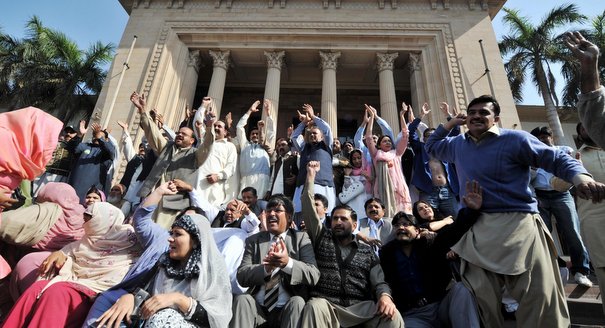
Islam alone will not aid Pakistan’s political development; instead, national stability will improve with better administrative, security, economic, and social services.
This paper analyzes the current situation in Pakistan through the prism of the country’s historical experience, proposing new approaches to the threats to Pakistan’s territorial integrity and the stability and security of South Asia as a whole.
Conventional political science labels, such as authoritarianism, democracy, Islamism and secularism, are of little use when applied to Pakistan. “Pakistan’s history shows that giving priority to Islam can be combined with a democratic system of government, as well as with an authoritarian regime,” Topychkanov writes. Islam’s supremacy in Pakistani society has manifested itself primarily through Muslim nationalism and Islamic socialism, as well as through various radical forms of Islamic ideology. Experiments with Islam, which is the foundation of the country’s national identity, are therefore not the solution to Pakistan’s problems. Resolving these problems requires comprehensive solutions that encompass the political, economic and social spheres.
Pakistan’s history shows that giving priority to Islam can be combined with a democratic system of government, as well as with an authoritarian regime.
Topychkanov also notes that the external environment, particularly problems in Afghanistan, has had a negative impact on Pakistan’s political development. Protracted or failed operations of the International Security Assistance Force in Afghanistan would strengthen pro-Taliban forces in Pakistan, while stabilization in Afghanistan would help weaken these groups and stop the rise of support for religious extremism. The escalation of tensions between Pakistan and India also contributes to the spread of extremism in Pakistan.
Topychkanov proposes a number of policy approaches, suggesting that the planning and implementation of aid programs for Pakistan should meet three main criteria:
Former Fellow, Nonproliferation Program, Moscow Center
Topychkanov was a fellow in the Carnegie Moscow Center’s Nonproliferation Program.
Recent Work


James M. Acton, Alexey Arbatov, Vladimir Dvorkin, …
Petr Topychkanov
Carnegie India does not take institutional positions on public policy issues; the views represented herein are those of the author(s) and do not necessarily reflect the views of Carnegie, its staff, or its trustees.

In any defense establishment, change is an ongoing process. However, despite the best of intentions, existing bureaucracies, bound by habit and years of socialization, have their limits in implementing transformative change.

Anit Mukherjee

After the chill in ties between 2020 and 2024 that brought India–China relations to their lowest point in several decades, the two countries have engaged each other afresh. This paper argues that there are predominantly four imperatives guiding India’s approach to China, and they exist in an order of priority.

Saheb Singh Chadha

On March 10, 2026, India’s Union Cabinet approved amendments to Press Note 3, a regulation that mandated government approval on all foreign direct investment (FDI) from countries sharing a land border with India. This amendment raises questions primarily about whether its stated benefits will materialize and if the risks have been adequately weighed. This piece will address the same.

Konark Bhandari

This piece argues that the present Indian strategy, based on opportunistic diversification and utilization of limited strategic reserves, remains inadequate when confronting supply disruptions. It evaluates India’s options in the short, medium, and long terms.

Vrinda Sahai

Trump 2.0 has unsettled India’s external environment—but has not overturned its foreign policy strategy, which continues to rely on diversification, hedging, and calibrated partnerships across a fractured order.



Milan Vaishnav, ed., Sameer Lalwani, Tanvi Madan, …