

Article
Marina Ottaway, Omar Hossino
{
  "authors": [
    "Marina Ottaway"
  ],
  "type": "legacyinthemedia",
  "centerAffiliationAll": "dc",
  "centers": [
    "Carnegie Endowment for International Peace"
  ],
  "collections": [],
  "englishNewsletterAll": "menaTransitions",
  "nonEnglishNewsletterAll": "",
  "primaryCenter": "Carnegie Endowment for International Peace",
  "programAffiliation": "MEP",
  "programs": [
    "Middle East"
  ],
  "projects": [],
  "regions": [
    "Middle East",
    "Israel",
    "Palestine"
  ],
  "topics": [
    "Political Reform"
  ]
}
Source: Getty
If anything can unblock the Palestinian-Israeli peace process and save the threatened prospects for a two-state solution, it is the Arab initiative.
Source: Al Hayat

This does not mean Arab countries should talk directly with Israel, thus implicitly recognizing it as a legitimate state. Recognition can only be the end of the process, after all issues have been settled, not the beginning. The Arab initiative is clear on this point. But there are plenty of tools in the kit of diplomacy that allow enemies to talk to each other without bestowing recognition and legitimacy on each other. All of them have been used in the Middle East at one time or another.
Whatever the exact form chosen, launching talks with Israel is crucial for many reasons. First, time is running out on the two state solution, as many analysts have pointed out in recent months. Second, there is no viable alternative. The “one state solution” some Arabs talk would lead to many years of bloodshed and continuing misery for Palestinians. It is true that in the long run Palestinians will be the majority of people living between the Jordan River and the Mediterranean. But in the short and medium run there would be nothing but misery. The “three-state solution” hard-line Israelis are proposing in unacceptable to all Arabs. In the Israeli vision, the three-state solution is an attempt to convince the international community and Egypt to take on the administration of Gaza, whose boundaries would be enlarged at the expense of Egypt’s, while Jordan would be saddled with whatever portions of the West Bank the Israelis do not want to keep. It will not be accepted by the Palestinians, or by Egypt, Jordan, and the international community. It is thus imperative to make the two-state solution work.
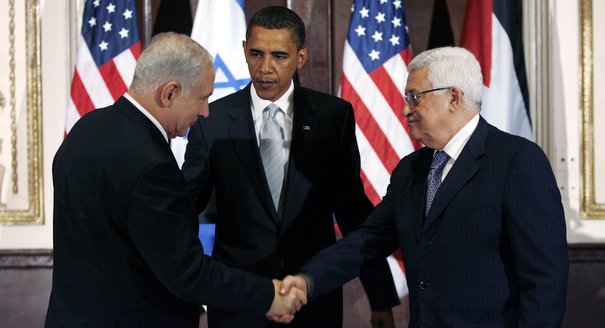
President Barack Obama appears genuinely committed to the two-state solution, but he cannot get there without the help of Arab countries. Nor can Arab countries make the Arab Initiative a reality without the help of the United States. The United States and Arab countries need each other, particularly in view of the character of the present Israeli government. All have to take courageous steps.
President Obama must take immediately two difficult, politically costly steps. First, he must declare that the United States will oppose all settlement expansion and is ready to impose sanctions in the form of a reduction of aid to back up its opposition. It is not enough for him to continue stating that the US opposes settlement expansion and that the issuing of new permits “is not helpful,” as Secretary of State Hillary Clinton has declared recently. Nor should the United States accept Israel’s distinction between legal settlements and illegal outposts—all are illegal under international law—or the extremely dubious concept that settlements are entitled to undergo a “natural growth” process, as if they were children.
President Obama must also declare that his administration favors reconciliation between Fatah and Hamas and the formation of a unity government. He must state unequivocally that while the United States will not deal directly with Hamas until it has met the Quartet conditions, it will deal with a Palestinian Authority in which Hamas is represented as long as the Palestinian Authority itself abides by those conditions. The Obama administration has hinted that it might be prepared to provide economic assistance to such a Palestinian Authority. It must go one step further and declare it openly in order to provide the two sides with an incentive to reconcile, or at least to remove an excuse not to do so.
It will not be easy for Obama to take those steps. Nor it will be easy for Arab countries to open talks with Israel, no matter how discretely and indirectly. But the Arab initiative has the potential for leading to a peace settlement that has eluded efforts for decades. Both the Obama administration and Arab countries need to act.
Former Senior Associate, Middle East Program
Before joining the Endowment, Ottaway carried out research in Africa and in the Middle East for many years and taught at the University of Addis Ababa, the University of Zambia, the American University in Cairo, and the University of the Witwatersrand in South Africa.
Recent Work
Marina Ottaway, Omar Hossino
Marina Ottaway
Carnegie India does not take institutional positions on public policy issues; the views represented herein are those of the author(s) and do not necessarily reflect the views of Carnegie, its staff, or its trustees.

An Israeli response to Iran’s October 1 attack is imminent. The key question is of its intensity and potential fallout, both within Iran, in terms of nuclear security policy changes, and across the broader region. The coming days are likely to reshape West Asia irreversibly.
Gaddam Dharmendra

As India’s economy recovers from the coronavirus pandemic, Indian businesses need efficient financial structures to regain their ground. Key reforms to India’s Insolvency and Bankruptcy Code could fill these gaps.

Anirudh Burman

Access to cross-border data is an integral piece of the law enforcement puzzle. India is well placed to lead the discussions on international data agreements subject to undertaking necessary surveillance reforms.

Smriti Parsheera, Prateek Jha

After the coronavirus pandemic wanes, how will China’s reorientation of the Belt and Road Initiative to address global health concerns influence its relationships with South Asian countries?
Deep Pal, Rahul Bhatia
Early in the outbreak, government researchers forecast several high-risk scenarios that were downplayed or ignored in public messaging.
Gautam I. Menon