

Article
Amel Boubekeur
{
  "authors": [
    "Amel Boubekeur"
  ],
  "type": "legacyinthemedia",
  "centerAffiliationAll": "dc",
  "centers": [
    "Carnegie Endowment for International Peace",
    "Malcolm H. Kerr Carnegie Middle East Center"
  ],
  "collections": [],
  "englishNewsletterAll": "menaTransitions",
  "nonEnglishNewsletterAll": "",
  "primaryCenter": "Malcolm H. Kerr Carnegie Middle East Center",
  "programAffiliation": "MEP",
  "programs": [
    "Middle East"
  ],
  "projects": [],
  "regions": [
    "Maghreb",
    "Morocco",
    "North Africa"
  ],
  "topics": [
    "Political Reform"
  ]
}
Source: Getty
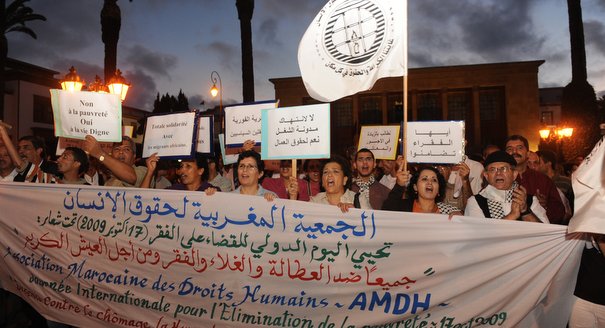
The reforms established for Morocco's recent local elections have helped improve community management, but have not succeeded in limiting royal intervention in politics.
Source: France 24

The reforms that were put in place for the occasion have indeed led to “technical” progress in the management of local communes, such as the voting of young people and women. However, they have not succeeded in consolidating the role of parties, limited by significant royal intervention in the organisation of the political scene.
"Moral" reforms
A financial fund for parties that was established for promoting female candidacies has been the greatest success of the new 2009 communal charter. The 12% minimum quota of female representation decreed was even exceeded and 3,406 women were elected (out of 20,458 candidates) against just 127 in 2003.
Civil society, namely through the "collective for the observation of elections", which includes 70 NGOs, was encouraged to ensure the transparency of elections. But even before the end of the elections, 1,767 complaints of fraud, purchase of votes, threats, or assault and battery had been registered.
Despite the reforms, Moroccans remain uninterested in the functioning of parties. For the majority of people, the development initiatives that concern them are the prerogative of the king alone, as those elected become somewhat 'absent' once the commune is won. Moroccans denounce a complicated electoral process that doesn’t guarantee that the party they voted for wins the commune due to post-electoral alliances among local counsellors.
The new indirect and proportional voting system that was chosen for these communes has contributed to the fragmentation of parties and reduced their impact on elections. Alliances are more the result of the balance of forces existing on the national political scene than a common interest in programmes at a local level.
Fragile parties
The great winner of the elections is the Authenticity and Modernity Party (PAM) a centre-right party, with 21.7 % of votes. Launched five months before the elections with the king’s support, this party was established upon the initiative of former interior minister Fouad El Himma.
Even though it didn’t take part in the last legislative elections, the party was able to significantly support the parliamentary majority ever since its creation, thanks to 100 seats won by deputies of the five small parties that merged to form it plus other elected politicians that joined it. PAM therefore allowed the king to "rationalise" the political scene.
While presenting itself as a party wanting to “renew politics”, PAM weakened and removed the credibility of the Koutla’s right-left coalition, contributed to the disintegration of some smaller parties and offered itself as an alternative to the Justice and Development Party (PJD), an Islamic party. The question now is whether PAM – which owes its success more to the social networks of its candidates than to a real political added value – can have a loyal base and survive the elections.
Although the Istiqlal party ranked second in the elections with 19 % of the votes, it was rather marginalised in the alliances formed for the local elections. The USFP, which only obtained 11.6% of the vote, is going through a more serious crisis. By joining the Koutla, this party had bet on the "critical support to the king". But it was unable to impose its reform programme of the Constitution that would allow the prime minister a strengthened role in the face of decisions from the Makhzen, the governing elite. Moreover, the party was unable to contest Istiqlal’s anti-strike measures during certain social conflicts. Consequently, the USFP has witnessed the erosion of its social basis for several years now.
The PJD Islamists obtained 5.4% of votes this time round, a significant regression compared to the 13% they won in the 2003 local elections. But it is also explained by the fact that the "king’s Islamists" have normalised their presence in the political field for the last 10 years, focusing on the sound management of towns rather than on their Islamic branding. The PJD has also had to face the erosion of its union branch (UNTM), embezzlement of funds by its elected members and the resignation of various deputies and militants.

Former Resident Scholar, Middle East Center
Boubekeur was an associate scholar at the Carnegie Middle East Center. Her research focuses on Maghreb country politics, Euro–Arab relations, and Islam in Europe.
Recent Work
Amel Boubekeur
Carnegie India does not take institutional positions on public policy issues; the views represented herein are those of the author(s) and do not necessarily reflect the views of Carnegie, its staff, or its trustees.

A partnership between India, a country of subcontinental size, and Africa, a continent of fifty-four countries, may seem asymmetric until one notes that both are home to nearly the same number of people—1.4 billion. This essay spells out the existing challenges to the partnership, its optimal potential, and the possible pathways to realize it over the next quarter-century.

Rajiv Bhatia

As India’s economy recovers from the coronavirus pandemic, Indian businesses need efficient financial structures to regain their ground. Key reforms to India’s Insolvency and Bankruptcy Code could fill these gaps.

Anirudh Burman

Access to cross-border data is an integral piece of the law enforcement puzzle. India is well placed to lead the discussions on international data agreements subject to undertaking necessary surveillance reforms.

Smriti Parsheera, Prateek Jha
After the coronavirus pandemic wanes, how will China’s reorientation of the Belt and Road Initiative to address global health concerns influence its relationships with South Asian countries?

Deep Pal, Rahul Bhatia
Early in the outbreak, government researchers forecast several high-risk scenarios that were downplayed or ignored in public messaging.
Gautam I. Menon