

Q&A
Suzanne Maloney, Aaron David Miller, Karim Sadjadpour
{
  "authors": [
    "Karim Sadjadpour"
  ],
  "type": "legacyinthemedia",
  "centerAffiliationAll": "dc",
  "centers": [
    "Carnegie Endowment for International Peace"
  ],
  "collections": [],
  "englishNewsletterAll": "menaTransitions",
  "nonEnglishNewsletterAll": "",
  "primaryCenter": "Carnegie Endowment for International Peace",
  "programAffiliation": "MEP",
  "programs": [
    "Middle East"
  ],
  "projects": [],
  "regions": [
    "North America",
    "United States",
    "Middle East",
    "Iran"
  ],
  "topics": [
    "Political Reform",
    "Foreign Policy"
  ]
}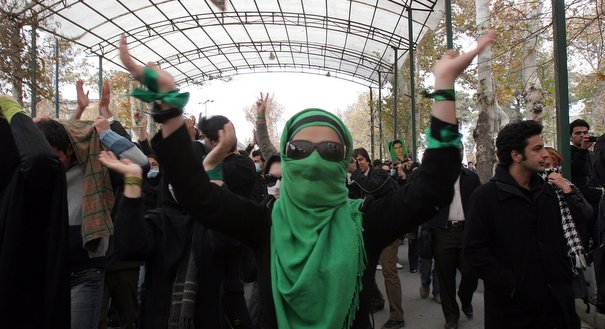
Source: Getty
The large crowds we witnessed last week in Tehran may have subsided for now, but the uneasy calm is misleading.
Source: The Independent

The Iranian regime -- which increasingly implies Supreme Leader Ayatollah Ali Khamenei, a turbaned Shah with a medieval mindset -- has not left itself much room to maneuver. Khamenei strongly supported President Ahmadinejad’s bid for reelection, referred to his “victory” as a “divine blessing,” and denounced allegations of fraud.
Despite the popular outcry, Khamenei is unlikely to cede ground, believing that compromise projects weakness and could embolden the opposition and the population. The Guardian Council—an important governmental organ which Khamenei has at his disposal—said Friday that allegations of election fraud by the opposition had proved groundless. “After ten days of examination we did not see any major irregularities,” said spokesperson Abbasali Kadkhodai, quite predictably. “I can say with certainty that there was no fraud in the election.”
In order to enforce Khamenei’s edicts, the regime’s shock troops will continue to have full authorization to use force, and the more radical elements of the Bassij militia -- kind of a cross between the Hell’s Angels and Al-Qaeda -- continue to do so with great enthusiasm.
Despite the popular outcry, Khamenei is unlikely to cede ground, believing that compromise projects weakness and could embolden the opposition and the population
What's significant, however, is that Khamenei's normally trusted servants have begun publicly expressing their misgivings about an election result which privately left many of them simmering. Ali Larijani, the powerful speaker of the parliament, declared that opposition leader Mir Hossein Mousavi should be given a chance to voice his views on official state TV.
The popular mayor of Tehran, former Revolutionary Guard commander and Ahmadinejad foe Mohammed Bagher Ghalibaf, has asked that people be allowed to protest peacefully. And though the conservative Iranian parliament was invited to attend a celebration for Ahmadinejad’s victory, only 105 of 280 MPs bothered to show up.
This is not to mention the sense of outrage and injustice among the opposition, as well as wide swaths of Iranian society, which is unlikely to subside anytime soon. On the contrary, the regime’s indiscriminate use of violence -- graphic videos show how women, the elderly, and even children have been targeted -- has only further eroded people’s respect for the government.
The scale of the demonstrations has decreased, given the regime’s use of overwhelming force and its ability to limit people’s movements in Tehran -- a sprawling city not unlike Los Angeles -- preventing large masses from gathering in the same place.
Making predictions about Iranian politics has always been a fool’s errand, but suffice it to say, the future of the Islamic Republic as we know it has never appeared more tenuous
The crackdown has moved the opposition into a new phase. Instead of mass rallies, they are now focusing on civil disobedience, including strikes among merchants (bazaaris), laborers, and key arteries of the Iranian economy (like the petroleum industry and oil ministry). So far, these strikes have seemingly failed to pick up steam, given that much of the opposition is either in prison, under house arrest, or unable to communicate. But in suppressing the opposition, the regime has been forced to show its true colors.
Making predictions about Iranian politics has always been a fool’s errand, but suffice it to say, the future of the Islamic Republic as we know it has never appeared more tenuous.


Senior Fellow, Middle East Program
Karim Sadjadpour is a senior fellow at the Carnegie Endowment for International Peace, where he focuses on Iran and U.S. foreign policy toward the Middle East.
Recent Work

Suzanne Maloney, Aaron David Miller, Karim Sadjadpour
Aaron David Miller, Karim Sadjadpour, Robin Wright
Carnegie India does not take institutional positions on public policy issues; the views represented herein are those of the author(s) and do not necessarily reflect the views of Carnegie, its staff, or its trustees.

How is AI reshaping space security, creating governance challenges, and where does international diplomacy stand today?


Tejas Bharadwaj, Almudena Azcárate Ortega

After the chill in ties between 2020 and 2024 that brought India–China relations to their lowest point in several decades, the two countries have engaged each other afresh. This paper argues that there are predominantly four imperatives guiding India’s approach to China, and they exist in an order of priority.

Saheb Singh Chadha

This piece argues that India’s central challenge is not managing a single flashpoint but resolving the underlying tension between expansion and institutional coherency of the BRICS grouping.

Vrinda Sahai

A partnership between India, a country of subcontinental size, and Africa, a continent of fifty-four countries, may seem asymmetric until one notes that both are home to nearly the same number of people—1.4 billion. This essay spells out the existing challenges to the partnership, its optimal potential, and the possible pathways to realize it over the next quarter-century.

Rajiv Bhatia

The U.S.–India semiconductor cooperation story is well-stocked with top-level strategic intent. What remains unresolved, however, are some underlying challenges that will determine whether the cooperation actually functions. Three such friction points stand out.

Shruti Mittal