

In The Media
John Judis
{
  "authors": [
    "John Judis"
  ],
  "type": "legacyinthemedia",
  "centerAffiliationAll": "",
  "centers": [
    "Carnegie Endowment for International Peace"
  ],
  "collections": [],
  "englishNewsletterAll": "",
  "nonEnglishNewsletterAll": "",
  "primaryCenter": "Carnegie Endowment for International Peace",
  "programAffiliation": "",
  "programs": [],
  "projects": [],
  "regions": [
    "North America",
    "United States"
  ],
  "topics": [
    "Political Reform",
    "Economy"
  ]
}
Source: Getty
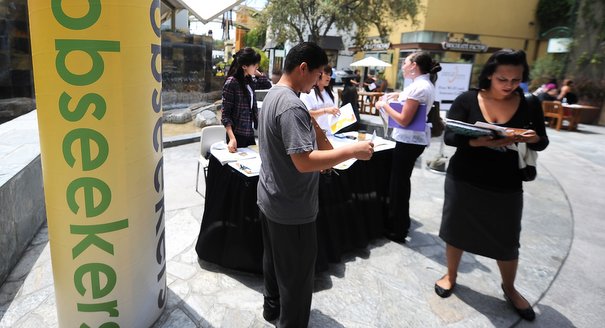
Policymakers in Washington should not be fooled by the slowed increase in unemployment numbers. Rather, as the actual number of people employed continues to decline, policymakers must keep doing things that will get people back to work.
Source: The New Republic

These reports dismiss unemployment as a "lagging indicator"--a figure that is not keeping pace with the economy a whole, and thus doesn't necessarily have any bearing on whether a recovery is occurring. This is a mistake, and it contributes to complacency about the depth of the slump and about the kind of measures necessary to get ourselves out of it. Unemployment isn't a lagging indicator, but rather at the heart of the current recession.
When people they say unemployment is a "lagging indicator," they are usually referring to the unemployment rate, or the percentage of people who are seeking work but not finding it. They argue that even if this rate is increasing from 8.9 percent in April to 9.4 percent in May, a recovery could still be underway. Literally speaking, this is true. According to the National Bureau of Economic Research, the 1990-91 recession began in July 1990 and ended in March 1991, but unemployment rose from 6.8 percent in March 1991 to 7.8 percent in June 1992.
But while the rate of unemployment may be a lagging indicator, the number of employed has actually served to be quite a good predictor of economic recovery over the past century. For example, as the 1990-91 recession was starting to reverse, the percentage of unemployed people rose--but so did the number of employed, which grew by about one million workers from March 1991 to June 1992 as a result of more people entering the workforce. In that case, the number of employed was not a lagging indicator, but rather a fairly good indicator that recovery was afoot. In the case of the present slump, the number of employed have continued to fall since December 2007.
Harvard economist Jeff Frankel takes this argument a step further, arguing that if you want to use employment figures to gauge economic recovery, you should look at the total hours worked rather than at the number of employed, because the beginning of a recovery businesses are likely to increase production by getting their employees to work overtime, or by raising them from part-time to full-time, rather than by hiring new workers. Frankel notes that increased work hours correlated with the beginning of recovery for both the 1990-91 and 2001 recessions.
If you apply this gauge to the current situation, there is little reason for optimism. Though some have used the Bureau of Labor Statistics' May figures--which showed that the rate of unemployment growth had been slightly reduced--to predict an imminent recovery, Frankel observes that if you look at the figures in terms of hours worked rather than people employed, "the rate of decline (0.7%) was very much in line with the rate of contraction that workers have experienced since September." Indeed, in May, the average length of the work week fell to its lowest total since 1964--a sign that businesses are cutting back by reducing their employees' hours. "The labor market does not quite yet suggest that the economy has hit bottom," Frankel concluded diplomatically.
Policymakers in Washington should thus not be fooled by the slowed increase in unemployment numbers; they have to keep doing things that will get people back to work. The most important trigger for economic recovery over the last century has been the growth of aggregate demand for consumer goods--which comes primarily from employed workers. If the number of employed workers declines, then there is a corresponding decline in income and demand. In a recession, that kind of decline can degenerate into a vicious spiral, as those who are still employed, seeing the threat of unemployment looming, choose to save rather than spend. As a result, demand is further reduced, more people are laid off, and the downward spiral continues.
So employment numbers aren't just a good sign of whether we are headed upwards or downwards; increasing employment through government spending is the most important way that the White House and Congress can get us out of this slump. That's worth remembering as Republicans and renegade Democrats call for budget cuts. This is not a time for cuts--it's time to begin thinking about whether a second stimulus program will be necessary.
This article originally appeared in The New Republic.

Former Visiting Scholar
As a visiting scholar at Carnegie, Judis wrote The Folly of Empire: What George W. Bush Could Learn from Theodore Roosevelt and Woodrow Wilson.
Recent Work
John Judis
John Judis
Carnegie India does not take institutional positions on public policy issues; the views represented herein are those of the author(s) and do not necessarily reflect the views of Carnegie, its staff, or its trustees.

How is AI reshaping space security, creating governance challenges, and where does international diplomacy stand today?


Tejas Bharadwaj, Almudena Azcárate Ortega

The U.S.–India semiconductor cooperation story is well-stocked with top-level strategic intent. What remains unresolved, however, are some underlying challenges that will determine whether the cooperation actually functions. Three such friction points stand out.

Shruti Mittal

On March 10, 2026, India’s Union Cabinet approved amendments to Press Note 3, a regulation that mandated government approval on all foreign direct investment (FDI) from countries sharing a land border with India. This amendment raises questions primarily about whether its stated benefits will materialize and if the risks have been adequately weighed. This piece will address the same.

Konark Bhandari

India and the United States are close to concluding a Reciprocal Defense Procurement Agreement (RDPA) that will allow firms from the two countries to sell to each other’s defense establishments more easily. While this may not remedy the specific grievances both sides may have regarding larger bilateral issues, an RDPA could restore some momentum, following the trade deal announcement.
Konark Bhandari

On the last day of the India AI Impact Summit, India signed Pax Silica, a U.S.-led declaration seemingly focused on semiconductors. While India’s accession to the same was not entirely unforeseen, becoming a signatory nation this quickly was not on the cards either.
Konark Bhandari