• Research
  • About
  • Experts
Carnegie India logoCarnegie lettermark logo
{
  "authors": [
    "Mark Medish"
  ],
  "type": "legacyinthemedia",
  "centerAffiliationAll": "dc",
  "centers": [
    "Carnegie Endowment for International Peace",
    "Carnegie Russia Eurasia Center"
  ],
  "collections": [],
  "englishNewsletterAll": "ctw",
  "nonEnglishNewsletterAll": "",
  "primaryCenter": "Carnegie Endowment for International Peace",
  "programAffiliation": "russia",
  "programs": [
    "Russia and Eurasia"
  ],
  "projects": [],
  "regions": [
    "Caucasus",
    "Russia"
  ],
  "topics": [
    "Political Reform",
    "Security",
    "Foreign Policy"
  ]
}
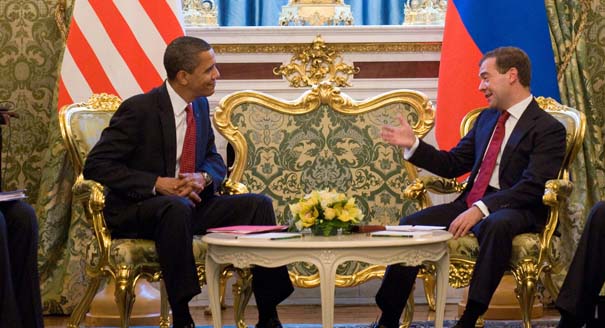
Source: Getty

In The Media

What's Russian for 'Empathy'?

Obama’s message in Moscow needs to translate his visionary pragmatism into a language that will resonate with Russians.

Link Copied
By Mark Medish
Published on Jul 6, 2009

Source: The Washington Post

What's Russian for 'Empathy'?The flap over the mistranslation of "reset button" into Russian was a harbinger of bigger translation challenges to come. The whole Obama phenomenon does not translate well into Russian. Obama is a visionary pragmatist, while the Russian political elite is full of cynical realists.

Empathy -- the centerpiece of Obama's philosophy -- does not have an exact Russian counterpart. The words "sochuvstvie" and "soboleznovanie" are closer to sympathy. The word "sostrandanie" means compassion. But empathy, the idea of putting yourself into somebody else's shoes as a way to think about the world, is a distinct concept. And it is not one that can be elegantly rendered into Russian.
There is a common view in Russia today that Obama is the representative of an America in decline. Just as the Soviet strategists thought that America was finished after Vietnam and Watergate, the cynical realists in the Kremlin today have a hard time understanding America's core dynamism. They look at the debacle in Iraq and the global financial meltdown, which started on Wall Street, and assume that American prospects must be going down. They look at Obama's use of the word "empathy" and think it means America is vulnerable.
 
Russians must be careful not to misunderstand the American president's intellectual solicitude as weakness because they would again be underestimating the nation's deep capacity for change and reinvention. Anybody who listens closely to Obama can hear that his empathy, an enormous intellectual and diplomatic asset, is matched by inner confidence and clarity of purpose, which are true gifts of leadership.
 
Following in the steps of Ronald Reagan who spoke brilliantly of freedom and trust before Russian students in 1988, Obama is expected to give a speech at a Moscow university. For his message to reach its student audience and beyond, Obama may require an extra dose of empathy for the lack of "empathy" in the Russian language.
What should be Obama's message in Moscow? He needs to translate his visionary pragmatism into a language that will resonate with Russians.
 
He should remind his listeners that Russia and America together defeated the two greatest evils of the 20th century: fascism and communism. The enormous sacrifices of our societies must not be forgotten.
 
He should pledge to work closely with Russia on all matters of security in Eurasia, with the expectation that Russia will reciprocate. Failure of this mutual commitment to peace in the region would be a betrayal of our shared victory over the divisions of the last century. The "reset button" is a metaphor for agreeing to avoid unnecessary and untenable confrontation, but we should be able to do much better than that.
 
Obama should restate his vision of a world without nuclear weapons. It is a distant goal, but it is one to which Russia and the United States together are uniquely positioned to lead the way. He should call on our scientific communities to work together on alternative energies for peace.
 
He should urge Russians to put away Cold War thinking, and he should also show that Americans are doing the same. One way is to commit himself to immediate repeal of the Cold War-era Jackson-Vanik Amendment, which denies most favored nation to countries with non-market economies that restrict emigration rights.
 
Finally, he should commit to tearing down the walls of visa restrictions that have made it more difficult for Russians and Americans to visit each other freely.
 
It is interesting to remember that Russia's greatest poet, Aleksander Pushkin, was of African descent, the great grandson of a man from Cameroon. Two centuries later, it is just possible that a young American president with Kenyan roots will also find the right language to move the Russian soul.
 
The article can also be found here.

About the Author

Mark Medish

Former Visiting Scholar

Medish served in the Clinton administration as special assistant to the President and senior director for Russian, Ukrainian, and Eurasian Affairs on the National Security Council from 2000 to 2001.

    Recent Work

  • Q&A
    Ukraine’s Presidential Election—The End of the Orange Revolution

      Mark Medish

Mark Medish
Former Visiting Scholar
Mark Medish
Political ReformSecurityForeign PolicyCaucasusRussia

Carnegie India does not take institutional positions on public policy issues; the views represented herein are those of the author(s) and do not necessarily reflect the views of Carnegie, its staff, or its trustees.

More Work from Carnegie India

  • Commentary
    The Impact of U.S. Sanctions and Tariffs on India’s Russian Oil Imports

    This piece examines India’s response to U.S. sanctions and tariffs, specifically assessing the immediate market consequences, such as alterations in import costs, and the broader strategic implications for India’s energy security and foreign policy orientation.

      Vrinda Sahai

  • Article
    Military Lessons from Operation Sindoor

    The India-Pakistan conflict that played out between May 6 and May 10, 2025, offers several military lessons. This article presents key takeaways from Operation Sindoor and breaks down how India’s preparations shaped the outcome and what more is needed to strengthen future readiness.

      Dinakar Peri

  • Book
    India and the Sovereignty Principle: The Disaggregation Imperative

    This book offers a comprehensive analysis of India's evolving relationship with sovereignty in a complex global order. Moving beyond conventional narratives, it examines how the sovereignty principle shapes India's behavior across four critical domains—from traditional military power to contemporary data governance.

      Rudra Chaudhuri, Nabarun Roy

  • Commentary
    NISAR Soars While India-U.S. Tariff Tensions Simmer

    On July 30, 2025, the United States announced 25 percent tariffs on Indian goods. While diplomatic tensions simmered on the trade front, a cosmic calm prevailed at the Sriharikota launch range. Officials from NASA and ISRO were preparing to launch an engineering marvel into space—the NASA-ISRO Synthetic Aperture Radar (NISAR), marking a significant milestone in the India-U.S. bilateral partnership.

      Tejas Bharadwaj

  • Article
    Hidden Tides: IUU Fishing and Regional Security Dynamics for India

    This article examines the scale and impact of Chinese IUU fishing operations globally and identifies the nature of the challenge posed by IUU fishing in the Indian Ocean Region (IOR). It also investigates why existing maritime law and international frameworks have struggled to address this growing threat.

      Ajay Kumar, Charukeshi Bhatt

Get more news and analysis from
Carnegie India
Carnegie India logo, white
Unit C-4, 5, 6, EdenparkShaheed Jeet Singh MargNew Delhi – 110016, IndiaPhone: 011-40078687
  • Research
  • About
  • Experts
  • Projects
  • Events
  • Contact
  • Careers
  • Privacy
  • For Media
Get more news and analysis from
Carnegie India
© 2026 Carnegie Endowment for International Peace. All rights reserved.





