• Research
  • About
  • Experts
Carnegie India logoCarnegie lettermark logo
{
  "authors": [
    "Maria Lipman"
  ],
  "type": "legacyinthemedia",
  "centerAffiliationAll": "",
  "centers": [
    "Carnegie Endowment for International Peace",
    "Carnegie Russia Eurasia Center"
  ],
  "collections": [],
  "englishNewsletterAll": "",
  "nonEnglishNewsletterAll": "",
  "primaryCenter": "Carnegie Russia Eurasia Center",
  "programAffiliation": "",
  "programs": [],
  "projects": [],
  "regions": [
    "North America",
    "United States",
    "Caucasus",
    "Russia"
  ],
  "topics": [
    "Political Reform",
    "Foreign Policy"
  ]
}
Source: Getty

In The Media
Carnegie Russia Eurasia Center

Words for a Russian Ghetto

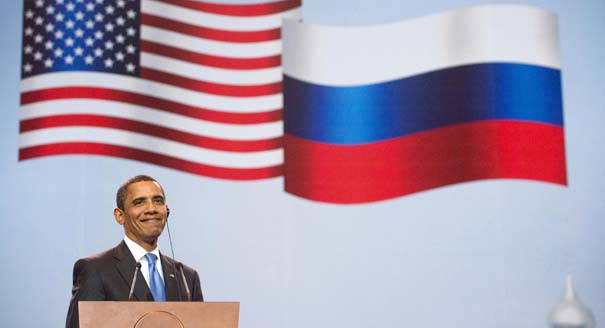
President Obama spoke brilliantly and powerfully at Russia's New Economic School during his Moscow trip. Unfortunately, few Russians heard his speech or got more than a glimpse of the American president on the television news.

Link Copied
By Maria Lipman
Published on Jul 9, 2009

Source: the Washington Post

Words for a Russian Ghetto President Obama spoke brilliantly and powerfully at Russia's New Economic School Tuesday. And his broader effort to reach out to Russian society during his trip -- meeting with civil society and human rights activists, as well as a group of opposition politicians -- was commendable. Unfortunately, few Russians heard his speech or got more than a glimpse of the American president on the television news.

If they had heard Obama's address, they probably would have appreciated that Obama spoke with high respect for Russian culture and history. He paid tribute to Russia's colossal contribution to the victory over Nazi Germany -- a victory in which Russians commonly believe their role is not properly recognized abroad. Obama was delicate and subtle, as well as firm and concrete. He described the end of the Cold War not as a victory of one political order over another but as a result of "the actions of many nations over many years." He admitted that America is not perfect. And he referred to democracy not as a moral virtue but as an effective means toward peaceful, secure and prosperous life.
 
But the president's speech -- at a Westernized institution founded by prominent Russian economists and modeled after the best American universities they attended -- was not broadcast live by any of the mass-audience television channels. These channels, which the Kremlin has long used as effective tools for shaping public opinion, offered benevolent but restrained coverage of the summit. Obama's performance in Russia, his eloquence, his ideas and his charms were thus mostly confined to those limited audiences, venues and outlets where free expression and public debate are still maintained. The Kremlin has mastered the art of keeping these liberal "ghettos" politically irrelevant.
 
The Kremlin keeps a firm grip on societal forces: Its concept of civil society implies loyalty to the state and rules out genuine autonomy. Those who dare defy the Kremlin vision may be tolerated, but they are consistently marginalized. Assistance to such groups from abroad is treated with great suspicion. Moreover, the West, and the United States in particular, are viewed as a threatening force seeking to do harm to Russia.
 
This dramatically hampers Russian development and leaves Russia still further behind the developed nations. A summit with Obama, and his attempt to reach out to the Russian people, no matter how brilliant or subtle, can hardly change this state of affairs. It is up to the Russian people to change this, but they will have to overcome their apathy and fragmentation. "Every country charts its own course," Obama told the students of the New Economic School. Russia is no exception.
 
The article can also be found here.

About the Author

Maria Lipman

Former Scholar in Residence, Society and Regions Program, Editor in Chief, Pro et Contra, Moscow Center

Lipman was the editor in chief of the Pro et Contra journal, published by the Carnegie Moscow Center. She was also the expert of the Carnegie Moscow Center’s Society and Regions Program.

    Recent Work

  • Commentary
    The Russian State Power and the Ukrainian Human Factor

      Maria Lipman

  • Commentary
    Putin’s Crimean Conquest Pushes Russia to an Anti-Modernization Course

      Maria Lipman

Maria Lipman
Former Scholar in Residence, Society and Regions Program, Editor in Chief, Pro et Contra, Moscow Center
Maria Lipman
Political ReformForeign PolicyNorth AmericaUnited StatesCaucasusRussia

Carnegie India does not take institutional positions on public policy issues; the views represented herein are those of the author(s) and do not necessarily reflect the views of Carnegie, its staff, or its trustees.

More Work from Carnegie India

  • Commentary
    India Signs the Pax Silica—A Counter to Pax Sinica?

    On the last day of the India AI Impact Summit, India signed Pax Silica, a U.S.-led declaration seemingly focused on semiconductors. While India’s accession to the same was not entirely unforeseen, becoming a signatory nation this quickly was not on the cards either.

      Konark Bhandari

  • Commentary
    The Impact of U.S. Sanctions and Tariffs on India’s Russian Oil Imports

    This piece examines India’s response to U.S. sanctions and tariffs, specifically assessing the immediate market consequences, such as alterations in import costs, and the broader strategic implications for India’s energy security and foreign policy orientation.

      Vrinda Sahai

  • Commentary
    NISAR Soars While India-U.S. Tariff Tensions Simmer

    On July 30, 2025, the United States announced 25 percent tariffs on Indian goods. While diplomatic tensions simmered on the trade front, a cosmic calm prevailed at the Sriharikota launch range. Officials from NASA and ISRO were preparing to launch an engineering marvel into space—the NASA-ISRO Synthetic Aperture Radar (NISAR), marking a significant milestone in the India-U.S. bilateral partnership.

      Tejas Bharadwaj

  • Commentary
    TRUST and Tariffs

    The India-U.S. relationship currently appears buffeted between three “Ts”—TRUST, Tariffs, and Trump.

      Arun K. Singh

  • Commentary
    Indian Airstrikes in Pakistan: May 7, 2025

    On May 7, 2025, between 1:05 and 1:30 a.m. (IST), airstrikes carried out by the Indian Air Force hit nine locations inside Pakistan and Pakistan occupied Kashmir (PoK). It was codenamed Operation Sindoor.

      Rudra Chaudhuri

Get more news and analysis from
Carnegie India
Carnegie India logo, white
Unit C-4, 5, 6, EdenparkShaheed Jeet Singh MargNew Delhi – 110016, IndiaPhone: 011-40078687
  • Research
  • About
  • Experts
  • Projects
  • Events
  • Contact
  • Careers
  • Privacy
  • For Media
Get more news and analysis from
Carnegie India
© 2026 Carnegie Endowment for International Peace. All rights reserved.