

Paper
Adam Baczko, Gilles Dorronsoro, Arthur Quesnay
{
  "authors": [
    "Gilles Dorronsoro"
  ],
  "type": "legacyinthemedia",
  "centerAffiliationAll": "dc",
  "centers": [
    "Carnegie Endowment for International Peace"
  ],
  "collections": [],
  "englishNewsletterAll": "ctw",
  "nonEnglishNewsletterAll": "",
  "primaryCenter": "Carnegie Endowment for International Peace",
  "programAffiliation": "SAP",
  "programs": [
    "South Asia"
  ],
  "projects": [],
  "regions": [
    "South Asia",
    "Afghanistan"
  ],
  "topics": [
    "Security",
    "Foreign Policy"
  ]
}
Source: Getty
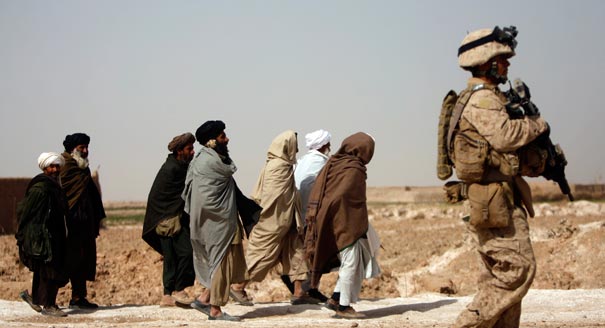
The coalition's "clear, hold, and build" strategy is failing. Before the endless demand for more troops exhausts its will to fight, the coalition should concentrate efforts on cities, key roads, and building up the Afghan army.
Source: Financial Times

The Taliban is winning the war in Afghanistan, a fact even the top US commander in the country reluctantly concedes. Offering a glimpse of the strategic assessment he was originally scheduled to deliver earlier this month, General Stanley McChrystal warned that American casualties were likely to keep rising, and said the US must deploy more troops to the south and east of the country.
The Taliban inflicted 76 casualties on coalition forces across Afghanistan in July. In Helmand, a historically restive province in the south, there is no safe area, and every day rockets fall on Lashkar Gah, the regional capital. Whatever tactical advances an increased American presence might win, the ultimate political objectives for which the US deployed its troops here are growing more distant. President Hamid Karzai is expected to lead in first-round elections later this week, but among Pashtuns in the south, attitudes toward Kabul and the international coalition are only growing more sour. Few tribes enjoy workable relations with the government – essentially only the Zirak tribes in Kandahar. Meanwhile, opinion polls in Britain and the US show the public has serious doubts about the meaning and direction of the war.
Gen McChrystal was named commander of US and Nato forces in Afghanistan in June, reportedly after he convinced Robert Gates, secretary of defence, that he could do more with less. Keenly aware of the war’s precarious domestic political context, Mr Gates is said to have been reluctant to commit more troops to the country, as the coalition has in every year since 2002, but Gen McChrystal persuaded him that he could turn the tide in its favour with only a change in strategy. In September, just three months after his appointment, Gen McChrystal is expected to ask for more troops – enough to put the total number of international forces in Afghanistan over 120,000, more than the Soviet army deployed there in the 1980s.
To sustain the strategy Gen McChrystal envisions – wresting control of the south and east of Afghanistan from the Taliban and building sustainable government institutions – counter-insurgency doctrine suggests the international coalition would need at least 200,000 soldiers. Even if that were politically feasible, there’s no guarantee it would succeed. With no real hope of closing the border with Pakistan, the reinforcements Gen McChrystal is reportedly requesting would be insufficient to stabilise even one or two provinces in the south, leaving him little choice but to request more troops next year. That is not a situation the Obama administration will want to confront on the eve of its first mid-term elections in 2010.
The coalition’s “clear, hold, and build” strategy is based on controlling territory and separating insurgents from the population. Troops clear an area, then implement a development programme. The US chose Helmand as a test case, and while operations are not yet finished, they are clearly not working as planned.
“Clearing” has become almost impossible. The insurgents are part of the population, and there is no way to distinguish them from ordinary villagers. In the Pashtun south, where xenophobic feelings are common, many if not most Afghans support the insurgents more readily than the international coalition. As a consequence, the area targeted by coalition forces remains unsafe, and in view of the weakness of the Afghan army, there is no way to withdraw without allowing the Taliban to regain control.
The US operation puts too much emphasis on one province, when security is deteriorating across the country. The Afghan government is barely present in half of its territory. Of the country’s 34 provinces, at least 10 in the south and east – the bulk of the country – have no real government presence, including Helmand. Coalition forces in these areas are exposed and isolated. In Kunar province in the northeast, the border with Pakistan remains wide open, and US outposts take fire so often that they have been redeployed. The Taliban, already in control of the countryside, is now applying direct pressure in the cities of the eastern provinces of Khost and Paktiya, and Kabul itself.
The coalition has again underestimated the Taliban’s tactical abilities. The US made a significant mistake in offering the insurgents a “historic” battle – comparable to the failed Soviet offensive in the Panjshir Valley in the 1980s. The insurgents chose not to fight US troops frontally in southern Helmand, instead regrouping in the northern area, where the terrain is more favourable to them, and fighting hard against the British.
In an ambush of British troops earlier this month, the Taliban killed three soldiers in an area that was supposed to have been cleared. Insurgent casualties have been relatively low, thanks to their reliance on improvised explosive devices, and the Taliban has not been substantially weakened even in the short term.
Though public officials seldom state it as clearly, the US still has a limited and achievable objective in Afghanistan: securing a viable state and preventing al-Qaeda from regaining its lost base. To have a reasonable chance of accomplishing that, US planners must recognise that the American public will not countenance more troops in Afghanistan in the same year troops are withdrawing from Iraq. They should focus their efforts on cities and key roads and build up the Afghan army.
The US still has time to come to terms with reality in Afghanistan, but it is running out. The Obama administration must change course before the endless demand for more troops exhausts America’s will to fight.
Former Nonresident Scholar, South Asia Program
Dorronsoro’s research focuses on security and political development in Afghanistan. He was a professor of political science at the Sorbonne in Paris and the Institute of Political Studies of Rennes.
Recent Work
Adam Baczko, Gilles Dorronsoro, Arthur Quesnay
Gilles Dorronsoro
Carnegie India does not take institutional positions on public policy issues; the views represented herein are those of the author(s) and do not necessarily reflect the views of Carnegie, its staff, or its trustees.

In any defense establishment, change is an ongoing process. However, despite the best of intentions, existing bureaucracies, bound by habit and years of socialization, have their limits in implementing transformative change.

Anit Mukherjee

After the chill in ties between 2020 and 2024 that brought India–China relations to their lowest point in several decades, the two countries have engaged each other afresh. This paper argues that there are predominantly four imperatives guiding India’s approach to China, and they exist in an order of priority.

Saheb Singh Chadha

This piece argues that India’s central challenge is not managing a single flashpoint but resolving the underlying tension between expansion and institutional coherency of the BRICS grouping.

Vrinda Sahai

A partnership between India, a country of subcontinental size, and Africa, a continent of fifty-four countries, may seem asymmetric until one notes that both are home to nearly the same number of people—1.4 billion. This essay spells out the existing challenges to the partnership, its optimal potential, and the possible pathways to realize it over the next quarter-century.

Rajiv Bhatia

The India–EU Free Trade Agreement (FTA) is shaping up to be one of the most consequential trade negotiations, both economically and strategically. But, what’s in the agreement, what’s missing, and what will determine its success in the years ahead
Vrinda Sahai, Nicolas Köhler-Suzuki