

Commentary
Nikolay Petrov
{
  "authors": [
    "Nikolay Petrov"
  ],
  "type": "legacyinthemedia",
  "centerAffiliationAll": "",
  "centers": [
    "Carnegie Endowment for International Peace",
    "Carnegie Russia Eurasia Center"
  ],
  "collections": [],
  "englishNewsletterAll": "",
  "nonEnglishNewsletterAll": "",
  "primaryCenter": "Carnegie Russia Eurasia Center",
  "programAffiliation": "",
  "programs": [],
  "projects": [],
  "regions": [
    "Caucasus",
    "Russia"
  ],
  "topics": [
    "Political Reform"
  ]
}
Source: Getty
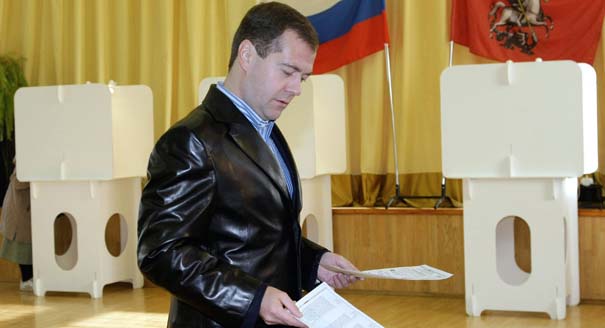
A new procedure in Russia’s gubernatorial elections that allows the party dominating the regional legislature to nominate gubernatorial candidates only perpetuates the worst problems of the previous system of appointments.
Source: The Moscow Times

The most recent example is Eduard Rossel, the former governor of the Sverdlovsk region who spent three months before the “election” in a frenzy trying to show his single constituent that he is influential, loyal and, at 72, still physically fit. But all his efforts didn’t help. In November, President Dmitry Medvedev replaced Rossel, who had headed the Sverdlosk region since 1990, with Alexander Misharin, a former deputy transportation minister.
The “election” marked the first application of a new procedure that allows the party dominating the regional legislature — which is to say United Russia, of course — to nominate gubernatorial candidates.
Influential groups can also nominate a candidate, including large state corporations such as Russian Technologies, Rosneft, Russian Railways and Rusnano. At the same time, siloviki structures seem to be losing ground, with their representatives gradually disappearing from the gubernatorial ranks.
On Friday, Medvedev signed a law making the allowable time frame for nominating gubernatorial candidates significantly shorter. The president said he introduced the change because the procedure for confirming governors should be “faster, more understandable and should strengthen the government’s authority.”
That seems to be logical, except that the president has shown no qualms about violating deadlines that his administration has interpreted broadly. Now, only one month is permitted for presenting an approved list of candidates, as if existing lists are not approved in advance by the presidential administration anyway.
Meanwhile, Medvedev has yet to officially approve the list of gubernatorial candidates for the Kurgan region, despite receiving the list in mid-September. And the president has not made a final decision, even though all the deadlines passed long ago. The governor of the Astrakhan region was appointed two weeks behind schedule as well.
A list of candidates started accumulating on Medvedev’s desk in early September. Over the past four months, United Russia has given the president the names of candidates for 13 governor positions. Of those, only two have been named. Incumbent Alexander Zhilkin was reappointed as the governor of Astrakhan and Misharin to Sverdlovsk. The backlog of appointments is bound to increase significantly, considering that the terms for one-third of all governors are set to expire in 2010 and that the current docket — with the exception of Dagestan — does not include any particularly difficult cases.
The new “party system” for naming governors only perpetuates the worst problems of the previous system of appointments — namely, the fear of strong competition for the governor from the regional political elite and an overreliance on representatives of state corporations.
The list of backup candidates is also diminishing. The result is that we are seeing an increasing number of St. Petersburg representatives of the Putin-Medvedev tandem being tapped for these jobs, and their children and acquaintances as well.
Medvedev is correct in saying the present system of selecting gubernatorial candidates is ineffective. The solution, however, is not to patch over the problems in the system, but to change the system entirely.
Former Scholar-in-Residence, Society and Regions Program, Moscow Center
Nikolay Petrov was the chair of the Carnegie Moscow Center’s Society and Regions Program. Until 2006, he also worked at the Institute of Geography at the Russian Academy of Sciences, where he started to work in 1982.
Recent Work
Nikolay Petrov
Nikolay Petrov
Carnegie India does not take institutional positions on public policy issues; the views represented herein are those of the author(s) and do not necessarily reflect the views of Carnegie, its staff, or its trustees.

This piece argues that India’s central challenge is not managing a single flashpoint but resolving the underlying tension between expansion and institutional coherency of the BRICS grouping.

Vrinda Sahai
As India’s economy recovers from the coronavirus pandemic, Indian businesses need efficient financial structures to regain their ground. Key reforms to India’s Insolvency and Bankruptcy Code could fill these gaps.

Anirudh Burman

Access to cross-border data is an integral piece of the law enforcement puzzle. India is well placed to lead the discussions on international data agreements subject to undertaking necessary surveillance reforms.

Smriti Parsheera, Prateek Jha
After the coronavirus pandemic wanes, how will China’s reorientation of the Belt and Road Initiative to address global health concerns influence its relationships with South Asian countries?
Deep Pal, Rahul Bhatia
Early in the outbreak, government researchers forecast several high-risk scenarios that were downplayed or ignored in public messaging.
Gautam I. Menon