{
  "authors": [
    "Amr Hamzawy"
  ],
  "type": "legacyinthemedia",
  "centerAffiliationAll": "",
  "centers": [
    "Carnegie Endowment for International Peace",
    "Malcolm H. Kerr Carnegie Middle East Center"
  ],
  "collections": [],
  "englishNewsletterAll": "",
  "nonEnglishNewsletterAll": "",
  "primaryCenter": "Carnegie Endowment for International Peace",
  "programAffiliation": "",
  "programs": [],
  "projects": [],
  "regions": [
    "Egypt"
  ],
  "topics": [
    "Political Reform"
  ]
}
Source: Getty
In The Media
Egypt's Opposition Misled by Fixation with Mubarak’s Son
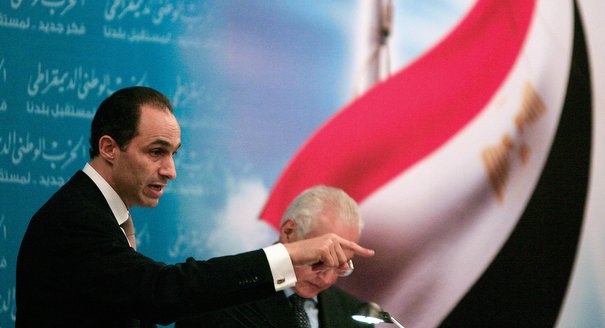
Opposition groups can only counter the regime’s hegemony by letting go of their obsession with Gamal Mubarak’s succession and addressing other issues at the core of the upcoming elections.
Egypt's Opposition Misled by Fixation with MubarakPolitical opposition in Egypt has been stirred by a recent campaign against Gamal Mubarak, the son of the president Hosni Mubarak, becoming Egypt’s new president in 2011. In particular, Ayman Nour, a key opposition figure and a presidential candidate in 2005, has mobilised a wide spectrum of political groups to present a united front in upcoming legislative and presidential elections in 2010 and 2011, respectively.
Upon closer look, however, Mr Nour’s rallying cry is troubling. In gearing up for elections, the opposition has demonstrated a near complete inability to prioritise the issues essential to its political future, and has squandered its efforts trying to prevent Gamal Mubarak’s succession.
Egypt’s opposition groups, including both legal parties and the Muslim Brotherhood, have been in disarray since the regime introduced stifling constitutional amendments in 2007. These measures limit the oversight powers of the judiciary in elections, fail to set term limits on the presidential mandate, and ban religiously affiliated political activities.
While opposition forces have been exclusively focused on the one issue – Gamal Mubarak’s possible ascendancy – the Egyptian regime has been carefully creating an environment which will sustain its rule. The ruling elite is no newcomer to this game. They have consistently manipulated the political process by preventing the opposition from registering candidates in elections, obstructing the campaign process, and fomenting violence on election day.
In contrast to the ruling elite’s clear direction, the opposition has no guiding compass and is left wandering through the challenges posed by the political agenda in Egypt. Their failure cannot be solely attributed to the regime’s repressive measures – a great part of the responsibility belongs to the opposition parties themselves.
Since 2005, parties including the liberal Wafd party, Ayman Nour’s Ghad party and the Democratic Front, as well as the Muslim Brotherhood (which is banned but has de facto representation in parliament) have all failed in two major tasks: formulating an elections platform and clear vision for Egypt’s political development, and applying sufficient pressure on the regime for political and economic reform.
Despite its acquisition of an unprecedented 88 parliamentary seats in the 2005 elections, the Muslim Brotherhood has yet to push for serious reform of the political system. Several concerns also remain unresolved in Egyptian and international public opinion regarding the Brotherhood’s positions on equal citizenship rights for Copts and Muslims, women’s participation in politics and freedom of expression.
The opposition parties urgently need to tackle several issues to position themselves for the 2010 and 2011 elections. First, groups have to clarify their stance on the question of domestic and international monitoring of elections. Especially with regard to the latter, the opposition remains divided.
Second, they have to prioritise calls for the abolition of the emergency law in effect in Egypt since 1981. Finally, parties should be more attuned to new political opportunities, expanding grassroots activities to capitalise on growing protest sentiment among wide segments of the population who are suffering from deteriorating social and economic conditions.
With Egypt’s declining GDP growth, the unemployment rate reaching 10.3 per cent, a poverty rate of 20 per cent, and an alarming level of debt – 76 per cent of GDP – citizens are in desperate need of competent political parties.
The implications of the upcoming elections will, of course, extend beyond Egypt’s borders. In light of the regime’s recent political manoeuvring and the opposition’s stagnation, the 2010 and 2011 elections in Egypt will test the Obama administration’s stance on democracy in the Middle East. Its position will either demonstrate a commitment to the incumbent regime of the Mubaraks as a strategic ally in a turbulent region regardless of its domestic behaviour, or signal pressure to create better conditions for democratic reform and political competition in Egypt.
The first signals from the Obama administration are not encouraging; the administration has so far put the promotion of democracy low on its list of priorities. Washington has only raised the issue of reform in the context of concessions that Mr Mubarak has already made. The Obama administration has also cut aid to numerous actors and organisations in civil society.
The campaign organised by Mr Nour is a step in the right direction for the opposition in Egypt, but he and other activists would be wise to adjust their agenda. Only by letting go of their obsession with Gamal Mubarak’s succession and addressing other issues at the core of the upcoming elections can opposition groups counter the regime’s hegemony.
Amr Hamzawy is a senior fellow and the director of the Carnegie Middle East Program. His research and writings focus on Egypt’s and other middle powers’ involvement in regional security in the Middle East, particularly through collective diplomacy and multilateral conflict resolution
Carnegie India does not take institutional positions on public policy issues; the views represented herein are those of the author(s) and do not necessarily reflect the views of Carnegie, its staff, or its trustees.
As India’s economy recovers from the coronavirus pandemic, Indian businesses need efficient financial structures to regain their ground. Key reforms to India’s Insolvency and Bankruptcy Code could fill these gaps.
Access to cross-border data is an integral piece of the law enforcement puzzle. India is well placed to lead the discussions on international data agreements subject to undertaking necessary surveillance reforms.
After the coronavirus pandemic wanes, how will China’s reorientation of the Belt and Road Initiative to address global health concerns influence its relationships with South Asian countries?
Governments around the world are turning to new forms of digital surveillance to monitor the spread of the coronavirus, though they are mostly using existing laws to do so.