

Other
Sharon Squassoni
{
  "authors": [
    "Sharon Squassoni"
  ],
  "type": "legacyinthemedia",
  "centerAffiliationAll": "dc",
  "centers": [
    "Carnegie Endowment for International Peace"
  ],
  "collections": [
    "U.S. Nuclear Policy"
  ],
  "englishNewsletterAll": "ctw",
  "nonEnglishNewsletterAll": "",
  "primaryCenter": "Carnegie Endowment for International Peace",
  "programAffiliation": "NPP",
  "programs": [
    "Nuclear Policy",
    "Sustainability, Climate, and Geopolitics"
  ],
  "projects": [],
  "regions": [
    "North America",
    "United States"
  ],
  "topics": [
    "Climate Change",
    "Nuclear Policy",
    "Nuclear Energy"
  ]
}
Source: Getty
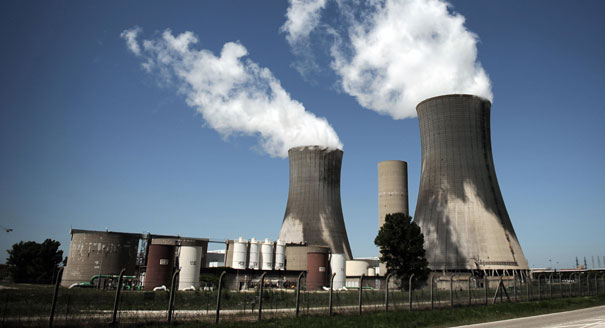
Nuclear power is not without risks, both from nuclear waste and the possible proliferation of nuclear fuel for weapons, and its cost and build-out time make it a partial solution, at best, to climate change.
Source: America.gov

First, Squassoni questions the practicality of switching to nuclear energy. Building sufficient nuclear capacity would take many years, while the need to reduce greenhouse gasses is immediate, she says. She argues the key to reducing energy consumption lies not just in replacing fuel but in improving energy efficiency. Switching to nuclear power would not immediately address emissions from other sources, such as cars, homes, businesses and industries.
While she agrees that a sense of panic won’t speed the process of replacing fossil fuels with nuclear power, Squassoni believes the climate change issue is urgent enough to require faster solutions — the leaders of the G8 countries have set 2015 as the year when carbon dioxide emissions cannot rise any higher. She also argues that private financial investors have shown little interest in funding the high cost of nuclear plants and are more focused on smaller renewable projects that offer a faster return. In addition, the hazards of nuclear waste and the possible proliferation of nuclear fuel for weapons are major concerns. Efficiency, she says, is the fastest and safest way to reduce emissions.
Finally, even if the world had 30 years to bring carbon dioxide emissions down, immediate action still would be the most methodical and logical approach, Squassoni argues. Since free markets favor coal as the cheapest energy source, governments still would have to act as soon as possible to make fast and low-cost changes that offer the least overall risk. Energy efficiency is not an abstract concept, but one that consumers easily can see in homes and offices. Ways to use less energy are not hard to find and are the fastest routes to reducing emissions. Also, using a mix of energy sources is better than relying on a single source, such as nuclear power. Even if nuclear energy is included in the mechanism that rewards developed countries for investing in clean technologies in developing countries, it likely would be too expensive even for the wealthiest of developed countries.

Former Senior Associate, Nuclear Policy Program
Squassoni came to Carnegie from the Congressional Research Service. She also served for nine years in the executive branch. Her last position at the State Department was director of Policy Coordination in the Nonproliferation Bureau.
Recent Work
Sharon Squassoni
Sharon Squassoni
Carnegie India does not take institutional positions on public policy issues; the views represented herein are those of the author(s) and do not necessarily reflect the views of Carnegie, its staff, or its trustees.

How is AI reshaping space security, creating governance challenges, and where does international diplomacy stand today?


Tejas Bharadwaj, Almudena Azcárate Ortega

The U.S.–India semiconductor cooperation story is well-stocked with top-level strategic intent. What remains unresolved, however, are some underlying challenges that will determine whether the cooperation actually functions. Three such friction points stand out.

Shruti Mittal

India and the United States are close to concluding a Reciprocal Defense Procurement Agreement (RDPA) that will allow firms from the two countries to sell to each other’s defense establishments more easily. While this may not remedy the specific grievances both sides may have regarding larger bilateral issues, an RDPA could restore some momentum, following the trade deal announcement.

Konark Bhandari

On the last day of the India AI Impact Summit, India signed Pax Silica, a U.S.-led declaration seemingly focused on semiconductors. While India’s accession to the same was not entirely unforeseen, becoming a signatory nation this quickly was not on the cards either.
Konark Bhandari

This piece examines India’s response to U.S. sanctions and tariffs, specifically assessing the immediate market consequences, such as alterations in import costs, and the broader strategic implications for India’s energy security and foreign policy orientation.

Vrinda Sahai