• Research
  • About
  • Experts
Carnegie India logoCarnegie lettermark logo
AI
{
  "authors": [
    "Nikolay Petrov"
  ],
  "type": "legacyinthemedia",
  "centerAffiliationAll": "",
  "centers": [
    "Carnegie Endowment for International Peace",
    "Carnegie Russia Eurasia Center"
  ],
  "collections": [],
  "englishNewsletterAll": "",
  "nonEnglishNewsletterAll": "",
  "primaryCenter": "Carnegie Russia Eurasia Center",
  "programAffiliation": "",
  "programs": [],
  "projects": [],
  "regions": [
    "Caucasus",
    "Russia"
  ],
  "topics": [
    "Political Reform"
  ]
}
Source: Getty

In The Media
Carnegie Russia Eurasia Center

Cosmetic Police Reforms

Systemic reform of the Russian Interior Ministry will require more than President Medvedev’s recent order to dismiss eighteen high-ranking police officials and to halve the ministry’s head office. Staff reductions are not enough to address the fundamental flaws that plague the institution.

Link Copied
By Nikolay Petrov
Published on Feb 24, 2010

Source: The Moscow Times

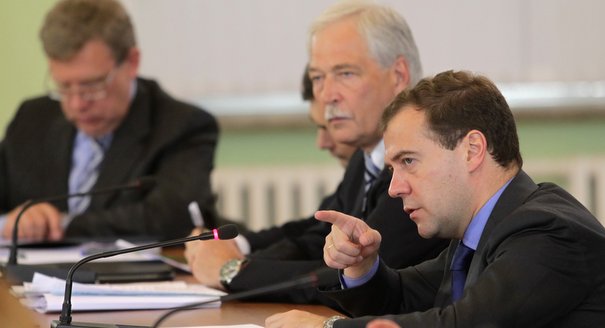
Cosmetic Police ReformsAt a meeting with top Interior Ministry officials on Thursday, President Dmitry Medvedev dismissed two deputy interior ministers and 16 other high-ranking police officials. He also ordered the number of personnel at the ministry’s head office to be halved to about 10,000. The authorities rushed to present these cuts as severe, unprecedented and almost revolutionary reforms, but this is not entirely accurate.

First, the Kremlin previously carried out massive layoffs that included generals in the Interior Ministry in 2002, the Federal Security Service in 2006, the army in 2007 and the Federal Prison Service in 2009. Second, large-scale staff reductions do not by themselves constitute reform. Even the “major changes” in the Interior Ministry that Medvedev announced in December and February lack the substance or careful planning required to be considered true reforms.
 
The presidential administration apparently asked the Interior Ministry beforehand to prepare an impressive list of people to fire so that Medvedev could announce those layoffs together with his reform bills for the State Duma during Thursday’s meeting with the Interior Ministry.
 
Unfortunately, the firings within the Interior Ministry do not directly punish those responsible for a string of high-profile police abuse cases over the past year, such as the death of lawyer Sergei Magnitsky in his pretrial detention cell in November or the supermarket shooting spree in Moscow committed by police major Denis Yevsyukov in April. Only two of the seven regional police heads dismissed were directly connected to well-publicized cases of gross negligence. For example, Viktor Grechman, the head of police in the Tomsk region, was dismissed after journalist Konstantin Popov was brutally beaten to death last month by a young police officer while in custody in a police station as seven other officials reportedly looked on.
 
Will the system work better after Medvedev’s shakeup? Probably not. The individuals who were fired were by far not the worst in the Interior Ministry’s ranks, and those replacing them are not likely to be any better. The problem is not limited to one or two dozen generals. The whole state apparatus operates inefficiently.
 
The Interior Ministry is not the worst part of the system, only the most visible part. Not only do law enforcement officials interact daily with ordinary citizens, but an endless string of scandals in 2009 and early 2010 has made the problems in the Interior Ministry a subject of discussion around the dinner table of every household.
 
The methods for raising the effectiveness of a nation’s government institutions vary depending on whether the country is democratic or authoritarian. In a democracy, the state might grant the people or their representatives in state and federal legislatures more control over all areas of government, including law enforcement officials. In countries where the people prefer a Stalinist state, they institute strict discipline, harsh punishments, periodic purges and an atmosphere of fear. But making changes to either form of government requires systemic reforms and not merely populist gestures or superficial administrative measures.
 
Medvedev needs to understand that he can’t carry out systemic reforms by addressing on an ad hoc basis individual aspects of the Interior Ministry if the entire system is fundamentally flawed. Reform of the ministry will require a lot more than simply removing a few bad apples from its ranks.

About the Author

Nikolay Petrov

Former Scholar-in-Residence, Society and Regions Program, Moscow Center

Nikolay Petrov was the chair of the Carnegie Moscow Center’s Society and Regions Program. Until 2006, he also worked at the Institute of Geography at the Russian Academy of Sciences, where he started to work in 1982.

    Recent Work

  • Commentary
    Moscow Elections: Winners and Losers

      Nikolay Petrov

  • Commentary
    September 8 Election As a New Phase of the Society and Authorities' Coevolution

      Nikolay Petrov

Nikolay Petrov
Former Scholar-in-Residence, Society and Regions Program, Moscow Center
Nikolay Petrov
Political ReformCaucasusRussia

Carnegie India does not take institutional positions on public policy issues; the views represented herein are those of the author(s) and do not necessarily reflect the views of Carnegie, its staff, or its trustees.

More Work from Carnegie India

  • Article
    Managing Divergence: India’s BRICS Presidency in 2026

    This piece argues that India’s central challenge is not managing a single flashpoint but resolving the underlying tension between expansion and institutional coherency of the BRICS grouping.

      Vrinda Sahai
  • Paper
    India’s Sustained Economic Recovery Will Require Changes to Its Bankruptcy Law

    As India’s economy recovers from the coronavirus pandemic, Indian businesses need efficient financial structures to regain their ground. Key reforms to India’s Insolvency and Bankruptcy Code could fill these gaps.

      Anirudh Burman

  • Paper
    Cross-Border Data Access for Law Enforcement: What Are India’s Strategic Options?

    Access to cross-border data is an integral piece of the law enforcement puzzle. India is well placed to lead the discussions on international data agreements subject to undertaking necessary surveillance reforms.

      Smriti Parsheera, Prateek Jha
  • Article
    The BRI in Post-Coronavirus South Asia

    After the coronavirus pandemic wanes, how will China’s reorientation of the Belt and Road Initiative to address global health concerns influence its relationships with South Asian countries?


      Deep Pal, Rahul Bhatia
  • Commentary
    India’s Unheeded Coronavirus Warning

    Early in the outbreak, government researchers forecast several high-risk scenarios that were downplayed or ignored in public messaging.

      Gautam I. Menon

Get more news and analysis from
Carnegie India
Carnegie India logo, white
Unit C-4, 5, 6, EdenparkShaheed Jeet Singh MargNew Delhi – 110016, IndiaPhone: 011-40078687
  • Research
  • About
  • Experts
  • Projects
  • Events
  • Contact
  • Careers
  • Privacy
  • For Media
Get more news and analysis from
Carnegie India
© 2026 Carnegie Endowment for International Peace. All rights reserved.