

Commentary
Maria Lipman
{
  "authors": [
    "Maria Lipman"
  ],
  "type": "legacyinthemedia",
  "centerAffiliationAll": "",
  "centers": [
    "Carnegie Endowment for International Peace",
    "Carnegie Europe",
    "Carnegie Russia Eurasia Center"
  ],
  "collections": [],
  "englishNewsletterAll": "",
  "nonEnglishNewsletterAll": "",
  "primaryCenter": "Carnegie Russia Eurasia Center",
  "programAffiliation": "",
  "programs": [],
  "projects": [],
  "regions": [
    "Caucasus",
    "Russia",
    "Eastern Europe",
    "Europe"
  ],
  "topics": [
    "Foreign Policy"
  ]
}
Source: Getty
The tragic death of the Polish president might give Poland and Russia a chance to move beyond their historical animosity, but it will still take hard effort on both sides to break away from the past and at long last come to terms with each other.
Source: Foreign Policy

In the past decade, conflicting perceptions of World War II's history have once again exacerbated the two countries' relations. So it was truly striking to see the outpouring of emotion between Russia and Poland over the tragic deaths of Polish President Lech Kaczynski and other Polish dignitaries killed in a plane crash on their way to commemorate the victims of the Katyn massacre. As Russian President Dmitry Medvedev plans to join other world leaders at Kaczynski's funeral on Sunday, the two countries may have a chance to overcome the dark historical legacy.
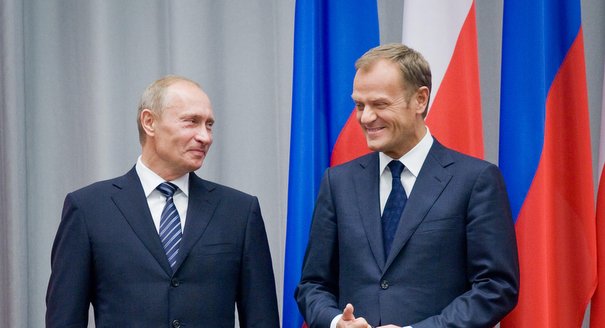
"Russia shares the grief and mourning of Poland," Medvedev announced in the wake of the plane crash. He declared a day of national mourning in Russia -- perhaps the first time Russia has officially mourned foreigners. Prime Minister Vladimir Putin set the tone for Russia's sympathetic response, immediately rushing to the scene of the disaster; his brotherly embrace of Polish Prime Minister Donald Tusk was deeply moving for Polish citizens. Putin personally took charge of the investigation into the crash, as well as providing assistance to the victims' families.
The Polish nation has received Russia's condolences with gratitude. "We are touched by the help and solidarity we have received from Russia," a group of Polish intellectuals and clerics wrote in an open letter. The Moscow correspondent for the Polish newspaper Gazeta Wyborcza praised Russia's "decent," "impeccable," and "noble" conduct throughout the affair. Polish Foreign Minister Radoslaw Sikorski, no political ally of Russia, expressed his gratitude and described the event as an "emotional breakthrough" in relations between the two countries.
The phrase "emotional breakthrough" is particularly resonant, given how divided the two countries are by the past. Poland is fixated on its victimization at the hands of the Soviet regime, while Russia is reluctant to discuss its Soviet-era crimes. Poland's perception of Russia as an aggressive and violent force goes back to the oppression by the Russian czars and was even more deeply ingrained by the events of World War II. Russia, on the other hand, remains resentful of any reading of the war's history that does not paint the Soviet Union as the liberator of Eastern Europe, including Poland, from Nazi Germany.
Polish politicians, including the late Kaczynski, frequently draw on anti-Russian sentiment. Russia has been repeatedly outraged by Poland driving anti-Russian policies in the European Union and supporting Russia's adversaries such as former Ukrainian President Viktor Yushchenko and Georgian President Mikheil Saakashvili. When the 2008 war broke out between Georgia and Russia, Kaczynski hurried to the Georgian capital of Tbilisi to give a fiery anti-Russian speech supporting Saakashvili.
Over the last two decades, the official stance on Katyn, easily the most sensitive issue of Russian-Polish relations, has shifted several times with the Russian political wind. Soviet media in the late 1980s, freed by Soviet leader Mikhail Gorbachev's perestroika, first exposed the truth about the mass executions. Gorbachev himself admitted in 1990 that the executions were a documented fact. The Soviet prosecutor's office subsequently launched an investigation into the massacre and authorized excavations of the burial sites.
During the 1991 coup attempt by hard-line Communists, the excavation issue briefly became a reflection of the political standoff between Communist conservatives and the forces for change and freedom. As soon as news of the coup attempt broke, local KGB authorities rushed to the excavation site and demanded that work be stopped immediately. But the coup-plotters quickly lost momentum, and the prosecutor's office promptly proceeded with its investigation.
President Boris Yeltsin, Russia's first post-communist leader, continued this reappraisal of Soviet history. In 1992 he made public the documents confirming that Polish citizens had been executed on orders of the Soviet leadership. Yeltsin visited the Katyn monument in Warsaw and asked forgiveness from the Polish people. Jointly with then-President Aleksander Kwasniewski, he agreed to construct memorials to the victims of the Katyn massacre on the sites where Polish citizens -- as well as a great number of Soviet people -- had been executed. Today the sites keep the memory of both, the Poles and the Russians.
This trend was changed under Putin. Asserting that Russia was a great nation with a proud history, Putin angrily rejected attempts to force Russia to assume responsibility for Stalin's crimes. Discussion of Soviet terror and repression was marginalized; Katyn was certainly among the subjects deemed inappropriate for broad public debate. The very existence of Katyn memorials was ignored by Russian officialdom. Families of Katyn victims were denied their petition to recognize that the executed Poles were victims of political repression; this denial made them ineligible for posthumous political rehabilitation.
Contrary to earlier official statements, the prosecutor's office announced that it would keep classified a significant part of the documents pertaining to its extensive investigation into the Katyn massacres. Although top officials mostly avoided the subject of Katyn, a number of Russian politicians and media outlets exploited the official silence to voice the old lie that the Poles killed in Katyn in 1940 were shot by Nazis upon their invasion of the Soviet Union.
The Russian reaction to the 2007 Polish film Katyn was another reminder of how sensitive this issue remains. The film is set in postwar Poland, where people take terrible risks to preserve the memory of Katyn despite the Communist ban, and was directed by Andrzej Wajda, a leading Polish film director greatly admired in Soviet and now Russian intellectual circles. But two decades after ideological censorship had been abolished in Russia, Katyn was barred from broad distribution. There are credible grounds to suspect that the de facto ban on the movie originated from the Kremlin.
Then, after Katyn had been all but banished from the broad public discourse, Putin unexpectedly invited Tusk this year to Katyn to commemorate the 70th anniversary of the executions. On April 7, the two prime ministers knelt together at the Katyn memorial complex to condemn the Soviet crimes and remember the innocent Polish and Soviet victims killed by Stalin's secret police.
Just prior to Putin's meeting with Tusk, Wajda's Katyn suddenly aired on Russian state television. Although the channel that showed the movie has a small audience, this was undeniably an act of goodwill. Putin has still not met many of the Poles' expectations -- he made no mention of the denied political rehabilitation of Katyn victims and supported the decision to keep the remaining Katyn materials classified -- but nevertheless, his move was rightly regarded as a step forward in Russian-Polish relations.
And then the tragedy occurred. The Polish delegation, headed by Kaczynski, was headed to Katyn to stage another commemoration, just a few days after the prime minister's visit. Amid the deep sympathy and generous assistance shown by the Russian leadership, Katyn was aired on Russian television again -- this time on the state channel, with an almost universal national audience.
Russia's humane reaction to the crash has enabled Poland -- at least for the present -- to get over the dark symbolism of this tragedy. Seventy years after the elite of Polish society was exterminated in Katyn, the Polish president and many top figures of Poland's government met their end on the same spot.
The tragedy might give the two countries a chance to move beyond their past animosity, but old suspicions will not disappear overnight. A national poll conducted in March asked Russians who organized the shooting of Polish officers in Katyn. Fifty-three percent had no opinion, 28 percent said they had been killed by Nazis, and only 19 percent thought that the Poles had been shot by the Soviet secret police. Likewise, anti-Russian sentiment is still alive in Poland. It will take hard effort on both sides, such as Russia's full and open cooperation on the investigation of Katyn and the elimination of the anti-Russian politics in Poland, to break away from the past and at long last come to terms with each other.
This article originally appeared in Foreign Policy.
Former Scholar in Residence, Society and Regions Program, Editor in Chief, Pro et Contra, Moscow Center
Lipman was the editor in chief of the Pro et Contra journal, published by the Carnegie Moscow Center. She was also the expert of the Carnegie Moscow Center’s Society and Regions Program.
Recent Work
Maria Lipman
Maria Lipman
Carnegie India does not take institutional positions on public policy issues; the views represented herein are those of the author(s) and do not necessarily reflect the views of Carnegie, its staff, or its trustees.

After the chill in ties between 2020 and 2024 that brought India–China relations to their lowest point in several decades, the two countries have engaged each other afresh. This paper argues that there are predominantly four imperatives guiding India’s approach to China, and they exist in an order of priority.

Saheb Singh Chadha

This piece argues that India’s central challenge is not managing a single flashpoint but resolving the underlying tension between expansion and institutional coherency of the BRICS grouping.

Vrinda Sahai

The ASML MoU with Tata Electronics is an indicator of how far the Indian semiconductor ecosystem has come. This ecosystem has been years in the making and represents real commercial logic.

Konark Bhandari

A partnership between India, a country of subcontinental size, and Africa, a continent of fifty-four countries, may seem asymmetric until one notes that both are home to nearly the same number of people—1.4 billion. This essay spells out the existing challenges to the partnership, its optimal potential, and the possible pathways to realize it over the next quarter-century.

Rajiv Bhatia

The India–EU Free Trade Agreement (FTA) is shaping up to be one of the most consequential trade negotiations, both economically and strategically. But, what’s in the agreement, what’s missing, and what will determine its success in the years ahead
Vrinda Sahai, Nicolas Köhler-Suzuki