
• Research
  • About
  • Experts
Carnegie India logoCarnegie lettermark logo
AI
{
  "authors": [],
  "type": "other",
  "centerAffiliationAll": "",
  "centers": [
    "Carnegie Endowment for International Peace"
  ],
  "collections": [],
  "englishNewsletterAll": "",
  "nonEnglishNewsletterAll": "",
  "primaryCenter": "Carnegie Endowment for International Peace",
  "programAffiliation": "",
  "programs": [],
  "projects": [],
  "regions": [
    "North Africa",
    "Egypt"
  ],
  "topics": [
    "Political Reform",
    "Democracy",
    "Foreign Policy"
  ]
}

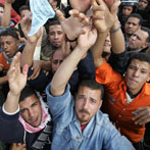
Source: Getty

Other

A Second Letter to Clinton from the Working Group on Egypt

The renewal of the state of emergency in Egypt heightens concerns that the Obama administration’s practice of quiet diplomacy is not bearing fruit. The United States is uniquely positioned to engage the Egyptian government and civil society and encourage them along a path toward reform.

Link Copied
Published on May 12, 2010

Source: May 11

Dear Madame Secretary,


Democracy in Egypt has suffered another blow. This week, the Egyptian government extended its state of emergency for an additional two years despite President Mubarak’s promises since 2005 to end it and replace it with a more limited anti-terror law. In light of this disturbing development, we write to you again to urge you strongly to take an interest in promoting democratic reform in Egypt.

In renewing the state of emergency, the Egyptian government has attempted to appease critics with slight changes to the emergency law text; however, these will not alter the fundamentally repressive atmosphere the state of emergency creates. Citizens still do not, for example, enjoy the freedom of assembly. The Egyptian government also has claimed that the emergency law will only apply to cases of terrorism or narcotics, but it has made such promises in the past and not abided by them.

Since 1981, the Government of Egypt has maintained the state of emergency continuously, ostensibly to fight terrorism and protect its citizens and national security. In practice, however, the emergency law has done precisely the opposite. It has encouraged human rights abuses, stifled the public voice, and fortified Egypt’s trend toward authoritarianism. Under the state of emergency, Egyptian citizens face arrest if they participate in political rallies or peaceful demonstrations, trial in military tribunals for political offenses, and prolonged administrative detention without charge. These measures are clearly incompatible with free elections and democratization, which President Mubarak promised twice since his recent return from surgery in Germany.

With elections scheduled for the parliament this year and the presidency in 2011, Egypt has a rare opportunity to reposition itself on the path toward healthy democratic reform. And neither must it start from scratch; while some changes must be constitutional and legal, others are merely administrative. It would require no changes in law, for example, to allow free campaigning and international and domestic election monitoring in this year’s parliamentary elections, to keep security forces away from polling places, or to refrain from violence against activists and protestors.

In our last letter to you, dated April 7, 2010, we outlined the importance of democracy in Egypt to the region, the United States, and the world in general, and we recommended a set of action items. In light of the renewal of the state of emergency, we are more convinced than ever of the importance of U.S. engagement. We urge you to persuade President Mubarak to lift the state of emergency now, as the critical elections period begins, and to release detainees held under the emergency law for clearly political offenses, while bringing all cases within a legitimate legal framework.

Madame Secretary, this is a bipartisan issue, and we strongly encourage you to act quickly and effectively. The renewal of the state of emergency heightens our concern that the administration’s practice of quiet diplomacy is not bearing fruit. As a major aid contributor to and strategic partner of Egypt, the United States is uniquely positioned to engage the Egyptian government and civil society and encourage them along a path toward reform. The time to use that leverage is now.


Sincerely,


The Working Group on Egypt


Thomas Carothers
Carnegie Endowment for International Peace

Elliott Abrams
Council on Foreign Relations

Brian Katulis
Center for American Progress

Tom Malinowski
Human Rights Watch

Michele Dunne
Carnegie Endowment for International Peace

Robert Kagan
Carnegie Endowment for International Peace

Scott Carpenter
Washington Institute for Near East Policy

Ellen Bork
Foreign Policy Initiative

Daniel Calingaert
Freedom House


The Group’s first letter to Secretary Clinton can be viewed here.

Political ReformDemocracyForeign PolicyNorth AfricaEgypt

Carnegie India does not take institutional positions on public policy issues; the views represented herein are those of the author(s) and do not necessarily reflect the views of Carnegie, its staff, or its trustees.

More Work from Carnegie India

  • Commentary
    The Impact of U.S. Sanctions and Tariffs on India’s Russian Oil Imports

    This piece examines India’s response to U.S. sanctions and tariffs, specifically assessing the immediate market consequences, such as alterations in import costs, and the broader strategic implications for India’s energy security and foreign policy orientation.

      Vrinda Sahai

  • Commentary
    NISAR Soars While India-U.S. Tariff Tensions Simmer

    On July 30, 2025, the United States announced 25 percent tariffs on Indian goods. While diplomatic tensions simmered on the trade front, a cosmic calm prevailed at the Sriharikota launch range. Officials from NASA and ISRO were preparing to launch an engineering marvel into space—the NASA-ISRO Synthetic Aperture Radar (NISAR), marking a significant milestone in the India-U.S. bilateral partnership.

      Tejas Bharadwaj

  • Commentary
    Indian Airstrikes in Pakistan: May 7, 2025

    On May 7, 2025, between 1:05 and 1:30 a.m. (IST), airstrikes carried out by the Indian Air Force hit nine locations inside Pakistan and Pakistan occupied Kashmir (PoK). It was codenamed Operation Sindoor.

      Rudra Chaudhuri

  • Research
    Views From Taipei: Essays by Young Indian Scholars on China

    This compendium brings together three essays by scholars who participated in Carnegie India's Security Studies Dialogue in 2024, each examining a different aspect of China’s policies. Drawing on their expertise and research, the authors offer fresh perspectives on key geopolitical challenges.

      • +1

      Vijay Gokhale, Suyash Desai, Amit Kumar, …

  • Commentary
    The India-U.S. TRUST Initiative: Advancing Semiconductor Supply Chain Cooperation

    As part of the TRUST initiative, leaders of the two countries committed to building trusted and resilient supply chains, including for semiconductors and critical minerals. India and the United States have made steady progress in this area over the years. This essay explores the takeaways from discussions on semiconductor supply chains that took place at Carnegie India’s 9th Global Technology Summit.

      Konark Bhandari

Get more news and analysis from
Carnegie India
Carnegie India logo, white
Unit C-4, 5, 6, EdenparkShaheed Jeet Singh MargNew Delhi – 110016, IndiaPhone: 011-40078687
  • Research
  • About
  • Experts
  • Projects
  • Events
  • Contact
  • Careers
  • Privacy
  • For Media
Get more news and analysis from
Carnegie India
© 2026 Carnegie Endowment for International Peace. All rights reserved.







