

Q&A
Mark Medish
{
  "authors": [
    "Mark Medish"
  ],
  "type": "legacyinthemedia",
  "centerAffiliationAll": "dc",
  "centers": [
    "Carnegie Endowment for International Peace",
    "Carnegie Europe",
    "Carnegie Russia Eurasia Center"
  ],
  "collections": [],
  "englishNewsletterAll": "ctw",
  "nonEnglishNewsletterAll": "",
  "primaryCenter": "Carnegie Endowment for International Peace",
  "programAffiliation": "russia",
  "programs": [
    "Russia and Eurasia"
  ],
  "projects": [],
  "regions": [
    "Caucasus",
    "Russia"
  ],
  "topics": [
    "Political Reform",
    "Foreign Policy"
  ]
}
Source: Getty
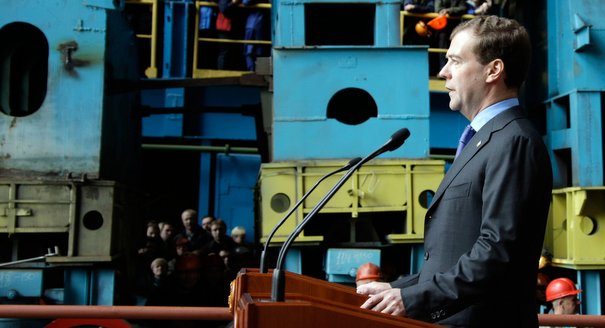
Modern Russian must overcome a number of internal and external pressures in the course of its struggle to determine its role in the changing global community.
Source: The International Herald Tribune

The Russia we know today has been looking for its place in the world ever since the collapse of the Soviet Union 20 years ago. Stripped of the shell of Soviet empire, the country’s identity has been in flux. The search is at once geopolitical, philosophical and profoundly psychological. The quest has been complicated by the fact that the world around Russia has been changing too.
Russian officials have had trouble concealing their pleasure at the perception that the West is in strategic decline due to Middle East quagmires and cascading financial crises.
Certainly Moscow is not alone in wondering about the future of the West. A pattern of strategic hedging is obvious from Turkey and Israel to Brazil and China. The balance of power in the world is more fluid than at any time since the beginning of the Cold War.
What should Russia do? In recent years Russia has experimented with several geostrategic options, most of which have proven either illusory or of limited value.
One option was a “strategic partnership” with China. Indeed one of the biggest diplomatic achievements of Vladimir Putin’s presidency was a final settlement in 2005 of the decades-long border dispute with China. The economic complementarities between the two countries seem obvious: Russia has excess natural resources and a labor shortage, while China has the opposite. But practical cooperation has been severely limited by deep-seated mutual mistrust. The Russians and Chinese have mutual superiority complexes that make partnership all but impossible.
Another tack for Moscow has been to trumpet its membership in the club of mega-emerging markets, the so-called BRICs. But, in terms of sheer economic dynamism, Russia is clearly an outlier, if not a total misfit, in the company of Brazil, India and China. Russia has a weak manufacturing base, apart from arms. Russia would be a more natural member of OPEC, which only underscores its dependence on hydrocarbon extraction.
The most problematic phase of Russia’s identity quest culminated in outright confrontation with the West during the deadly Georgia conflict of August 2008.
Oil was touching $150 per barrel and Russia’s currency reserves soared to almost half a trillion dollars. The Russians felt powerful and were spoiling for a fight. The newly installed President Medvedev found himself spokesmen for hard-liners who wanted to teach Georgia and its Western patrons an object lesson about Russia’s interests in the post-Soviet borderlands.
To be sure, the confrontation was baited by Russophobes in the Bush-Cheney administration. From their hyper-realist viewpoint, it was probably a “win-win” scenario — either the Georgians would surprise the Russians with new defensive technologies or Russia would show its true colors as a brutal, imperialist meddler, further diminishing its European credentials.
Rarely has a country moved from hubris to humility as quickly as Russia after the events of 2008. Russia celebrated its victory and rushed to recognize South Ossetia and Abkhazia, despite the fact Moscow had always counseled the West against recognizing breakaway provinces such as Kosovo. Within a few weeks, the Wall Street collapse brought reality home, with Russia this time on the receiving end of acute market contagion.
It is against this dangerous backdrop that the newly elected Barack Obama put forward the idea of a “reset” of bilateral relations. The Russians at first reacted with skepticism but now tend to view Mr. Obama as somebody they can do business with. More important, the Russian elite has had time to reflect on where their long-term interests lie.
A recently leaked Russian foreign ministry “white paper” suggests an important debate is under way. The paper echoes President Medvedev’s themes of the urgent need for modernization and closer association with the West.
It is doubtful that the hard-line camp based around Russia’s security services has come around to this view. They are still wedded to the notion that the West is in civilizational decline and that Russia has an opportunity to press its short-term interests in the immediate neighborhood including Ukraine, the Caucasus and Central Asia.
The Medvedev camp is not persuaded by the end-of-the-West thesis, and they are clear-eyed about Russia’s own national decline. They probably do not underestimate the organic strength of the West to recover from its current economic woes. They also know that the other BRICs are humming along. They know that Russia cannot afford neo-imperialist delusions.
Prime Minister Putin is usually assumed to represent the security camp, and his fingerprints are certainly on a number of brutal policies at home and abroad. However, his record also suggests that he is an arbiter between opposing factions and is capable of policy pivots. The recent rapprochement with Poland over Soviet-era crimes was a smart and possibly significant step.
The abiding trouble with Mr. Putin is that while he wants modern results, he does not limit himself to modern methods at home. Instead, faith in autocracy — which doomed czars and commissars alike — still haunts Russia.
Mr. Medvedev talks about promoting nanotechnology in Russia. This is a perfectly rational economic objective, but Russia’s deeper challenge is that it needs a new operating system, preferably a European-oriented one based on representative government, civil liberties, property rights and true federalism.
The great Russian historian Vasily Klyuchevsky wrote of the 18th-century czar Peter the Great: “He did not want to borrow the results of Western technique, but wanted to appropriate the skill and knowledge, and build industries on the Western European model.” Peter himself said: “We need Europe for a few decades; later on we must turn our back on it.”
The Russian president seems to be saying something different. Only time will tell whether Mr. Medvedev can deliver. His Western counterparts, including President Obama, Chancellor Angela Merkel and President Nicolas Sarkozy, should continue to encourage the idea that Russia can become a European country.
Former Visiting Scholar
Medish served in the Clinton administration as special assistant to the President and senior director for Russian, Ukrainian, and Eurasian Affairs on the National Security Council from 2000 to 2001.
Recent Work
Carnegie India does not take institutional positions on public policy issues; the views represented herein are those of the author(s) and do not necessarily reflect the views of Carnegie, its staff, or its trustees.

After the chill in ties between 2020 and 2024 that brought India–China relations to their lowest point in several decades, the two countries have engaged each other afresh. This paper argues that there are predominantly four imperatives guiding India’s approach to China, and they exist in an order of priority.

Saheb Singh Chadha

This piece argues that India’s central challenge is not managing a single flashpoint but resolving the underlying tension between expansion and institutional coherency of the BRICS grouping.

Vrinda Sahai

A partnership between India, a country of subcontinental size, and Africa, a continent of fifty-four countries, may seem asymmetric until one notes that both are home to nearly the same number of people—1.4 billion. This essay spells out the existing challenges to the partnership, its optimal potential, and the possible pathways to realize it over the next quarter-century.

Rajiv Bhatia

The India–EU Free Trade Agreement (FTA) is shaping up to be one of the most consequential trade negotiations, both economically and strategically. But, what’s in the agreement, what’s missing, and what will determine its success in the years ahead
Vrinda Sahai, Nicolas Köhler-Suzuki

Trump 2.0 has unsettled India’s external environment—but has not overturned its foreign policy strategy, which continues to rely on diversification, hedging, and calibrated partnerships across a fractured order.



Milan Vaishnav, ed., Sameer Lalwani, Tanvi Madan, …