The bloodshed on the ceasefire line should focus minds and be a reminder that a new conflict over Nagorno-Karabakh would be catastrophic for everyone, not just Armenians and Azeris.
A Forever Smoldering Conflict in the CaucasusAs U.S. Secretary of State Hillary Clinton travels to Baku and Yerevan on July 4-5, an old issue will again dominate her discussions: the Nagorno-Karabakh conflict.
Former Soviet leader Mikhail Gorbachev will have a wry smile if he watches the media reports. He was the first leader to fail to solve this conflict in 1988. Since his day, the dispute has escalated into full-scale war and then degraded into a miserable deadlock, but its fundamentals have not changed. For years, the broad international consensus is that the competing Armenian and Azeri claims over Nagorno-Karabakh are still so extreme and contradictory that it did not merit a high-level peace initiative. The perception has been that the conflict — halted by a cease-fire but not resolved — is at least being managed and that the risks of a new war are negligible.
But recent developments are pushing Nagorno-Karabakh up the agenda again. First the good news. Since the end of 2008, President Dmitry Medvedev has surprised skeptics by personally working on a peace agreement. It is gruelling work. In Sochi this past January, Medvedev spent most of a day with Azeri President Ilham Aliyev and Armenian President Serzh Sargsyan and got absolutely nowhere. In St. Petersburg last month, he spent more than two hours with them and made a little more progress. This top-level Russian initiative has not received much attention outside Russia.
The default position of many in Washington, for example, is that Moscow wants to “keep the conflict smoldering.” But that does not jibe with the facts. No sane senior politician of Medvedev’s rank would work so hard on this if he did not want genuinely to see success. The Russians have also been scrupulous in involving their co-mediators, inviting the U.S. and French Nagorno-Karabakh envoys to St. Petersburg to join in the discussions with the two presidents. It looks as though Medvedev has made peace in Nagorno-Karabakh a personal project, and his government sees a peaceful initiative with Armenia and Azerbaijan as a good PR response to the damage Russia suffered internationally in Georgia in 2008. This is one area where, at the moment at least, Medvedev and Clinton are pushing in the same direction.
The bad news is that this latest push for peace comes at a time when more and more people are talking war. On June 18, only a few hours after the St. Petersburg meeting, one of the worst incidents in years occurred on the Nagorno-Karabakh ceasefire line. Four Armenian soldiers and one Azeri were killed. The circumstantial evidence points more to this having been an Azeri attack than an Armenian one — the bodies were on the Armenian side of the line — but the true picture will probably never be known. Clashes like this threaten the equilibrium that has held since 1994, when the ceasefire deal ended fighting. They reflect an overall hardening of positions on both sides. Many Armenians talk more openly about history ratifying the victory they won in 1994 in the hope that Nagorno-Karabakh will follow Kosovo down the path of international legitimacy. For its part, oil-rich Azerbaijan now spends more than $2 billion a year on its military and many Azeris adopt a more belligerent tone, calling for a war to recapture Nagorno-Karabakh from the Armenians.
The international mechanism designed to deal with the conflict, the Minsk Process of the Organization for Security and Cooperation in Europe, is still extremely modest. There are just six European monitors in charge of observing the ceasefire — basically a token presence given that there are more than 20,000 soldiers on each side facing each other along more than 175 kilometers of trenches. The chief work of mediation falls on three Organization for Security and Cooperation in Europe ambassadors representing France, Russia and the United States, who keep up the tortuous negotiations over a compromise document in a climate of almost total distrust in Armenia and Azerbaijan.
Naturally suspicious, neither government offers the offer anything constructive. To be precise, the Armenians offer constructive engagement on small issues such as sharing water over the ceasefire line, but the Azeris reject these gestures, worrying that this is “doing business with the enemy.” The Armenian side rejects all proposals to give up even an inch of Armenian-held land, before pledges on the status of Nagorno-Karabakh are made up front. The Azeris, saying that they are in a state of war, even reject the proposal made by the French, Russia and U.S foreign ministers in Helsinki in 2008 to remove snipers from the front line.
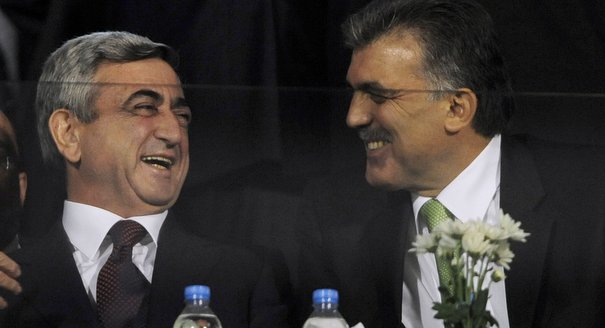
The result is that, even when Medvedev is pushing them, the two presidents lack the will to put their signatures on a piece of paper that will set their countries down a path of historic compromise with each other. To do so would unleash a storm of domestic criticism, while the international reward for taking this step is much less certain. So the leaders calculate that they will not pay a high price for doing nothing — and that other bilateral issues, such as Armenian diaspora concerns, gas pipelines and Afghanistan-bound flights over Azerbaijan will keep their relations with Moscow, Washington and Brussels on an even footing.
The bloodshed on the ceasefire line should focus minds and be a reminder that a new conflict over Nagorno-Karabakh would be catastrophic for everyone, not just Armenians and Azeris. More positive relationships between Moscow, Washington, Paris and Brussels makes this a good moment to have a conversation about what each of these capitals can offer to underpin a post-conflict settlement in terms of funding and peacekeepers. If the world’s top leaders send a signal to the Armenians and Azeris that they are more serious about a lasting peace, then the local actors may finally have to accept that the day of peaceful reckoning has come.
Carnegie India does not take institutional positions on public policy issues; the views represented herein are those of the author(s) and do not necessarily reflect the views of Carnegie, its staff, or its trustees.
In any defense establishment, change is an ongoing process. However, despite the best of intentions, existing bureaucracies, bound by habit and years of socialization, have their limits in implementing transformative change.
After the chill in ties between 2020 and 2024 that brought India–China relations to their lowest point in several decades, the two countries have engaged each other afresh. This paper argues that there are predominantly four imperatives guiding India’s approach to China, and they exist in an order of priority.
This piece argues that India’s central challenge is not managing a single flashpoint but resolving the underlying tension between expansion and institutional coherency of the BRICS grouping.
A partnership between India, a country of subcontinental size, and Africa, a continent of fifty-four countries, may seem asymmetric until one notes that both are home to nearly the same number of people—1.4 billion. This essay spells out the existing challenges to the partnership, its optimal potential, and the possible pathways to realize it over the next quarter-century.
The India–EU Free Trade Agreement (FTA) is shaping up to be one of the most consequential trade negotiations, both economically and strategically. But, what’s in the agreement, what’s missing, and what will determine its success in the years ahead