{
  "authors": [],
  "type": "other",
  "centerAffiliationAll": "",
  "centers": [
    "Carnegie Endowment for International Peace",
    "Malcolm H. Kerr Carnegie Middle East Center"
  ],
  "collections": [],
  "englishNewsletterAll": "",
  "nonEnglishNewsletterAll": "",
  "primaryCenter": "Carnegie Endowment for International Peace",
  "programAffiliation": "",
  "programs": [],
  "projects": [],
  "regions": [
    "North Africa",
    "Egypt"
  ],
  "topics": [
    "Political Reform"
  ]
}
Source: Getty
Other
Egypt’s Parliamentary Elections: A Statement by the Working Group on Egypt
The irregularities observed before and during the parliamentary elections indicate that President Mubarak’s government remains resistant to domestic and international calls for reform.
Link Copied
Published on Nov 30, 2010
Source: November 30
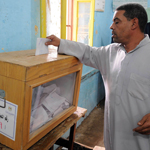
Egypt’s November 28 People’s Assembly elections were characterized by a lack of transparency, widespread fraud, and intimidation. As a result of regime actions that prevented the people of Egypt from exercising their political rights, the elections cannot be said to reflect the will of the people. The Working Group on Egypt is deeply troubled by the irregularities observed before and during the parliamentary elections, which indicate that President Mubarak’s government remains resistant to domestic and international calls for reform. Despite Mubarak’s promise that Egypt would undertake political reform at its own pace, the recent elections were more problematic than those of 2005 and represent a clear step backward.
Numerous Egyptian and international organizations released reports in the aftermath of the parliamentary election with universally grim conclusions. Human Rights Watch, the Egyptian Association for Supporting Democratic Development, and other Egyptian civil society organizations found clear evidence of ballot fraud, police intimidation, thug violence, and the exclusion of certified domestic monitors from polling stations. Even after the government refused to allow international monitors on the grounds that domestic monitoring activities would be sufficient to guarantee the integrity of the elections, it proceeded to deny accreditation to thousands of Egyptian observers and failed to instruct poll workers to admit those accredited. Flaws were not limited to the voting process itself, but permeated the pre-election campaign period, during which hundreds of opposition activists were arrested or subjected to systematic harassment and media coverage was repressed.
The Working Group applauds the U.S. administration for publicly acknowledging that Egypt’s latest election falls far short of a free and fair process. The White House and State Department expressed disappointment with the Egyptian government’s mishandling of elections that represented an important opportunity for progress.
In the aftermath of a profoundly flawed election, the U.S. administration has an opportunity to press Egypt to adopt a new course toward political reform. The Working Group has been troubled by the inconsistency of the administration’s public signals to Egypt in recent months, and in particular by Secretary of State Clinton’s omission of domestic political issues from her discussion with Egypt’s foreign minister in early November 2010. What transpired in Egypt last Sunday is proof that the administration cannot afford to remain silent on the need for substantive political reform. With a pivotal presidential election on the horizon for 2011, it is not too late for the administration to reassert its commitment to promoting political and civil liberties for all Egyptians.
The Working Group urges the administration to develop a comprehensive strategy that will urge Egypt onto the path to free and fair elections, without which the next Egyptian president will lack the political legitimacy that is essential to maintaining domestic and regional stability. Congress should support this effort through legislation that calls on Egypt to protect human rights and introduce political reforms so that the voices of the people of Egypt can be heard. As Egypt approaches a presidential succession, the United States has an important role to play in ensuring that Egypt emerges from this transitional period as a beacon of progress in the Arab world.
The Working Group on Egypt is a bipartisan initiative bringing substantial expertise on Egyptian politics and political reform, and aimed at ensuring that Egypt’s elections are free and fair and open to opposition candidates.
Carnegie India does not take institutional positions on public policy issues; the views represented herein are those of the author(s) and do not necessarily reflect the views of Carnegie, its staff, or its trustees.
A partnership between India, a country of subcontinental size, and Africa, a continent of fifty-four countries, may seem asymmetric until one notes that both are home to nearly the same number of people—1.4 billion. This essay spells out the existing challenges to the partnership, its optimal potential, and the possible pathways to realize it over the next quarter-century.
As India’s economy recovers from the coronavirus pandemic, Indian businesses need efficient financial structures to regain their ground. Key reforms to India’s Insolvency and Bankruptcy Code could fill these gaps.
Access to cross-border data is an integral piece of the law enforcement puzzle. India is well placed to lead the discussions on international data agreements subject to undertaking necessary surveillance reforms.
After the coronavirus pandemic wanes, how will China’s reorientation of the Belt and Road Initiative to address global health concerns influence its relationships with South Asian countries?