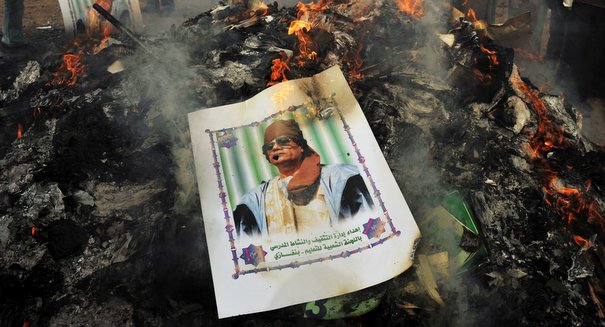
Qaddafi has released hundreds of jailed Islamist terrorists who are now poised to exploit the chaos in Libya and directly threaten the security of both Libya and the United States.
Islamist Terrorists in LibyaDespite the international community’s choice to intervene militarily and impose a no-fly zone in Libya, the rebels and forces loyal to Muammar Qaddafi appear stuck in a stalemate. This, however, is not the only concern.
As the world debates what needs to be – and can be – done in Libya, the significant threat of terrorism is going largely unnoticed. Islamist terrorists once in custody can now exploit Libya’s internal chaos and operate with impunity, directly threatening US interests.
Because of my research on terrorists and disengagement efforts in Yemen and Saudi Arabia, the Qaddafi Foundation invited me to visit Libya last year along with a group of journalists and other researchers to learn about the country’s so-called extremist rehabilitation program.
It was a relatively simple concept. Imprisoned Islamist fighters were able to gain their freedom in exchange for recognizing the government’s legitimacy and renouncing violence.
I was at Tripoli’s notorious Abu Salim prison the day more than 200 detainees were released from prison. It was a chaotic sight to see as the prisoners simply walked out of the prison to go their separate ways and rejoin their families. There was no process for preparing prisoners for release, nothing to help reintegrate them into society, and no way to monitor their future activities or ensure that they weren’t participating in terrorist activities.
This was essentially a political choice to demobilize former fighters – not rehabilitation or reintegration. The focus was solely on ending the violence against the state, and not reducing the likelihood of future militancy. There were few signs that many former detainees had truly given up their previous beliefs.
Libyan ties to Al Qaeda
During my time in Libya, I met with the emir, spiritual guide, and military commander of the Libyan Islamic Fighting Group (LIFG), a jihadi group that waged a violent insurgency in Libya during the late 1990s and tried to assassinate Mr. Qaddafi several times. The network had been the greatest single challenge to the Qaddafi regime up until the uprising began a few months ago.
The LIFG was largely made up of veterans of the war against the Soviet Union in Afghanistan, some of whom were reportedly close to Osama bin Laden. The group reportedly trained more than a thousand Libyan nationals in Afghan training camps before 9/11 and the group was often thought of as the most lethal Islamist group in North Africa. Some members were tied directly to Al Qaeda, but others chose instead to deal solely with the Islamist fight against Qaddafi in Libya.
Libyans are instrumental in international terrorist networks. Only Saudis made up a bigger segment of foreigners in Iraq fighting against the American military according to one study. And there have been several notable Libyans who have served instrumental and senior leadership positions in Al Qaeda. Since the Libyan uprising began, there has been an unprecedented flurry of messages from Al Qaeda in support of their bid to bring down the hated Qaddafi regime.
Qaddafi's half-baked release of militant Islamists
With this reality, Qaddafi’s ill-conceived and half-baked release of Islamist fighters over the past couple years is now a major concern for the international community. Hundreds of Islamist fighters who were recently in jail have been released in the past couple of years as beneficiaries of Libya’s haphazard rehabilitation program and this includes committed militants, many of whom have previously participated in violence.
The number of once-jailed Islamists at-large is even higher as the regime unwisely released more prisoners this year in a vain attempt to quell the uprising before it took hold – and more have escaped from prison as fighting broke out. Militant Islamists freed by Qaddafi and those who escaped from prison are now operating amid a raging civil war. There is now little – and rapidly evaporating – state control over a space that has a great deal of small arms and under-guarded stocks of chemical warfare agents.
Who makes up Libyan opposition?
Where are these Islamists now? And what are they doing? These are the questions that Washington must find answers to immediately. While there’s no doubt that not all of the Islamists who were released are a threat to the United States, there needs to be better information shared about who was let out and why they were originally put in prison.
We know next to nothing about the composition of Libya’s opposition. Over the last few weeks, a number of media stories have reported on Islamist extremists fighting alongside the rebels. European newspapers have even quoted Libyan rebel commanders as stating that some of their fighters have links to Al Qaeda, including ones who have allegedly fought against Western forces in Afghanistan.
Very clearly, such elements of the opposition do not share long-term US goals in Libya and present a lurking danger for the US as we get further enmeshed in the future of the country.
Risk is clear: Washington needs to act
As Libya descends deeper into chaos, the risk stemming from Islamist fighters on the loose goes up: Violent extremists find fertile ground in weak and failing states for planning terrorist attacks abroad. Even if Qaddafi manages to cling to power, the issue of Islamists working at large in Libya will still be a major problem, and the United States can’t take its eyes off this threat. We must work now to stanch this little seen danger.
Washington needs to do everything in its power to ensure that any future Libyan government is a partner in fighting terrorism. And thinking beyond Libya, the Obama administration should do more to support, finance, and ensure that countries abide by the world’s best practices in disengagement and rehabilitation programs for extremists. Such practices include comprehensive post-release monitoring and reintegration support, which are a far cry from Libya’s politically motivated, perilous release of Islamists who now threaten Libyan and US security.
Boucek was an associate in the Carnegie Middle East Program where his research focused on security challenges in the Arabian Peninsula and Northern Africa.
Carnegie India does not take institutional positions on public policy issues; the views represented herein are those of the author(s) and do not necessarily reflect the views of Carnegie, its staff, or its trustees.
In any defense establishment, change is an ongoing process. However, despite the best of intentions, existing bureaucracies, bound by habit and years of socialization, have their limits in implementing transformative change.
After the chill in ties between 2020 and 2024 that brought India–China relations to their lowest point in several decades, the two countries have engaged each other afresh. This paper argues that there are predominantly four imperatives guiding India’s approach to China, and they exist in an order of priority.
A partnership between India, a country of subcontinental size, and Africa, a continent of fifty-four countries, may seem asymmetric until one notes that both are home to nearly the same number of people—1.4 billion. This essay spells out the existing challenges to the partnership, its optimal potential, and the possible pathways to realize it over the next quarter-century.
This piece argues that the present Indian strategy, based on opportunistic diversification and utilization of limited strategic reserves, remains inadequate when confronting supply disruptions. It evaluates India’s options in the short, medium, and long terms.
This piece examines India’s response to U.S. sanctions and tariffs, specifically assessing the immediate market consequences, such as alterations in import costs, and the broader strategic implications for India’s energy security and foreign policy orientation.