• Research
  • About
  • Experts
Carnegie India logoCarnegie lettermark logo
AI
{
  "authors": [],
  "type": "pressRelease",
  "centerAffiliationAll": "dc",
  "centers": [
    "Carnegie Endowment for International Peace"
  ],
  "collections": [],
  "englishNewsletterAll": "ctw",
  "nonEnglishNewsletterAll": "",
  "primaryCenter": "Carnegie Endowment for International Peace",
  "programAffiliation": "russia",
  "programs": [
    "Russia and Eurasia"
  ],
  "projects": [],
  "regions": [
    "Caucasus",
    "Georgia"
  ],
  "topics": [
    "Foreign Policy"
  ]
}
REQUIRED IMAGE

REQUIRED IMAGE

Press Release

Charting a future for Georgia in uncertain times

Georgia is entering a period of political transition and will have a new constitution after parliamentary and presidential elections in 2012 and 2013. While the current government has made progress in building a functioning state, the country’s economic situation is increasingly uncertain.

Link Copied
Published on Jun 13, 2011

WASHINGTON—Georgia is entering a period of political transition and will have a new constitution after parliamentary and presidential elections in 2012 and 2013. While the current government has made progress in building a functioning state, the country’s economic situation is increasingly uncertain.

In a new report, Thomas de Waal examines the challenges facing Georgia and argues that the government must start building institutions and choose a long-term development model after years of governing in an informal and improvisational way. The governing elite has no serious domestic political opposition and risks turning Georgia into a one-party state.

Models for Georgia’s Future:

  • The “old Georgia” model: This conservative option representing the country’s traditional value system and way of doing business offers little as an economic or political model.
  • The “Singapore” model: Opening Georgia to worldwide investment enjoys support, especially from an influential libertarian group seeking greater deregulation. But with foreign investment falling, this model does little to solve problems like rural poverty and high unemployment
  • The EU model: A comprehensive free trade agreement with the European Union would offer privileged access to the EU single market in return for institutional reform. Although a painful process, this is Georgia’s best hope for long-term development.

“Georgia now faces real dilemmas whose resolution will determine how the country develops,” de Waal writes. “Greater integration with the EU will not deliver an economic miracle to Georgia, but having a European anchor would ensure greater political stability for Georgia, which in turn would benefit the economy.”

NOTES

Click here to read the full report

Thomas de Waal is a senior associate in the Russia and Eurasia Program at the Carnegie Endowment, specializing primarily in the South Caucasus region comprising Armenia, Azerbaijan, and Georgia and their breakaway territories, as well as the wider Black Sea region.

The Carnegie Russia and Eurasia Program has, since the end of the Cold War, led the field on Eurasian security, including strategic nuclear weapons and nonproliferation, development, economic and social issues, governance, and the rule of law.

Press Contact: Karly Schledwitz, +1 202 939 2233, pressoffice@ceip.org

Foreign PolicyCaucasusGeorgia

Carnegie India does not take institutional positions on public policy issues; the views represented herein are those of the author(s) and do not necessarily reflect the views of Carnegie, its staff, or its trustees.

More Work from Carnegie India

  • Article
    India–Africa Strategic Partnership: Challenges, Potential, and Possible Pathways

    A partnership between India, a country of subcontinental size, and Africa, a continent of fifty-four countries, may seem asymmetric until one notes that both are home to nearly the same number of people—1.4 billion. This essay spells out the existing challenges to the partnership, its optimal potential, and the possible pathways to realize it over the next quarter-century.

      Rajiv Bhatia

  • Commentary
    Emerging From the “Zombie State” of Trade Agreements: The India-EU FTA

    The India–EU Free Trade Agreement (FTA) is shaping up to be one of the most consequential trade negotiations, both economically and strategically. But, what’s in the agreement, what’s missing, and what will determine its success in the years ahead

      Vrinda Sahai, Nicolas Köhler-Suzuki

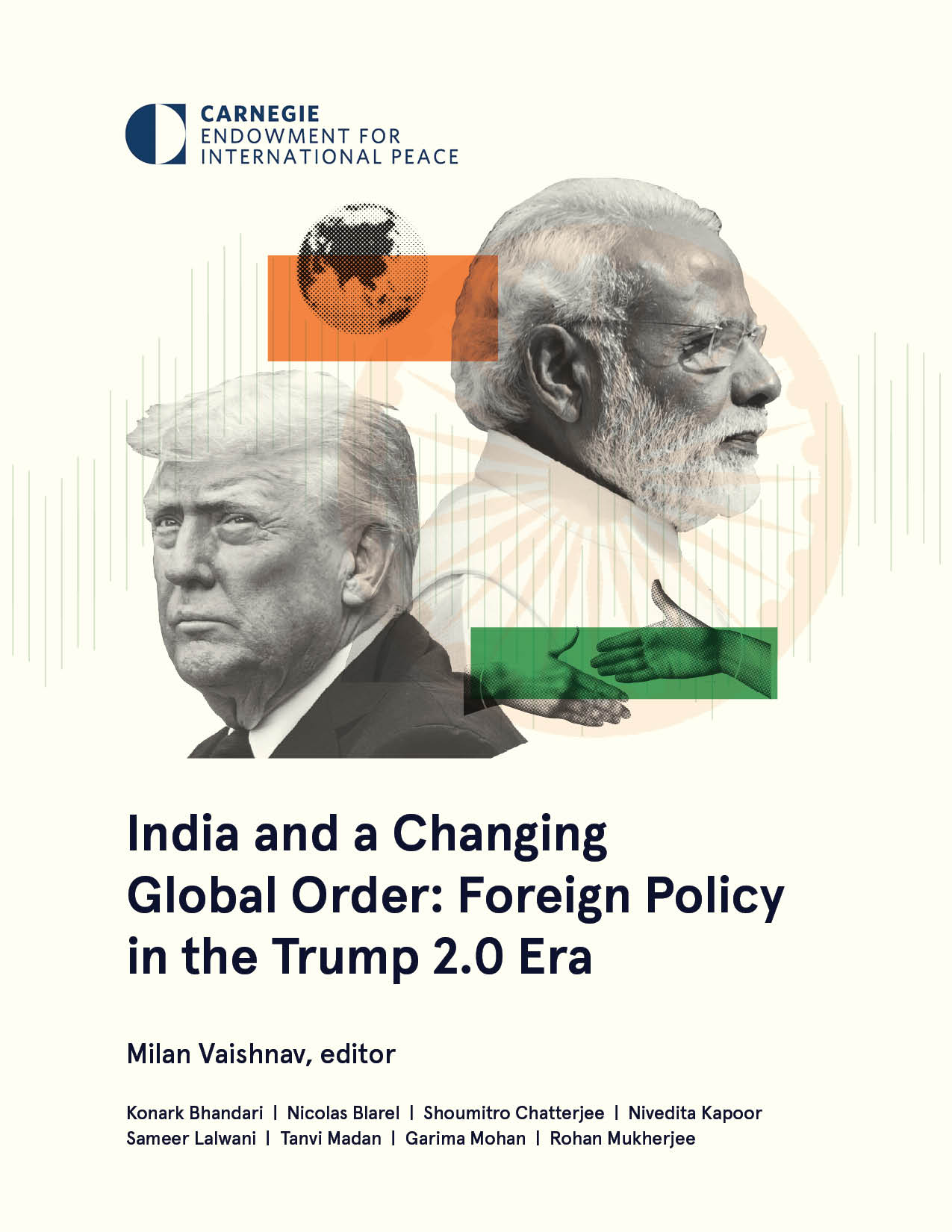
  • India and a Changing Global Order: Foreign Policy in the Trump 2.0 Era
    Research
    India and a Changing Global Order: Foreign Policy in the Trump 2.0 Era

    Trump 2.0 has unsettled India’s external environment—but has not overturned its foreign policy strategy, which continues to rely on diversification, hedging, and calibrated partnerships across a fractured order.

      • Sameer Lalwani
      • +6

      Milan Vaishnav, ed., Sameer Lalwani, Tanvi Madan, …

  • Commentary
    The Impact of U.S. Sanctions and Tariffs on India’s Russian Oil Imports

    This piece examines India’s response to U.S. sanctions and tariffs, specifically assessing the immediate market consequences, such as alterations in import costs, and the broader strategic implications for India’s energy security and foreign policy orientation.

      Vrinda Sahai

  • Commentary
    NISAR Soars While India-U.S. Tariff Tensions Simmer

    On July 30, 2025, the United States announced 25 percent tariffs on Indian goods. While diplomatic tensions simmered on the trade front, a cosmic calm prevailed at the Sriharikota launch range. Officials from NASA and ISRO were preparing to launch an engineering marvel into space—the NASA-ISRO Synthetic Aperture Radar (NISAR), marking a significant milestone in the India-U.S. bilateral partnership.

      Tejas Bharadwaj

Get more news and analysis from
Carnegie India
Carnegie India logo, white
Unit C-4, 5, 6, EdenparkShaheed Jeet Singh MargNew Delhi – 110016, IndiaPhone: 011-40078687
  • Research
  • About
  • Experts
  • Projects
  • Events
  • Contact
  • Careers
  • Privacy
  • For Media
Get more news and analysis from
Carnegie India
© 2026 Carnegie Endowment for International Peace. All rights reserved.