

In The Media
Lilia Shevtsova
{
  "authors": [
    "Lilia Shevtsova"
  ],
  "type": "legacyinthemedia",
  "centerAffiliationAll": "",
  "centers": [
    "Carnegie Endowment for International Peace",
    "Carnegie Russia Eurasia Center"
  ],
  "collections": [],
  "englishNewsletterAll": "",
  "nonEnglishNewsletterAll": "",
  "primaryCenter": "Carnegie Russia Eurasia Center",
  "programAffiliation": "",
  "programs": [],
  "projects": [],
  "regions": [
    "Caucasus",
    "Russia"
  ],
  "topics": [
    "Political Reform"
  ]
}
Source: Getty
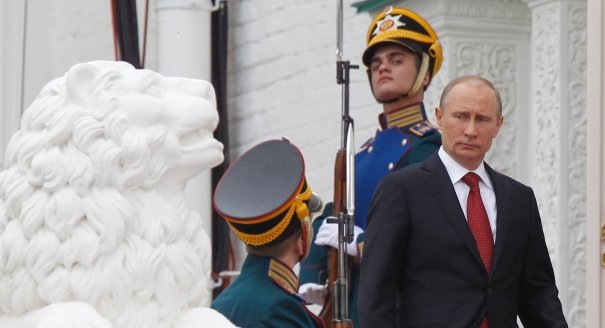
As Vladimir Putin and United Russia struggle to retain power, they are facing a new post-Soviet generation that grew up without a deeply ingrained fear of the Kremlin’s power. A confrontation between the ruling authorities and the people may be unavoidable.
Source: The Moscow Times

The fallout from the widely discredited State Duma elections is a sign that a fundamentally new situation is unfolding in the country. Society has awoken, and it is demonstrating its frustration with the authorities' relentless hold on power. The "Putin contract" — an agreement whereby voters put up with the abuses of a corrupt regime in return for stability — is falling apart. The most dynamic segments of society — Internet-savvy, educated young Russians, the intelligentsia, the middle class and residents of major cities — are stepping up to the fore. By voting against United Russia, they tried to use peaceful, democratic methods to protest Putin and his government.
What was the result? Some observers made optimistic but baseless claims that United Russia's poor showing in the elections and its need to work more closely with the other three parties in the Duma will be a boost for Russia's democracy. In reality, the elections brought little if any change. United Russia manipulated the results to win a simple majority in the Duma so that it could continue rubber-stamping legislation handed down by the Kremlin.
The only way that A Just Russia can meet the expectations of the many protest voters who supported it would be to openly speak out against the Putin regime. But A Just Russia has already demonstrated that it is ready to play the Kremlin chess game.
Russia will face a new trial when Putin attempts to prolong his rule in the March presidential election. It will be important for Putin to win during the first round of voting. Otherwise, he risks losing his ability to control his own team along with the country. Since Putin has little chance of winning in the first round of a competitive and truly fair election, the Kremlin is looking for ways to ensure victory for the leader of a party that a significant percentage — perhaps the majority — of voters rejected in the Duma elections.
What must Putin do to win at least a third of the vote in March without having to resort to mass falsification? As the Kremlin's soft approach to Saturday's rally on Bolotnaya Ploshchad demonstrates, it decided to imitate dialogue with the people, pretending that it was listening to their demands. But if Putin held truly free Duma elections, it would have jeopardized his victory in the March election. Moreover, dumping United Russia in favor of the All-Russia People's Front can save Putin only if he sacrifices his bureaucracy, turning it into a scapegoat for the country's ills. But the bureaucracy is Putin's key basis of support, and he can hardly afford to demonize it.
There is only one thing left to try: create a state of emergency in Russia that would either force people to vote for him as the lesser of two evils. This would make it a lot easier to manipulate the election results. Or Putin will have to cancel the election entirely. The Kremlin team must be desperately searching for a pretext that would leave Russian voters with no option but to agree to another six years of Putin's rule. And they will not let any moral considerations stand in their way. After all, Putin's team has every intention of remaining in power as well.
The way the authorities conducted the Duma elections was essentially a trial run for those in March. It is clear that the presidential campaign will be even dirtier. This will be the next step toward delegitimizing the government and discrediting elections themselves as a democratic mechanism for ensuring the transition of authority. Unfortunately, Russian society will be left with only one way to accomplish that transition — by taking to the streets in protest. This method for getting rid of leaders who have outworn their welcome has always been fraught with unpredictable consequences — especially in Russia. But the Kremlin is not leaving the people any other choice.
How will the authorities respond? One place to look is the 33 percent increase in funds for siloviki agencies over the next two years and a simultaneous 10 percent decrease in spending for the economy, education and health care. That should silence everyone who claim that we may see a new "Putin 2.0" after his re-election in 2012, one dedicated to reforms and liberalization. The only change we are likely to see from Putin, however, is a shift in a more authoritarian direction.
Putin is not extending his rule to implement reforms that would only undermine his influence and authority. He is returning to the Kremlin to preserve the status quo. But he has no way to accomplish that except through outright intimidation, as evidenced by the excessive use of force in detaining and beating back protestors on Dec. 5 and 6. The authorities are trying to scare the people. But now they are dealing with a new post-Soviet generation that grew up without a deeply ingrained fear of their leaders or an instinctive impulse to obey them.
This suggests that a confrontation between the ruling authorities and the people might be nearly impossible to avoid. Can the pragmatists within the government unite in time to avoid this confrontation? Or are they already too late?
Nobody should be misled by the relative calm despite the protests and broader discontent with the ruling regime. Nobody should be misled by the Kremlin decision not to provoke the protesters. The authorities have already lost Moscow and St. Petersburg, the two cities from which epic changes have always begun in Russia. Once 500,000 people take to the streets, the floodgates of change will finally be flung wide open.
A new era has begun.

Former Senior Associate, Russian Domestic Politics and Political Institutions Program, Moscow Center
Shevtsova chaired the Russian Domestic Politics and Political Institutions Program at the Carnegie Moscow Center, dividing her time between Carnegie’s offices in Washington, DC, and Moscow. She had been with Carnegie since 1995.
Recent Work
Lilia Shevtsova
Lilia Shevtsova
Carnegie India does not take institutional positions on public policy issues; the views represented herein are those of the author(s) and do not necessarily reflect the views of Carnegie, its staff, or its trustees.

This piece argues that India’s central challenge is not managing a single flashpoint but resolving the underlying tension between expansion and institutional coherency of the BRICS grouping.

Vrinda Sahai
As India’s economy recovers from the coronavirus pandemic, Indian businesses need efficient financial structures to regain their ground. Key reforms to India’s Insolvency and Bankruptcy Code could fill these gaps.

Anirudh Burman
Access to cross-border data is an integral piece of the law enforcement puzzle. India is well placed to lead the discussions on international data agreements subject to undertaking necessary surveillance reforms.

Smriti Parsheera, Prateek Jha
After the coronavirus pandemic wanes, how will China’s reorientation of the Belt and Road Initiative to address global health concerns influence its relationships with South Asian countries?
Deep Pal, Rahul Bhatia
Early in the outbreak, government researchers forecast several high-risk scenarios that were downplayed or ignored in public messaging.
Gautam I. Menon