{
  "authors": [
    "Nathan J. Brown",
    "Nathan J. Brown"
  ],
  "type": "legacyinthemedia",
  "centerAffiliationAll": "dc",
  "centers": [
    "Carnegie Endowment for International Peace",
    "Malcolm H. Kerr Carnegie Middle East Center"
  ],
  "collections": [
    "Arab Awakening"
  ],
  "englishNewsletterAll": "menaTransitions",
  "nonEnglishNewsletterAll": "",
  "primaryCenter": "Carnegie Endowment for International Peace",
  "programAffiliation": "MEP",
  "programs": [
    "Middle East"
  ],
  "projects": [],
  "regions": [
    "North Africa",
    "Egypt"
  ],
  "topics": [
    "Political Reform"
  ]
}
Source: Getty
In The Media
The Evolution within the Revolution
A number of longer-term trends engendered by the revolution that may gradually make the Egyptian state of the future very different from the one of the past half century.
Nearly two decades ago, I entered an Egyptian embassy in an Arab state in order to request a visa. I was brought to the consular officer who immediately noticed that I seemed startled by her appearance. "You're surprised at this?" she asked, gesturing to her hijab. Somewhat embarrassed, I indicated that I had never met an Egyptian diplomat who was covered. She acknowledged that there were very few but also spoke of how she had been pleasantly surprised not simply that she was accepted as a diplomat but that some senior people in the ministry were supportive and protective.
Her story was in one sense a bit odd: hijabs have become extremely widespread in Egyptian society, but she was speaking as if she was operating in alien terrain in the diplomatic corps. And in a sense she was. To this day, it is uncommon to find covered women in specific places in Egyptian society; the long beard characteristic of Salafis is similarly all but unknown in sensitive state institutions like the security establishment and the judiciary. The reasons are clear -- security-vetting blocks the entrance of those suspected of Islamist inclinations and those at the top positions of authority in various institutions often work to protect them as enclaves for their part of Egyptian society.
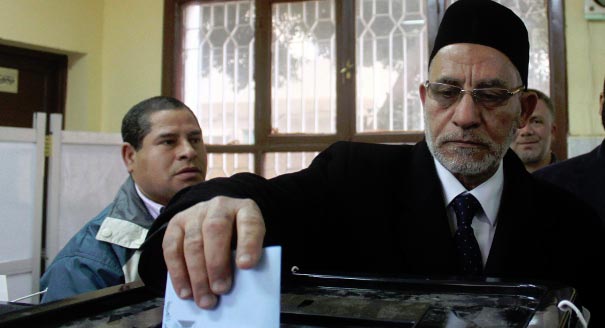
Or at least that is how things have worked to date. But they may slowly change. In Egypt over the past year, most political attention has focused understandably on the daily drama: demonstrations, revolution, referendum, and elections dominate the headlines. And these things bear careful watching. But they should not obscure some longer-term evolutionary trends engendered by the revolution that may gradually make the Egyptian state a very different animal than it has been for the past half century.
The first trend of significance may be the erosion of the walls imposed by the security apparatus around certain institutions. The Egypt of the past half century has been one in which the security establishment exercised control over civilian life. There are now powerful forces at work that seek a reversal so that there will be civilian oversight of the security establishment. This may be a Herculean task but it is not completely a Sisyphean one. An attainable goal over the short term may be a relaxation of security vetting for sensitive state institutions. With Salafis occupying a considerable portion of parliamentary seats and with a leading member of the Muslim Brotherhood chairing the parliament's foreign affairs committee it may be a bit more difficult to block a bright and able young graduate with Islamist inclinations from the diplomatic corps, the judiciary, or even the officer corps. There will be no sudden change -- the geriatric leadership of many Egyptian state institutions will neither step aside quickly nor allow the floodgates to open immediately -- but the slow transformation of state institutions to be far more diverse is a likely result even if it occurs at a glacial pace.
The second trend is one that I have referred to in a recent piece on the Egyptian judiciary as the "Balkanization" of the Egyptian state. Egypt has been a state of strong institutions for a considerable time, but those institutions have been controlled in a variety of ways by the presidency. Egyptians have become so accustomed to this arrangement that they often describe it as a timeless part of their heritage, referring to their Pharonic past or the image of pyramids to describe the nature of political authority in the country. My own historically-minded sensibilities force me to insist that the period of institution building took place in the 19th and 20th centuries, and the era of presidential domination began in the early 1950s. But these features still must seem eternal to those who live under them.
Yet the institutions brought long ago under presidential domination are now striving hard to wriggle free. Two of the major tools they seek to use to achieve independence are the ability to select their own leaders from their own ranks (rather than have the president dominate the institution through a hand-picked sycophant) and the writing of a law that will give them full institutional autonomy from other parts of the Egyptian state. The leading Islamic institution, Al-Azhar, has already achieved some of that goal; labor unions, the judiciary, professional associations, and the universities will be working to shove their way to the agenda of the newly-elected parliament to attain something similar. In a sense, the military is seeking the same thing: to be able to run its own affairs, administer its own budget, make its own security policy, and select its own leaders with only minimal civilian oversight. Many of these causes (such as the judiciary's claim on independence) are popular; some (such as the military's) are far more controversial but still backed by powerful political forces.
The odd result may be that just as Egyptians are beginning to realize truly democratic parliamentary and presidential elections, those positions with strong democratic credentials may be losing some of their authority to the forces of bureaucratic autonomy and professional expertise.
The two trends -- a decline of security-vetting but more institutional autonomy -- may work against each other, at least over the short term. Allowing each institution to be self-governing and self-perpetuating should make it easier over the short term for it to police its own ranks and preserve whatever homogeneity it now enjoys. But even if the trends do not always point in the same direction over the short term, they both augur for a less coherent and controllable state apparatus. And over the long run, even Balkanization is unlikely to allow each institution to exclude completely wide segments of the society.
Two decades from now, I should therefore not be surprised if I enter an Egyptian embassy again and meet a consular officer with a very long beard who explains -- in response to my surprised look -- that Salafis are now common in the diplomatic corps and that he considers himself quite lucky, because he knows people in high places in the ministry he was able to avoid being sent to Paris but managed to snag the coveted Riyadh posting instead.
Nathan J. Brown, a professor of political science and international affairs at George Washington University, is a distinguished scholar and author of nine books on Arab politics and governance, as well as editor of five books.
Nathan J. Brown, a professor of political science and international affairs at George Washington University, is a distinguished scholar and author of nine books on Arab politics and governance, as well as editor of five books.
Carnegie India does not take institutional positions on public policy issues; the views represented herein are those of the author(s) and do not necessarily reflect the views of Carnegie, its staff, or its trustees.
A partnership between India, a country of subcontinental size, and Africa, a continent of fifty-four countries, may seem asymmetric until one notes that both are home to nearly the same number of people—1.4 billion. This essay spells out the existing challenges to the partnership, its optimal potential, and the possible pathways to realize it over the next quarter-century.
As India’s economy recovers from the coronavirus pandemic, Indian businesses need efficient financial structures to regain their ground. Key reforms to India’s Insolvency and Bankruptcy Code could fill these gaps.
Access to cross-border data is an integral piece of the law enforcement puzzle. India is well placed to lead the discussions on international data agreements subject to undertaking necessary surveillance reforms.
After the coronavirus pandemic wanes, how will China’s reorientation of the Belt and Road Initiative to address global health concerns influence its relationships with South Asian countries?