

Research
- +10
Rosa Balfour, Frances Z. Brown, Yasmine Farouk, …
{
  "authors": [
    "Moisés Naím"
  ],
  "type": "legacyinthemedia",
  "centerAffiliationAll": "dc",
  "centers": [
    "Carnegie Endowment for International Peace"
  ],
  "collections": [],
  "englishNewsletterAll": "ctw",
  "nonEnglishNewsletterAll": "",
  "primaryCenter": "Carnegie Endowment for International Peace",
  "programAffiliation": "SAP",
  "programs": [
    "South Asia"
  ],
  "projects": [],
  "regions": [
    "North America",
    "United States",
    "South Asia",
    "Afghanistan"
  ],
  "topics": [
    "Security",
    "Military",
    "Foreign Policy"
  ]
}
Source: Getty
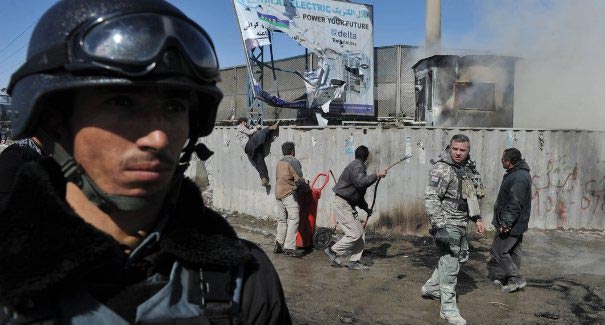
The fact that the Afghanistan war is not going well is no surprise. The surprise is that, according to Lt. Col. Davis, it is going even worse.
Source: El País

What are the implications of all this? That the Afghanistan war is going badly is no surprise. The surprise is that, according to Davis, it is going even worse than we thought, and much worse than we are told in the far from encouraging reports from top American officers. Naturally, the other surprise is that an officer on active service has decided to run the risk of breaking the rules, disseminating his devastating evaluation of the situation, and denouncing what he considers the mendacity of top Pentagon officials. Even more surprising is the fact that Davis has not yet been punished for his actions. A Pentagon spokesman hastily denied an NBC report that an investigation had been opened against Davis.
One possibility is that the colonel enjoys the support and protection of a group of senior military officers, and is in some way acting as their spokesman, something that Davis stridently denies. Another possibility is that the Pentagon fears that a reprisal against Davis might spark a wave of protest, and only serve to boost the visibility and influence of his views.
Lastly, another surprise is that Colonel Davis does not believe that the US ought to withdraw its troops from Afghanistan in 2014, as President Obama has promised. For Davis, the strategy ought to be to leave strong military bastions located at strategic points, while changing the nature of the mission. The troops, he says, ought to concern themselves mainly with capturing — or killing — terrorists that may be using the country as a base of operations. This is a crude way of saying that there is no hope of Afghanistan developing into a peaceful, prosperous and democratic nation.

Distinguished Fellow
Moisés Naím is a distinguished fellow at the Carnegie Endowment for International Peace, a best-selling author, and an internationally syndicated columnist.
Recent Work



Rosa Balfour, Frances Z. Brown, Yasmine Farouk, …
Moisés Naím
Carnegie India does not take institutional positions on public policy issues; the views represented herein are those of the author(s) and do not necessarily reflect the views of Carnegie, its staff, or its trustees.

In any defense establishment, change is an ongoing process. However, despite the best of intentions, existing bureaucracies, bound by habit and years of socialization, have their limits in implementing transformative change.

Anit Mukherjee

How is AI reshaping space security, creating governance challenges, and where does international diplomacy stand today?


Tejas Bharadwaj, Almudena Azcárate Ortega

After the chill in ties between 2020 and 2024 that brought India–China relations to their lowest point in several decades, the two countries have engaged each other afresh. This paper argues that there are predominantly four imperatives guiding India’s approach to China, and they exist in an order of priority.

Saheb Singh Chadha

This piece argues that India’s central challenge is not managing a single flashpoint but resolving the underlying tension between expansion and institutional coherency of the BRICS grouping.

Vrinda Sahai

A partnership between India, a country of subcontinental size, and Africa, a continent of fifty-four countries, may seem asymmetric until one notes that both are home to nearly the same number of people—1.4 billion. This essay spells out the existing challenges to the partnership, its optimal potential, and the possible pathways to realize it over the next quarter-century.

Rajiv Bhatia