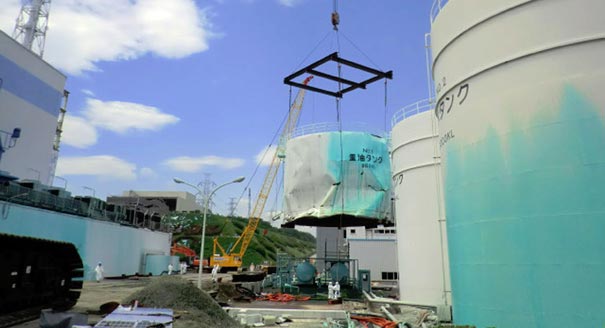
On March 11, 2011, we watched in horror as a triple tragedy -- earthquake, tsunami and nuclear meltdown --befell Japan.
One year later, Fukushima Daiichi Nuclear Power Station may be in ''cold shutdown'' but the effects of the accident there are still being felt on a daily basis.
In contrast to devastated towns and villages elsewhere, rebuilding of the communities around the plant has barely begun. Inevitably, an unprecedented number of Japanese are asking whether nuclear power should have any place in their country's energy policy.
Whatever Japan decides, however, it needs a much more robust system of nuclear regulation. (After all, even if Japan were to phase out nuclear energy tomorrow -- and that hardly seems possible -- the management of nuclear waste must be overseen.)
Since the accident, criticism of the Nuclear and Industrial Safety Agency (NISA) has focused on its lack of independence from the Ministry of Economy, Trade and Industry, which is responsible for promoting nuclear power. Quite rightly, NISA is now being reconstituted under the Ministry of the Environment. However, regulation in Japan has other problems that must be addressed.
As well as lacking independence from government, NISA also lacked independence from industry. Amakudari (''descent from heaven''), the practice of giving senior regulators jobs at the helm of industry, has been stopped. However, amaagari (''ascent to heaven''), in which industry safety experts are employed by regulators, still continues.
Industry safety experts certainly have an important -- indeed irreplaceable -- role in regulation. However, NISA and its technical support organization, the Japan Nuclear Energy Safety Organization, have probably become over-reliant on them. Fostering a new generation of independent experts is a key challenge -- and one that cannot be solved by legislation alone.
Perhaps partly because of its over-reliance on industry expertise, NISA showed a lack of imagination about potential threats to nuclear power plants.
Its strong focus on seismic safety appears to have come at the expense of considering other risks. We have no doubt that Japan's new regulator will take tsunami safety very seriously. However, there are many other potential threats, ranging from extreme meteorological effects resulting from climate change to terrorism.
To properly consider all these risks, Japan's nuclear regulator must engage with experts from many different fields and move beyond the relative insularity that has been a hallmark of much of the Japanese nuclear sector in the past.
NISA's most fundamental failing was, however, that it appeared to believe that a major accident was simply not possible. Perhaps only this can explain why it did not issue regulations covering the long-term loss of electricity in a nuclear power plant or insist on the development of robust procedures for managing a severe accident.
In the years to come, a major challenge for the new regulator will be avoiding complacency. Leadership will be required from within -- as will public scrutiny from without. Ultimately, the best way to avoid a repeat of Fukushima is to remember that one is always possible.
Hibbs is a Germany-based nonresident senior fellow in Carnegie’s Nuclear Policy Program. His areas of expertise are nuclear verification and safeguards, multilateral nuclear trade policy, international nuclear cooperation, and nonproliferation arrangements.
Carnegie India does not take institutional positions on public policy issues; the views represented herein are those of the author(s) and do not necessarily reflect the views of Carnegie, its staff, or its trustees.
In any defense establishment, change is an ongoing process. However, despite the best of intentions, existing bureaucracies, bound by habit and years of socialization, have their limits in implementing transformative change.
After the chill in ties between 2020 and 2024 that brought India–China relations to their lowest point in several decades, the two countries have engaged each other afresh. This paper argues that there are predominantly four imperatives guiding India’s approach to China, and they exist in an order of priority.
This piece argues that the present Indian strategy, based on opportunistic diversification and utilization of limited strategic reserves, remains inadequate when confronting supply disruptions. It evaluates India’s options in the short, medium, and long terms.
This piece examines India’s response to U.S. sanctions and tariffs, specifically assessing the immediate market consequences, such as alterations in import costs, and the broader strategic implications for India’s energy security and foreign policy orientation.
The India-Pakistan conflict that played out between May 6 and May 10, 2025, offers several military lessons. This article presents key takeaways from Operation Sindoor and breaks down how India’s preparations shaped the outcome and what more is needed to strengthen future readiness.