

Commentary
Dmitri Trenin
{
  "authors": [
    "Dmitri Trenin"
  ],
  "type": "legacyinthemedia",
  "centerAffiliationAll": "",
  "centers": [
    "Carnegie Endowment for International Peace",
    "Carnegie Russia Eurasia Center"
  ],
  "collections": [],
  "englishNewsletterAll": "",
  "nonEnglishNewsletterAll": "",
  "primaryCenter": "Carnegie Russia Eurasia Center",
  "programAffiliation": "",
  "programs": [],
  "projects": [],
  "regions": [
    "Caucasus",
    "Russia"
  ],
  "topics": [
    "Political Reform",
    "Foreign Policy"
  ]
}
Source: Getty
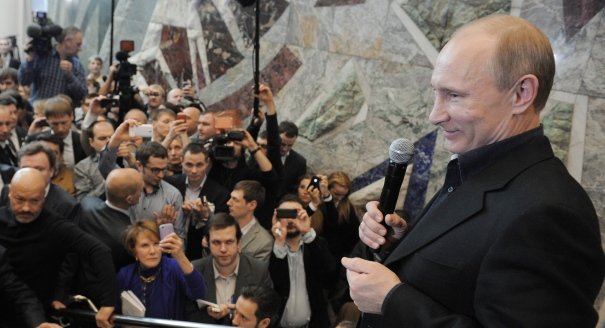
While Vladimir Putin’s election to the presidency should not change the course of Russia’s foreign policy, his fate will largely depend on his government’s socio-economic and political performance.
Source: New York Times

As president, his fate will largely depend on his government’s socio-economic and political performance. Thus, he will not want trouble with the United States. He can't be expected to offer Washington too many concessions on contentious issues, but he can be relied on to honor Russia’s commitments under the Afghanistan transit agreement.
There is also some room for cooperation on Syria and Iran, as long as the United States does not resort to force against Damascus and Tehran. In an even more positive vein, Putin may open up Russia, including its energy sector, to U.S. investments. If that happens, the U.S.-Russian relationship will begin maturing beyond the traditional politico-military sphere.There are risks, however. Putin’s victory at the polls is not being seen as either free or fair by many in the Russian opposition, including the protest movement. This has a bearing on the future president’s legitimacy, both at home and abroad. If the U.S. public is led to believe that Putin is, in fact, less than a fully legitimate head of Russia, this will constrain the Obama administration’s outreach to him, and to his government. This, in turn, would only confirm Putin’s belief that the United States is planning a regime change in Russia, and the reset will be reset.
Should — God forbid — the so far peaceful protests in Moscow degenerate into violent clashes, the relationship would deteriorate way beyond where it was in the wake of the 2008 Russia-Georgia war. This will not be a good thing for Russia, for its modernization agenda will be in jeopardy. Isolated in the West, Moscow would need to look to China for secondhand technology.
Former Director, Carnegie Moscow Center
Trenin was director of the Carnegie Moscow Center from 2008 to early 2022.
Recent Work
Dmitri Trenin
Dmitri Trenin
Carnegie India does not take institutional positions on public policy issues; the views represented herein are those of the author(s) and do not necessarily reflect the views of Carnegie, its staff, or its trustees.

After the chill in ties between 2020 and 2024 that brought India–China relations to their lowest point in several decades, the two countries have engaged each other afresh. This paper argues that there are predominantly four imperatives guiding India’s approach to China, and they exist in an order of priority.

Saheb Singh Chadha

This piece argues that India’s central challenge is not managing a single flashpoint but resolving the underlying tension between expansion and institutional coherency of the BRICS grouping.

Vrinda Sahai

A partnership between India, a country of subcontinental size, and Africa, a continent of fifty-four countries, may seem asymmetric until one notes that both are home to nearly the same number of people—1.4 billion. This essay spells out the existing challenges to the partnership, its optimal potential, and the possible pathways to realize it over the next quarter-century.

Rajiv Bhatia

The India–EU Free Trade Agreement (FTA) is shaping up to be one of the most consequential trade negotiations, both economically and strategically. But, what’s in the agreement, what’s missing, and what will determine its success in the years ahead
Vrinda Sahai, Nicolas Köhler-Suzuki
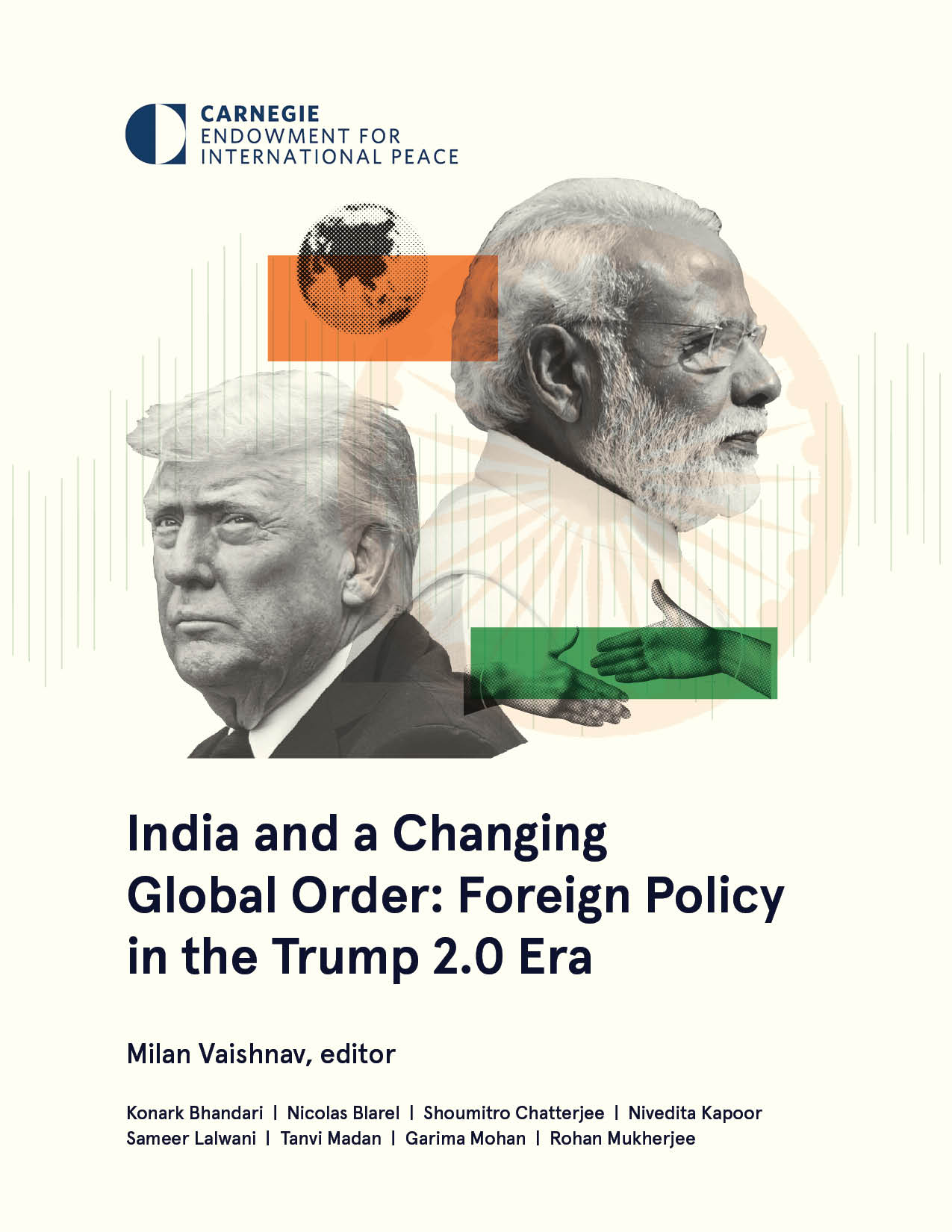
Trump 2.0 has unsettled India’s external environment—but has not overturned its foreign policy strategy, which continues to rely on diversification, hedging, and calibrated partnerships across a fractured order.

Milan Vaishnav, ed., Sameer Lalwani, Tanvi Madan, …