

Paper
George Perkovich
{
  "authors": [
    "George Perkovich"
  ],
  "type": "legacyinthemedia",
  "centerAffiliationAll": "dc",
  "centers": [
    "Carnegie Endowment for International Peace"
  ],
  "collections": [
    "U.S. Nuclear Policy"
  ],
  "englishNewsletterAll": "ctw",
  "nonEnglishNewsletterAll": "",
  "primaryCenter": "Carnegie Endowment for International Peace",
  "programAffiliation": "NPP",
  "programs": [
    "Nuclear Policy"
  ],
  "projects": [],
  "regions": [
    "North America",
    "United States",
    "Middle East",
    "Iran",
    "Western Europe"
  ],
  "topics": [
    "Nuclear Policy"
  ]
}
Source: Getty
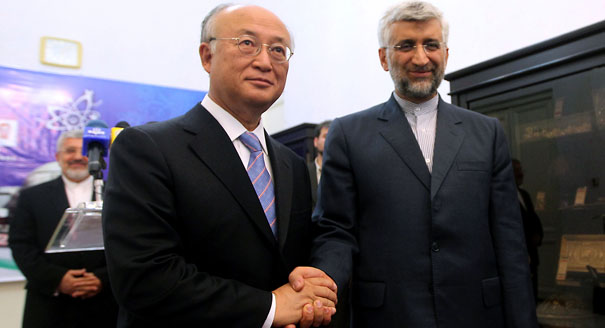
The head of the U.N.'s nuclear agency says he is close to signing an agreement with Iran which would allow inspectors to asses Iran's nuclear activities.
Source: NPR's All Things Considered

PETER KENYON: There has been some of the usual hard-line bluster in the run-up to the Baghdad talks. Senior Iranian officials are insisting they will never give up their inalienable rights, which include the right to enrich their own uranium. Israeli Prime Minister Benjamin Netanyahu, meanwhile, dismissed the talks as another opportunity for Iran, in his words, "to deceive and delay, as North Korea did." But there's also a new strain of optimism boosted by business-like preparatory meetings and signals that Tehran is prepared to move beyond rhetoric and deal with substance.
GEORGE PERKOVICH: Well, I think the chances of productive diplomacy are better than they've been probably in the last seven years.KENYON: George Perkovich directs the nuclear program at the Carnegie Endowment for International Peace in Washington. He says there are a number of reasons for the positive trend, not least the painful economic sanctions that have been wearing down the Iranian economy, and the threat of even more punitive oil sanctions due to kick in July 1st.
PERKOVICH: Sanctions have started to have a significant impact in Iran. And also, the Iranians have accomplished enough in the development of their nuclear capability that they might be able to say, OK, we've demonstrated a capability, let's make a deal.
KENYON: The delicate question now is whether this more positive atmosphere can lead to confidence-building steps, and then toward a diplomatic agreement to diffuse the crisis. The likely first step will involve Iran's recent focus on enriching uranium to 20 percent, which is much closer to weapons grade than the 3 to 5 percent needed for nuclear energy. There is a medical use for 20 percent enriched uranium, and the West has offered in the past to give Iran that type of fuel if it stops enriching its own. Mark Fitzpatrick, with the non-proliferation program at the London-based International Institute for Strategic Studies, says from the international point of view, the most that could be hoped for out of the next few discussions is a set of three agreements.
MARK FITZPATRICK: One is the suspension of 20 percent enrichment. Two, doing something with the stockpile, a hundred kilograms or so, of 20 percent enriched uranium. And three, stopping the work at the underground facility at Fordow.
KENYON: Fordow is where Iran built a nuclear facility deep inside a mountain near the holy city of Qom. That's where the 20 percent enrichment is taking place. Fitzpatrick argues that if Iran stops enriching to 20 percent, it will be doing nothing at Fordow, so why keep it open? But for Iran, the security of its nuclear program is a sensitive issue. Tehran's fears of a potential military strike have been exacerbated by the assassination of several of its nuclear scientists. Overcoming those fears, analysts say, will take time and the kind of effort neither side has seemed willing to put forth to date.
Analyst George Perkovich at Carnegie says for Iran, avoiding the July 1st EU oil sanctions is crucial. And if the Baghdad meeting and a hoped for next meeting in June don't lead to that, the atmosphere could quickly sour.
PERKOVICH: If those sanctions kick in, why would Iran make a deal now? They won't. I think they'd just say, well, hell, if you're going to punish us in any case, then why should I concede anything? So agreeing to suspend those sanctions will be a very important factor for Iran.
KENYON: Officials say that kind of concession on sanctions is very unlikely to come this week in Baghdad. But if Iran continues to move toward a possible agreement, at some point, the West will have to not only drop future sanctions but ease existing ones. And analysts say for Washington that won't be easy, because Congress has written some of the unilateral Iran sanctions in such a way that they will be extremely difficult to undo.

Japan Chair for a World Without Nuclear Weapons, Senior Fellow
George Perkovich is the Japan Chair for a World Without Nuclear Weapons and a senior fellow in the Carnegie Endowment for International Peace’s Nuclear Policy Program. He works primarily on nuclear deterrence, nonproliferation, and disarmament issues, and is leading a study on nuclear signaling in the 21st century.
Recent Work
George Perkovich
George Perkovich
Carnegie India does not take institutional positions on public policy issues; the views represented herein are those of the author(s) and do not necessarily reflect the views of Carnegie, its staff, or its trustees.

How is AI reshaping space security, creating governance challenges, and where does international diplomacy stand today?


Tejas Bharadwaj, Almudena Azcárate Ortega

The U.S.–India semiconductor cooperation story is well-stocked with top-level strategic intent. What remains unresolved, however, are some underlying challenges that will determine whether the cooperation actually functions. Three such friction points stand out.

Shruti Mittal

India and the United States are close to concluding a Reciprocal Defense Procurement Agreement (RDPA) that will allow firms from the two countries to sell to each other’s defense establishments more easily. While this may not remedy the specific grievances both sides may have regarding larger bilateral issues, an RDPA could restore some momentum, following the trade deal announcement.

Konark Bhandari

On the last day of the India AI Impact Summit, India signed Pax Silica, a U.S.-led declaration seemingly focused on semiconductors. While India’s accession to the same was not entirely unforeseen, becoming a signatory nation this quickly was not on the cards either.
Konark Bhandari

This piece examines India’s response to U.S. sanctions and tariffs, specifically assessing the immediate market consequences, such as alterations in import costs, and the broader strategic implications for India’s energy security and foreign policy orientation.

Vrinda Sahai