

Commentary
Dmitri Trenin
{
  "authors": [
    "Dmitri Trenin"
  ],
  "type": "legacyinthemedia",
  "centerAffiliationAll": "",
  "centers": [
    "Carnegie Endowment for International Peace",
    "Carnegie China",
    "Carnegie Russia Eurasia Center"
  ],
  "collections": [
    "China’s Foreign Relations",
    "China and the Developing World",
    "U.S.-China Relations"
  ],
  "englishNewsletterAll": "",
  "nonEnglishNewsletterAll": "",
  "primaryCenter": "Carnegie Russia Eurasia Center",
  "programAffiliation": "",
  "programs": [],
  "projects": [
    "Eurasia in Transition"
  ],
  "regions": [],
  "topics": [
    "Security"
  ]
}
Source: Getty
If a solution to the Syria problem is not found soon, not only will Syria descend into wholesale carnage, but the prospects for future conflict management in the world will become much bleaker.
Source: China Daily

The Syrian opposition leaders who traveled to Moscow in early July immediately voiced their disappointment that Russia was not ready to turn against the government of President Bashar al-Assad. Russia then tabled a draft resolution at the UN Security Council that failed to satisfy the US and its allies, and the US-proposed counter-draft, complete with new condemnations and sanctions against the Syrian authorities, was criticized by Moscow and Beijing for being unbalanced. A new round of international controversy makes the prospect of a full-scale civil war in Syria ever more likely.
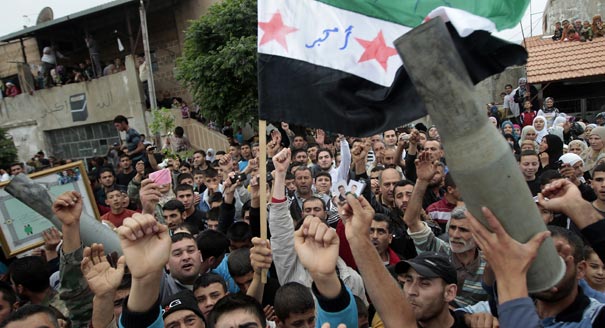
This argument has been borne out by developments on the ground in Syria. The reports of a new massacre of innocent civilians, this time in the village of Treimsa, are particularly disturbing. Like the previous one at Houla, this despicable act of violence has been blamed on forces loyal to Assad, but no independent confirmation has been possible. The bodies, wrapped in blankets and shown on television around the world, have mobilized popular support in the West for some resolute action to stop the bloodshed.The Barack Obama administration in the US, defending its control of the White House in the November presidential elections, has been criticized by the Republicans for not launching a military intervention on humanitarian grounds and accused of using Russia's intransigence as a pretext for doing nothing. The Republican critics, of course, know fully well that intervening in Syria is a very different proposition from last year's experience in Libya, but in an election year they are only too happy to attack the incumbent president as indecisive. In what is shaping up as a surprisingly close presidential race, Obama can hardly afford to ignore Syria. He has to act.
But action, for Obama, is unlikely to be a military operation. A political transition would be much more to his liking. However, a successful transition in Syria requires negotiating with Assad, not just pressuring him into retirement. It also requires consolidating the highly fractious Syrian opposition and taking its representatives to the bargaining table with the government in Damascus.
A political transition, finally, requires policy coordination among the world's leading powers at the UN Security Council and cooperation with the regional heavyweights, such as Iran. The last time it was done, in Yemen, the negotiating process had more than the usual share of ups and downs, and lasted many months. Yet, although for many, the result has been a disappointment, a civil war has been averted.
The transition in Yemen, however, was all at the hands of the US and its principal ally in the Arab world, Saudi Arabia. The rest of the Arab states, along with China and Russia, accepted the results of the settlement worked out by the Yemeni parties and the US-Saudi peacemakers. The only thing that makes the Syrian situation similar to the one in Yemen is that, at the present stage, a negotiated solution is still possible, although it is becoming increasingly more remote.
The logic of war, in Syria, is becoming evidently more powerful than the logic of peace. The Syrian opposition talks about a revolution to topple the regime, while President Assad is maneuvering to stay in power, whatever the cost. As the civil war broadens its scope and claims more lives, reconciliation becomes more difficult to imagine, never mind engineer.
As Syrian society unravels, the country has drawn Islamic militants from across the region, and there is little patience among the regional players. Both Saudi Arabia and Iran view Syria as a battlefield in a regional Sunni-Shiite contest, which would destabilize the region from the Mediterranean to the Gulf. Iraq already sees itself as a potential new battleground in that geopolitical and religious competition. While the Turks are also concerned about what is happening in the neighboring former Ottoman provinces. The Israelis, who gave up on Assad some time ago, are primarily preoccupied with the Iranian threat.
Meanwhile, at the UN Security Council, two rival concepts of the global order have clashed. The US promotes democratic change across borders, and its European allies, Britain and France, advocate humanitarian intervention to save lives. China and Russia, on the other hand, defend international stability based on state sovereignty. This is not just a small difference of opinion. And although, in principle, the gulf between the two concepts is not so wide as to preclude cooperation in resolving particular issues, time is running out.
If a solution to the Syria problem is not found soon by the five powers entrusted with special responsibility for world peace, not only will a country of 20 million descend into wholesale carnage, but the prospects for future conflict management in the world, from Iran to the Democratic People's Republic of Korea, will become much bleaker.
Former Director, Carnegie Moscow Center
Trenin was director of the Carnegie Moscow Center from 2008 to early 2022.
Recent Work
Dmitri Trenin
Dmitri Trenin
Carnegie India does not take institutional positions on public policy issues; the views represented herein are those of the author(s) and do not necessarily reflect the views of Carnegie, its staff, or its trustees.

In any defense establishment, change is an ongoing process. However, despite the best of intentions, existing bureaucracies, bound by habit and years of socialization, have their limits in implementing transformative change.

Anit Mukherjee

After the chill in ties between 2020 and 2024 that brought India–China relations to their lowest point in several decades, the two countries have engaged each other afresh. This paper argues that there are predominantly four imperatives guiding India’s approach to China, and they exist in an order of priority.

Saheb Singh Chadha

This piece argues that the present Indian strategy, based on opportunistic diversification and utilization of limited strategic reserves, remains inadequate when confronting supply disruptions. It evaluates India’s options in the short, medium, and long terms.

Vrinda Sahai

This piece examines India’s response to U.S. sanctions and tariffs, specifically assessing the immediate market consequences, such as alterations in import costs, and the broader strategic implications for India’s energy security and foreign policy orientation.
Vrinda Sahai
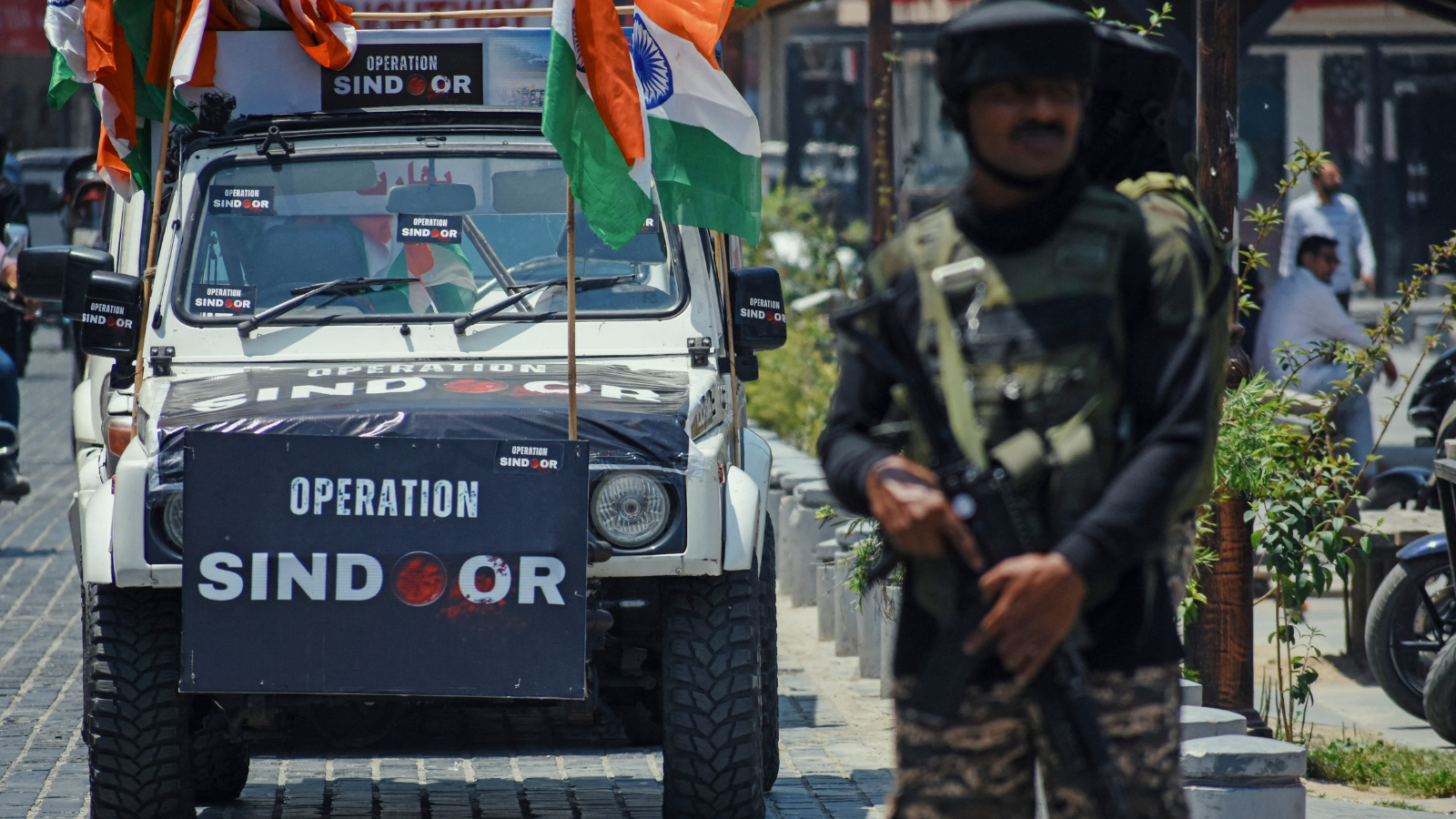
The India-Pakistan conflict that played out between May 6 and May 10, 2025, offers several military lessons. This article presents key takeaways from Operation Sindoor and breaks down how India’s preparations shaped the outcome and what more is needed to strengthen future readiness.

Dinakar Peri