• Research
  • About
  • Experts
Carnegie India logoCarnegie lettermark logo
{
  "authors": [
    "Thomas de Waal"
  ],
  "type": "legacyinthemedia",
  "centerAffiliationAll": "dc",
  "centers": [
    "Carnegie Endowment for International Peace",
    "Carnegie Europe",
    "Carnegie Russia Eurasia Center"
  ],
  "collections": [],
  "englishNewsletterAll": "ctw",
  "nonEnglishNewsletterAll": "",
  "primaryCenter": "Carnegie Europe",
  "programAffiliation": "russia",
  "programs": [
    "Russia and Eurasia"
  ],
  "projects": [],
  "regions": [
    "Caucasus",
    "Georgia"
  ],
  "topics": [
    "Political Reform"
  ]
}
Source: Getty

In The Media
Carnegie Europe

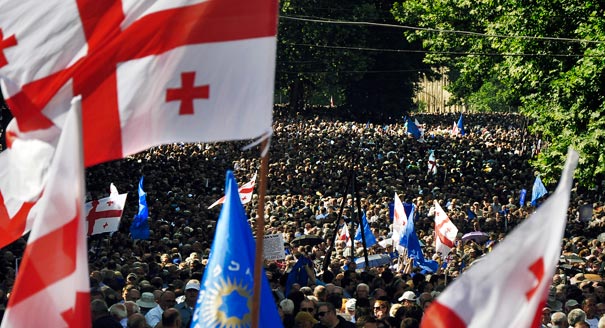
Georgia’s Parliamentary Elections

With the ruling party’s loss to the opposition Georgian Dream coalition, the country’s leading political parties must find a way to share power and enable a peaceful political transition.

Link Copied
By Thomas de Waal
Published on Oct 1, 2012

Source: Worldview

In the wake of the recent parliamentary elections, Carnegie’s Thomas de Waal sat down with WBEZ's Worldview to discuss the short history of Georgia, President Saakashvili's legacy, and the factors behind his party's legislative defeat.

Topics discussed include:

  • A Post-Soviet Republic: The Rose Revolution brought Saakashvili to the presidency, where he enacted a number of reforms. But his legacy as a modernizer was not enough to overcome voter frustration with the country’s civil rights shortcomings, de Waal explained.
     
  • High Stakes: The victorious faction will name the new prime minister, a position that will gain a great deal of power once Saakashvili's presidential term ends in 2013, de Waal said. He added that the opposition's success has dealt another blow to the outgoing majority's legitimacy.
     
  • International Attention: Georgia has been the focus of a great deal of international attention, both positive, like the U.S. interest in promoting the country as a model developing democracy, and negative, like the country’s brief war with Russia, de Waal said.
     
  • The Future of the United National Movement (UNM): The UNM could become a vocal opposition, since the party remains very well organized in comparison with the Georgian Dream coalition, de Waal suggested.
     
  • The Leader of the Opposition: Bidzina Ivanishvili, the leader of the Georgian Dream coalition, remains an enigma despite his recent transformation from reclusive businessman to mainstream politician, de Waal said. His considerable fortune is subject to some controversy, as is his citizenship, although the Saakashvili government's attempt to strip his Georgian citizenship now appears to have been a strategic mistake.
     
  • This Election's Legacy: If there is international pressure to respect the ballot, this could be a positive step toward harmony in Georgia, de Waal said. A peaceful transfer of power would give the electorate confidence that its opinion is respected and matters, he concluded.

About the Author

Thomas de Waal

Senior Fellow, Carnegie Europe

De Waal is a senior fellow at Carnegie Europe, specializing in Eastern Europe and the Caucasus.

    Recent Work

  • Commentary
    Europolis, Where Europe Ends

      Thomas de Waal

  • Commentary
    Taking the Pulse: Is It Time for Europe to Reengage With Belarus?

      Thomas de Waal, ed.

Thomas de Waal
Senior Fellow, Carnegie Europe
Thomas de Waal
Political ReformCaucasusGeorgia

Carnegie India does not take institutional positions on public policy issues; the views represented herein are those of the author(s) and do not necessarily reflect the views of Carnegie, its staff, or its trustees.
More Work from Carnegie India

  • Paper
    India’s Sustained Economic Recovery Will Require Changes to Its Bankruptcy Law

    As India’s economy recovers from the coronavirus pandemic, Indian businesses need efficient financial structures to regain their ground. Key reforms to India’s Insolvency and Bankruptcy Code could fill these gaps.
      Anirudh Burman
  • Paper
    Cross-Border Data Access for Law Enforcement: What Are India’s Strategic Options?

    Access to cross-border data is an integral piece of the law enforcement puzzle. India is well placed to lead the discussions on international data agreements subject to undertaking necessary surveillance reforms.

      Smriti Parsheera, Prateek Jha
  • Article
    The BRI in Post-Coronavirus South Asia

    After the coronavirus pandemic wanes, how will China’s reorientation of the Belt and Road Initiative to address global health concerns influence its relationships with South Asian countries?
      Deep Pal, Rahul Bhatia
  • Commentary
    India’s Unheeded Coronavirus Warning

    Early in the outbreak, government researchers forecast several high-risk scenarios that were downplayed or ignored in public messaging.

      Gautam I. Menon

  • Article
    Intrusive Pandemic-Era Monitoring Is the Same Old Surveillance State, Not a New One

    Governments around the world are turning to new forms of digital surveillance to monitor the spread of the coronavirus, though they are mostly using existing laws to do so.

      Anirudh Burman

Get more news and analysis from
Carnegie India
Carnegie India logo, white
Unit C-4, 5, 6, EdenparkShaheed Jeet Singh MargNew Delhi – 110016, IndiaPhone: 011-40078687
  • Research
  • About
  • Experts
  • Projects
  • Events
  • Contact
  • Careers
  • Privacy
  • For Media
Get more news and analysis from
Carnegie India
© 2026 Carnegie Endowment for International Peace. All rights reserved.