

Commentary
Thomas de Waal
{
  "authors": [
    "Thomas de Waal"
  ],
  "type": "legacyinthemedia",
  "centerAffiliationAll": "dc",
  "centers": [
    "Carnegie Endowment for International Peace",
    "Carnegie Europe",
    "Carnegie Russia Eurasia Center"
  ],
  "collections": [],
  "englishNewsletterAll": "ctw",
  "nonEnglishNewsletterAll": "",
  "primaryCenter": "Carnegie Europe",
  "programAffiliation": "russia",
  "programs": [
    "Russia and Eurasia"
  ],
  "projects": [],
  "regions": [
    "Caucasus",
    "Georgia"
  ],
  "topics": [
    "Political Reform"
  ]
}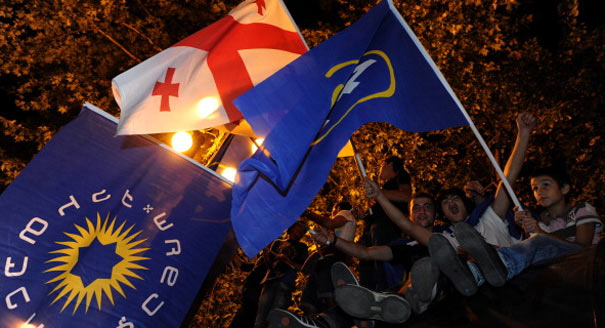
Source: Getty
Despite widespread fears of a deadlocked, disputed election and protests on the streets, Georgia is—so far—on the path toward a surprisingly orderly transfer of power following the recent parliamentary elections.
Source: Foreign Policy

Most opinion polls had been predicting a victory for the governing party, the United National Movement (UNM), and most of the mental effort in Western capitals had been focused on the problem of how to persuade Georgian Dream to accept defeat gracefully. I realized something was wrong with this conventional wisdom when I traveled through western Georgia two weeks ago and encountered a palpably pro-opposition mood, even in the booming port city of Batumi, which has been the showcase of Saakashvili's new Georgia. But I also got it wrong, predicting that the two main parties would divide the popular vote equally but that the UNM would win the most seats.
The missing factor in most calculations was Georgia's silent majority: the large number of voters who responded "don't know" and "refuse to answer" in the pre-election polls. (That said, the late-breaking scandal of leaked video footage of abuse in Georgian prisons surely also shifted a large number of undecided voters.) But one can't discount that Georgian politics remain quite feudal. Many Georgians voted for Ivanishvili because he successfully projected himself as the country's next leader and attracted the crowds on the street to prove it. The momentum simply went Ivanishvili's way, and many voters deserted one ship for another.Constitutional deadlock beckons. Saakashvili will still serve as president, with the same powers he currently possesses, for a year or more, while a new opposition-dominated Parliament challenges him and probably forms a new government. The new constitution, which endows the job of prime minister with stronger executive powers, takes effect only when Saakashvili's term ends. The French call what happens in the meantime "cohabitation," but it will be taking place in a political culture with an aversion to compromise, where the two sides just recently declared each other mortal enemies and without European rules or institutions to buffer the country against shocks. There are also bound to be calls for an early presidential election and questions about the legitimacy of Georgia's rather lax rules on election timing. In January 2013, Saakashvili will have completed the full five years of his second term in office, but Georgian legislation allows for elections to be held at any point in the calendar year of 2013, permitting Saakashvili to serve out the entire year of 2013, should he choose to.
And there will be tensions not just between the two new big players in Georgian politics but within their ranks. Georgian Dream is a coalition of very diverse politicians, united mainly by their opposition to Saakashvili. And the president's UNM combines real reformers with do-nothing bureaucrats. Expect it to take a while for a working government to emerge out of all this.
Whatever happens, this is the beginning of the end of the Saakashvili era. The president has earned his place in history as a state-builder and modernizer. But this election shows that Georgia was tired of his furious and divisive style of government. Georgia's revolutionary phase is now over. Saakashvili is a supremely talented politician, and still only 44, but it is hard to imagine a scenario where he comes back to power. He has made too many enemies.
But it is more than plausible that one of Saakashvili's allies will win high office in the future, when the political mood in Georgia changes again. One key Saakashvili lieutenant, the mayor of Tbilisi, Gigi Ugulava, keeps his job in any case and probably has ambitions for the future. But what's immediately clear is that this was not an election Saakashvili wanted to lose -- indeed he used all the means at his disposal to win it by making liberal use of state resources and the power of the country's two most powerful television stations.
That strategy failed -- and it is to the credit of Saakashvili and his government that they are accepting their defeat. The key factor in ensuring Georgia's historically democratic election was the massive and close Western scrutiny of the election. Western officials will now inevitably be involved behind the scenes in helping manage and mediate the messy political transition as Georgian politicians now find themselves in unknown territory, forced to actually negotiate with each other.
They will need time to get to grips with the new reality of how, as the president declared, "democracy works."

Senior Fellow, Carnegie Europe
Thomas de Waal is a senior fellow at Carnegie Europe, specializing in Eastern Europe and the Caucasus.
Recent Work
Thomas de Waal
Thomas de Waal
Carnegie India does not take institutional positions on public policy issues; the views represented herein are those of the author(s) and do not necessarily reflect the views of Carnegie, its staff, or its trustees.
As India’s economy recovers from the coronavirus pandemic, Indian businesses need efficient financial structures to regain their ground. Key reforms to India’s Insolvency and Bankruptcy Code could fill these gaps.

Anirudh Burman
Access to cross-border data is an integral piece of the law enforcement puzzle. India is well placed to lead the discussions on international data agreements subject to undertaking necessary surveillance reforms.
Smriti Parsheera, Prateek Jha
After the coronavirus pandemic wanes, how will China’s reorientation of the Belt and Road Initiative to address global health concerns influence its relationships with South Asian countries?
Deep Pal, Rahul Bhatia
Early in the outbreak, government researchers forecast several high-risk scenarios that were downplayed or ignored in public messaging.
Gautam I. Menon
Governments around the world are turning to new forms of digital surveillance to monitor the spread of the coronavirus, though they are mostly using existing laws to do so.
Anirudh Burman