

Commentary
Nathan J. Brown
{
  "authors": [
    "Nathan J. Brown"
  ],
  "type": "legacyinthemedia",
  "centerAffiliationAll": "dc",
  "centers": [
    "Carnegie Endowment for International Peace",
    "Malcolm H. Kerr Carnegie Middle East Center"
  ],
  "collections": [
    "Arab Awakening"
  ],
  "englishNewsletterAll": "menaTransitions",
  "nonEnglishNewsletterAll": "",
  "primaryCenter": "Carnegie Endowment for International Peace",
  "programAffiliation": "MEP",
  "programs": [
    "Middle East"
  ],
  "projects": [],
  "regions": [
    "North Africa",
    "Egypt"
  ],
  "topics": [
    "Political Reform",
    "Democracy"
  ]
}
Source: Getty
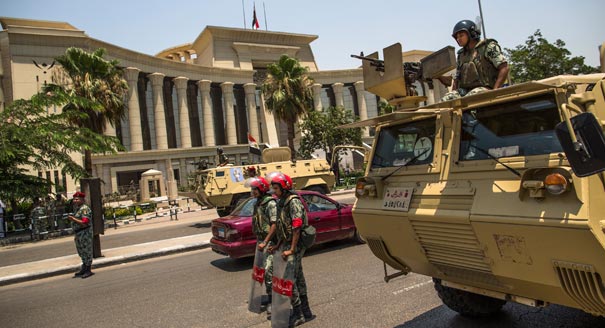
Egypt is a country where those with gavels are often more powerful than those with guns and contestants speak in legal language.
Source: Arabist

And now, in the midst of what looks like mortal combat between the presidency and Islamists on the one side and a set of judicial actors and non-Islamist forces on the other—a confrontation set off (predictably enough) by a series of presidential edicts published in the Official Gazette—we may be seeing the shape of a compromise emerging. It is hard to tell what that compromise is, however, not only because the political struggle is so knotty, but also because the language used is unfamiliar and abstract.
The footprints of the compromise can be found in today’s statement by the Supreme Judicial Council (SJC). While yesterday’s Judges Club meeting got (well deserved) attention, the SJC is actually the authoritative body that oversees the judiciary. Staffed by a group of senior judges, its statements can pack a punch. And today it has called on judges to do their work (and thus not to strike). But there is also one critical element in today’s statement that is less immediately apparent because it is difficult to understand for anyone not schooled in Egyptian constitutional controversies of the mid–20th century and French constitutional thought of the nineteenth century (I’m an amateur in the first category and a hopeless novice in the second, but I’ll do my best to explain.) It rests on the doctrine of “acts of sovereignty.” (Those interested in a bit more expertise and depth should consult Mohamed Maher Abouelenen, “Judges and Acts of Sovereignty,” in Nathalie Bernard-Maugiron (editor), Judges and Political Reform in Egypt.)The SJC seems to recognize some of Morsi’s authority to act but only related to acts of sovereignty. That suggests in effect that he can a issue constitutional declaration but not in matters that should be covered by normal legislation. The doctrine of “acts of sovereignty” holds that officials can sometimes be acting pursuant to some clear legal authority that is subject to normal procedures and judicial oversight. On some isolated matters, however, they draw their authority from the fact that they are acting in a sovereign manner; such actions are not subject to court review.
If that is less than clear, the problem is not merely my ability to explain. It’s also the doctrine itself.
“Acts of sovereignty” is a vague idea that past authoritarian rulers have used as a bulldozer. A lot of judges are embarrassed about the doctrine and the Supreme Constitutional Court in Egypt tried to chip away at it in the 1980s and 1990s and even move toward an approach more familiar to Americans in which courts restrain themselves in some “political questions” that are properly left for the political process rather than any judicial one.
But the doctrine has come back in force in discussions since February 2011. It is a major part of the current legal case involving the Constituent Assembly and the courts’ authority to dissolve it.
What the SJC seems to be suggesting here is that parts of Morsi’s constitutional declaration–and his authority to issue the declaration–can stand, but that parts of it cannot or perhaps that they cannot be applied in the way that they have been.
For those looking for a compromise, this may provide a basis. Are there such people? A few—and I suspect that judicial and presidential figures are making a go of hashing out some details now. And if they succeed, this may lead to a style of compromise that is now a bit familiar in which antagonists shout loudly, tie up the matter in abstruse legal doctrines which nobody can understand, and move on to a new problem.
This article originally appeared in the Arabist.

Nonresident Senior Fellow, Middle East Program
Nathan J. Brown, a professor of political science and international affairs at George Washington University, is a distinguished scholar and author of nine books on Arab politics and governance, as well as editor of five books.
Recent Work
Nathan J. Brown
Nathan J. Brown
Carnegie India does not take institutional positions on public policy issues; the views represented herein are those of the author(s) and do not necessarily reflect the views of Carnegie, its staff, or its trustees.

A partnership between India, a country of subcontinental size, and Africa, a continent of fifty-four countries, may seem asymmetric until one notes that both are home to nearly the same number of people—1.4 billion. This essay spells out the existing challenges to the partnership, its optimal potential, and the possible pathways to realize it over the next quarter-century.

Rajiv Bhatia

Experts weigh in on whether the United States is too hostile toward China.


Stephen Wertheim, Evan S. Medeiros, Vijay Gokhale

As India’s economy recovers from the coronavirus pandemic, Indian businesses need efficient financial structures to regain their ground. Key reforms to India’s Insolvency and Bankruptcy Code could fill these gaps.

Anirudh Burman

Access to cross-border data is an integral piece of the law enforcement puzzle. India is well placed to lead the discussions on international data agreements subject to undertaking necessary surveillance reforms.

Smriti Parsheera, Prateek Jha

After the coronavirus pandemic wanes, how will China’s reorientation of the Belt and Road Initiative to address global health concerns influence its relationships with South Asian countries?


Deep Pal, Rahul Bhatia