

Commentary
Judy Dempsey
{
  "authors": [
    "Judy Dempsey"
  ],
  "type": "legacyinthemedia",
  "centerAffiliationAll": "",
  "centers": [
    "Carnegie Endowment for International Peace",
    "Carnegie Europe"
  ],
  "collections": [],
  "englishNewsletterAll": "",
  "nonEnglishNewsletterAll": "",
  "primaryCenter": "Carnegie Europe",
  "programAffiliation": "",
  "programs": [],
  "projects": [],
  "regions": [
    "Europe",
    "Western Europe",
    "Germany"
  ],
  "topics": [
    "EU",
    "Political Reform"
  ]
}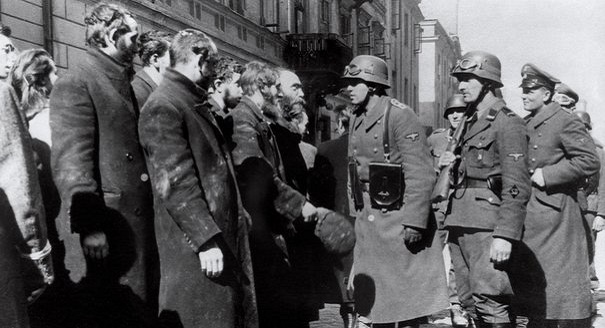
Source: Getty
Germany is struggling with how to pay pensions to Jews who worked voluntarily in the ghettos during World War II.
Source: New York Times

The federal lawmakers had invited pension experts, lawyers, historians and Holocaust survivors to discuss one of the chapters of World War II that Germany has yet to close: how to pay pensions to Jews who worked voluntarily in the ghettos.
That may seem a strange topic to be discussing so long after 1945. The German government has already compensated Jews who were forced to work in the ghettos. But until 2002, there was no payment system for Jews who chose to work.
“We wanted to work. It meant surviving,” Mr. Chanoch, 84, a board member of the Center of Organizations of Holocaust Survivors in Israel, told the committee.As a young boy, Mr. Chanoch worked in the ghetto of Kaunas, Lithuania, after the city’s thriving community of 40,000 Jews was rounded up in August 1941. “We got paid for our work. We also paid into the insurance funds,” he said in an interview. “That money is our money.”
Mr. Chanoch was later deported to the Stutthof concentration camp in Poland and then to Dachau. His grandparents, parents and sister were killed in Auschwitz and Stutthof.
“For me and every other ghetto survivor, recognition for the work we did in the ghetto would mean that this aspect of history has also finally been acknowledged and will be taken into account in both compensation and social legislation,” Mr. Chanoch told the committee.
In 2002, the Bundestag, or German Parliament, retroactively passed a law: “German Pensions for Work in the Ghettos.” The Federal Social Court, which is responsible for insurance claims, ruled in 1997 that work carried out in the ghettos could be recognized as employment time under German pension laws.
At the time, the government believed the payments would not be exorbitant. It estimated that about 700 of the ghetto workers would apply for pensions. This was despite the fact that there had been more than 1,150 ghettos, according to Stephan Lehnstaedt, a historian at the German Historical Institute in Warsaw who participated in the committee hearing. The Warsaw ghetto alone held more than half a million Jews.
Once the 2002 law was enacted, 70,000 survivors applied to receive pensions. The pension insurance funds were taken aback because of the costs involved. After assessments, they rejected more than 90 percent of the applications.
The pension insurance funds argued that those who had worked in the ghettos were forced laborers. They were therefore entitled to compensation to be paid by the Finance Ministry, not from the public pension fund.
As for boys barely in their teens, like Mr. Chanoch, they were considered too young to have held proper jobs. “The pension fund experts did not understand the historical conditions of life in the ghetto,” Mr. Lehnstaedt said at the committee hearing.
In 2009, after criticism by Israel and Jewish organizations over the rejection of so many claimants, the German Federal Social Court relaxed the restrictive measures. Rejected cases were reconsidered.
But the court’s ruling did not end the matter. The National Pension Board announced that payments under review would be backdated by four years, the statutory limit, to 2005. Germany’s Federal Social Court backed that position.
In the meantime, thousands of elderly claimants had died, according to the Conference on Jewish Material Claims Against Germany, or Claims Conference. The conference represents world Jewry in negotiating compensation and restitution for victims of Nazi persecution and their heirs.
Jan-Robert von Renesse, one of the German judges who attended the committee hearing, said it was shameful how the pension funds and courts had acted.
“What has been established is that in dealing with the ghetto pension issue, the National Pension Fund misjudged both real and legal conditions of the ghetto — culpably,” he said.
Even after the hearing last month, nothing was decided. The opposition Social Democrats, Green and Left parties said they wanted payments to be backdated to 1997. Chancellor Angela Merkel’s government coalition is more cautious, fearing new legal entanglements and lawsuits. All acknowledged, however, that somehow this ignominious chapter of German history needs to be closed.
On his return to Israel after the hearing, Mr. Chanoch was cautiously optimistic that some compromise could be found.
“All I ask,” he said, “is that we get old gracefully.”

Nonresident Senior Fellow, Carnegie Europe
Judy Dempsey is a nonresident senior fellow at Carnegie Europe
Recent Work
Judy Dempsey
Judy Dempsey
Carnegie India does not take institutional positions on public policy issues; the views represented herein are those of the author(s) and do not necessarily reflect the views of Carnegie, its staff, or its trustees.

The India–EU Free Trade Agreement (FTA) is shaping up to be one of the most consequential trade negotiations, both economically and strategically. But, what’s in the agreement, what’s missing, and what will determine its success in the years ahead

Vrinda Sahai, Nicolas Köhler-Suzuki

This article argues that the geopolitical circumstances have never been more conducive, not merely for the early conclusion of the free trade agreement (FTA) between India and the EU, but also for crafting a substantive and comprehensive strategic partnership.

Mohan Kumar
Foreign ministers from India, France, and Australia recently met (virtually) at the Raisina Dialogue, India’s flagship annual conference on geopolitics and geoeconomics. What can they get done if they work together?


Rudra Chaudhuri, Shibani Mehta

As India’s economy recovers from the coronavirus pandemic, Indian businesses need efficient financial structures to regain their ground. Key reforms to India’s Insolvency and Bankruptcy Code could fill these gaps.

Anirudh Burman
Access to cross-border data is an integral piece of the law enforcement puzzle. India is well placed to lead the discussions on international data agreements subject to undertaking necessary surveillance reforms.

Smriti Parsheera, Prateek Jha