

Q&A
Suzanne Maloney, Aaron David Miller, Karim Sadjadpour
{
  "authors": [
    "Karim Sadjadpour"
  ],
  "type": "legacyinthemedia",
  "centerAffiliationAll": "dc",
  "centers": [
    "Carnegie Endowment for International Peace",
    "Malcolm H. Kerr Carnegie Middle East Center"
  ],
  "collections": [
    "Iranian Proliferation"
  ],
  "englishNewsletterAll": "menaTransitions",
  "nonEnglishNewsletterAll": "",
  "primaryCenter": "Carnegie Endowment for International Peace",
  "programAffiliation": "MEP",
  "programs": [
    "Middle East"
  ],
  "projects": [],
  "regions": [
    "Middle East",
    "Iran",
    "Gulf"
  ],
  "topics": [
    "Political Reform",
    "Foreign Policy",
    "Nuclear Policy"
  ]
}
Source: Getty
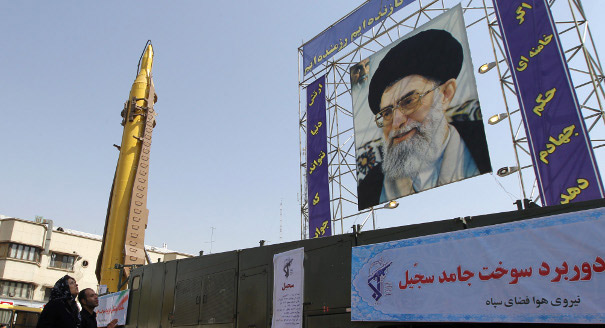
Despite the increasing economic pressure induced by Western sanctions, Ayatollah Khamenei has demonstrated little willingness to engage in substantive negotiations regarding the Iranian nuclear program.
Source: PBS NewsHour
JEFFREY BROWN: For more, I'm joined by Karim Sadjadpour, a senior associate in the Middle East Program at the Carnegie Endowment for International Peace.
Welcome back.
KARIM SADJADPOUR, Carnegie Endowment for International Peace: Thanks for having me.
JEFFREY BROWN: Were those -- are these mixed signals from Iran, or is it pretty clear today?
KARIM SADJADPOUR: Well, I think the perennial challenge we have had in our dealing with Iran is that those Iranians who want to talk to American can't deliver and those Iranians who can deliver don't want to talk to America.And the person who needs to deliver in this case is the supreme leader, Ali Khamenei. And he's been someone who has been incredibly consistent for the last 24 years, since he became supreme leader.
JEFFREY BROWN: He's been consistent, you're saying?
KARIM SADJADPOUR: Incredibly consistent, on almost a weekly basis since 1989 expressing his contempt and mistrust for the United States.
JEFFREY BROWN: What about the overture by Joe Biden? Surprise or a feeler? How much do we know about the U.S. attempt here?
KARIM SADJADPOUR: Well, this Obama administration between President Obama, Joe Biden, Secretary of State John Kerry, potential Secretary of Defense Chuck Hagel, I would argue, is the most pro-Iran engagement U.S. national security Cabinet since the 1979 revolution.
This is an administration which desperately does want to do a deal with Iran to defuse the nuclear issue and to gradually reduce our footprint in the Middle East. They certainly don't want to the go to war. And I'm not sure if Ayatollah Khamenei understands that this is going to be the best deal he's going to get from the United States.
JEFFREY BROWN: Well, the demands of the U.S. and others seems fairly clear and the push for further sanctions goes on. We will go into that in a minute.
The Iranians say they want the sanctions lifted first. So have you heard anything that suggests it's a sort of vicious cycle in that regard?
KARIM SADJADPOUR: This has also been a perennial challenge that -- the synchronizing negotiations, who takes the first step, who makes the first overture, but it's not within the realm of possibilities that the U.S. Congress or President Obama is going to remove sanctions before the negotiations start.
And I do see the two sides still being quite far away before any resolution can be reached.
JEFFREY BROWN: You do? You don't see any particular way around it at the moment?
KARIM SADJADPOUR: The way I look at these negotiations is that the best-case scenario is that we have another round of negotiations, and I see these -- talking with ...
JEFFREY BROWN: You mean the multilateral negotiations?
KARIM SADJADPOUR: Exactly.
I mean, the utility I see of talking to Iran isn't to resolve our differences. I think that's unlikely. But it's to prevent what is now a cold war from deteriorating into a hot war.
JEFFREY BROWN: Now, tell us more about the new sanctions that were announced yesterday. What are they aimed at?
KARIM SADJADPOUR: Well, Iran is facing unprecedented sanctions, both in terms of its depth and its breadth, meaning you have Central Bank sanctions, U.S. central -- sanctions against Iran's Central Bank. And you have remarkable multilateral buy-in.
Europeans have stopped buying Iranian oil. Countries like Japan, China, India that were once big traders with Iran have had reduced economic contacts. And the sanctions which were implemented yesterday, what has happened is that Iran has had a much more difficult time producing and exporting oil. And oil is 80 percent of its export revenue.
The sanctions which took effect yesterday make it much more difficult for Iran to get paid for the oil it does export. So over the last several years, their oil revenue has dropped more than 50 percent. Inflation has skyrocketed. Their currency has tail spinned.
But we still haven't seen that economic malaise have an impact on the supreme leader's nuclear calculations.
JEFFREY BROWN: Well, that's the next question, of course, is, what can be said about the impact that the sanctions are having at this point?
KARIM SADJADPOUR: The sanctions certainly have had an adverse effect on the population. People are having difficulty getting access to medicine. The quality of life for most people has dropped precipitously.
But, again, the intent of sanctions is to try to subject Iran to enough pressure, so the leader will feel what I would describe as existential angst that either he has to do a nuclear deal or the regime itself could be in peril.
And there's no signs that he's feeling that. Now, the challenge also with Ayatollah Khamenei is that he's a man who hasn't left the country since 1989. He's surrounded himself with these sycophants who don't necessarily give him full information. So it's unclear whether he will appreciate the full magnitude of the situation he's in.
And this, by the way, isn't necessarily unique to Khamenei. I think being a dictator is a very lonely vocation. And that's why oftentimes, dictatorships don't bend. They end up breaking.
JEFFREY BROWN: All right, Karim Sadjadpour, thanks for the update.
KARIM SADJADPOUR: Thanks Jeff.

Senior Fellow, Middle East Program
Karim Sadjadpour is a senior fellow at the Carnegie Endowment for International Peace, where he focuses on Iran and U.S. foreign policy toward the Middle East.
Recent Work


Suzanne Maloney, Aaron David Miller, Karim Sadjadpour
Aaron David Miller, Karim Sadjadpour, Robin Wright
Carnegie India does not take institutional positions on public policy issues; the views represented herein are those of the author(s) and do not necessarily reflect the views of Carnegie, its staff, or its trustees.

After the chill in ties between 2020 and 2024 that brought India–China relations to their lowest point in several decades, the two countries have engaged each other afresh. This paper argues that there are predominantly four imperatives guiding India’s approach to China, and they exist in an order of priority.

Saheb Singh Chadha

This piece argues that India’s central challenge is not managing a single flashpoint but resolving the underlying tension between expansion and institutional coherency of the BRICS grouping.

Vrinda Sahai

A partnership between India, a country of subcontinental size, and Africa, a continent of fifty-four countries, may seem asymmetric until one notes that both are home to nearly the same number of people—1.4 billion. This essay spells out the existing challenges to the partnership, its optimal potential, and the possible pathways to realize it over the next quarter-century.

Rajiv Bhatia

The India–EU Free Trade Agreement (FTA) is shaping up to be one of the most consequential trade negotiations, both economically and strategically. But, what’s in the agreement, what’s missing, and what will determine its success in the years ahead
Vrinda Sahai, Nicolas Köhler-Suzuki

Trump 2.0 has unsettled India’s external environment—but has not overturned its foreign policy strategy, which continues to rely on diversification, hedging, and calibrated partnerships across a fractured order.



Milan Vaishnav, ed., Sameer Lalwani, Tanvi Madan, …