

Commentary
Sarah Chayes
{
  "authors": [
    "Sarah Chayes"
  ],
  "type": "legacyinthemedia",
  "centerAffiliationAll": "dc",
  "centers": [
    "Carnegie Endowment for International Peace",
    "Malcolm H. Kerr Carnegie Middle East Center"
  ],
  "collections": [
    "Arab Awakening"
  ],
  "englishNewsletterAll": "democracy",
  "nonEnglishNewsletterAll": "",
  "primaryCenter": "Carnegie Endowment for International Peace",
  "programAffiliation": "DCG",
  "programs": [
    "Democracy, Conflict, and Governance"
  ],
  "projects": [],
  "regions": [
    "North Africa",
    "Tunisia",
    "Maghreb"
  ],
  "topics": [
    "Political Reform",
    "Democracy",
    "Foreign Policy"
  ]
}
Source: Getty
In the aftermath of an assassination and violent protests, Tunisia's Ennahda party has a unique opportunity to save the country's revolution and redefine political Islam.
Source: CNN
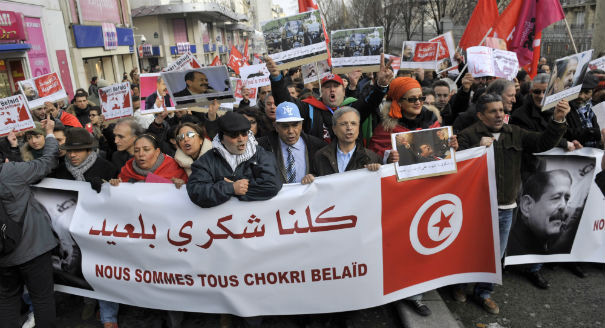
Avenue Bourgiba, the leafy, cafe-lined thoroughfare that abuts Tunis's ancient walled bazaar, was a solid mass of people. The ambulance carrying the body of political organizer Chokri Belaid, shot dead that morning, was scarcely able to pass.
Two days later, outside the cemetery where he was being laid to ground, stinging plumes of tear gas lanced the air. Security forces clashed with mourners. Tunisia, and its revolution, are in crisis.
Crisis, however, always conceals opportunity. And this one offers the ruling Muslim Brotherhood-linked Ennahda party the chance to redirect Tunisia's transition in a way that could serve, again, as a blueprint for the region. The challenge is for ruling parties to disentangle their short-term partisan objectives from their obligations as arbiters—on behalf of the whole country—of once-in-a-lifetime political transformations.Belaid's assassination shocked Tunisians. More placid than Egypt with its intense, teeming vitality, Tunisia has had a calmer transition, and has often been described as the success story of the Arab Awakenings. But for that very reason, the significance of violence like last week's assassination—or the September 11 attack on the U.S. embassy in Tunis—may be greater, because of its higher psychological impact on ordinary people.
In fact, the post-revolution trajectory in Egypt and Tunisia has been remarkably similar. In both cases, Islamist parties were able to convert name recognition and long-standing grass-roots organization into electoral victories. Now both Muslim Brotherhood-linked parties are taking steps to try to translate that electoral supremacy into a durable lock on power.
In Egypt, the struggle has largely centered on the content and approval of the country's new constitution. In Tunisia, many accuse the government of a deliberately lax attitude toward acts of organized political violence, including not arresting extremist assailants or vandals, or letting calls for political assassination from the pulpits of some mosques go unchallenged. The aim would be to cultivate deniable "proxies" with which to intimidate political opponents. Tunisian opposition leaders have also accused Ennahda of pushing to stack the professional civil service with party loyalists.
For their part, secular Tunisian political parties have struggled to organize and to connect meaningfully with large parts of the population. Some of the difficulties have been due to the sheer number of these new parties, which split the vote of their sympathizers. Their inexperience and lack of resources have also been obstacles. By contrast, Ennahda is able to finance thousands of neighborhood offices, where party workers run after-school activities for local children, donate items to needy families, or help neighbors sort out administrative headaches.
Most secular parties are led by a highly internationalized elite, however, who are often as comfortable speaking French as Arabic, and who are culturally disconnected from the vast majority of their compatriots, even uncomfortable in their company. "People shouldn't speak of Tunisia in the same breath as Egypt," said one activist last fall. "We're more like France, or any other European country."
It is in this context that the Islamist Ennahda party won a nearly 40% of the votes in parliamentary elections last fall. It would be hard to argue that all of those ballots represented detailed and active endorsements of Ennahda's political program. Rural and inland voters may have felt a sense of cultural and even economic affinity with the less wealthy and ostentatiously western-looking Ennahda candidates.
Most importantly, many voters said they were looking for "clean" candidates. What was seen as the acute, structured corruption of the regime of Zine Al Abidine Bin Ali—and the social injustice that resulted from it—was a key impetus driving Tunisians into the streets in 2011. In the subsequent vote, many voters explained that they trusted Ennahda's candidates because a number of them had served long prison terms and so could not be accused of collusion with the former dictator's regime.
But with Ennahda's rise to power, the debate over the political and public role of religion has overshadowed the economic issues that gave rise the revolution.
In two years the government has made negligible headway in devising a systematic transitional justice procedure, in assessing the level and nature of past economic crimes, and in obtaining restitution for the population. The government's failure to address these problems, and its apparent unwillingness to disturb longstanding practices, including public corruption, is fueling popular frustration. And if these issues of political economy are not addressed, it is likely that Tunisians will continue to radicalize.
Still, Tunisia's window of opportunity is not yet shut. Westerners should recall the extraordinary racial, cultural, economic, and intellectual homogeneity of our own revolutionary generations. And even so, it took decades for stable western democracies to emerge from our revolutions.
The task that the Arab Spring countries have set for themselves is monumental. And they are tackling it without the benefit of an intellectual elite that has spent years considering different models of political and economic organization, as had early American or French revolutionary activists, or many Eastern European dissidents in the 1970s and '80s. In that perspective, two years is nothing -- and every crisis is still an opportunity.
The current one offers Ennahda a second chance to rise above its partisan instinct to try to lock in its control over Tunisia, and to serve instead as an honest broker for all Tunisians.
To do so, it should accept Prime Minister Hamadi Jebali's proposal to appoint a non-partisan cabinet to enforce neutral rules of political discourse until the next parliamentary election. Such a reshuffle has been in the works for months, and the shock of last week's assassination provides the perfect opening to implement it.
The new cabinet must launch a serious and structured process of transitional justice, which would address issues of systematic economic crime as well as more traditional human rights violations. And, if Ben Ali-era functionaries are removed from their positions during this process, they should be replaced via merit-based recruitment to the civil service.
As a religious movement, Ennahda (which seems currently like a slow-motion version of more radical Salafi movements) is missing an extraordinary opportunity. Given the country's symbolic role in sparking the Arab Awakenings, the party could turn Tunis into an influential magnet for innovative faith-based thinking about how Islam should best interface with the modern world. Such a project would secure its place in history.
Former Senior Fellow, Democracy, Conflict, and Governance Program
Sarah Chayes is internationally recognized for her innovative thinking on corruption and its implications. Her work explores how severe corruption can help prompt such crises as terrorism, revolutions and their violent aftermaths, and environmental degradation.
Recent Work
Sarah Chayes
Carnegie India does not take institutional positions on public policy issues; the views represented herein are those of the author(s) and do not necessarily reflect the views of Carnegie, its staff, or its trustees.

After the chill in ties between 2020 and 2024 that brought India–China relations to their lowest point in several decades, the two countries have engaged each other afresh. This paper argues that there are predominantly four imperatives guiding India’s approach to China, and they exist in an order of priority.

Saheb Singh Chadha

This piece argues that India’s central challenge is not managing a single flashpoint but resolving the underlying tension between expansion and institutional coherency of the BRICS grouping.

Vrinda Sahai

A partnership between India, a country of subcontinental size, and Africa, a continent of fifty-four countries, may seem asymmetric until one notes that both are home to nearly the same number of people—1.4 billion. This essay spells out the existing challenges to the partnership, its optimal potential, and the possible pathways to realize it over the next quarter-century.

Rajiv Bhatia

The India–EU Free Trade Agreement (FTA) is shaping up to be one of the most consequential trade negotiations, both economically and strategically. But, what’s in the agreement, what’s missing, and what will determine its success in the years ahead
Vrinda Sahai, Nicolas Köhler-Suzuki
Trump 2.0 has unsettled India’s external environment—but has not overturned its foreign policy strategy, which continues to rely on diversification, hedging, and calibrated partnerships across a fractured order.



Milan Vaishnav, ed., Sameer Lalwani, Tanvi Madan, …