

Commentary
How is AI reshaping space security, creating governance challenges, and where does international diplomacy stand today?
Tejas Bharadwaj, Almudena Azcárate Ortega
{
  "authors": [
    "Thomas Carothers",
    "Diane de Gramont"
  ],
  "type": "legacyinthemedia",
  "centerAffiliationAll": "dc",
  "centers": [
    "Carnegie Endowment for International Peace"
  ],
  "collections": [
    "Democracy and Governance"
  ],
  "englishNewsletterAll": "democracy",
  "nonEnglishNewsletterAll": "",
  "primaryCenter": "Carnegie Endowment for International Peace",
  "programAffiliation": "DCG",
  "programs": [
    "Democracy, Conflict, and Governance"
  ],
  "projects": [],
  "regions": [
    "North America",
    "United States",
    "Middle East",
    "North Africa",
    "Southern, Eastern, and Western Africa"
  ],
  "topics": [
    "Political Reform",
    "Democracy",
    "Foreign Policy"
  ]
}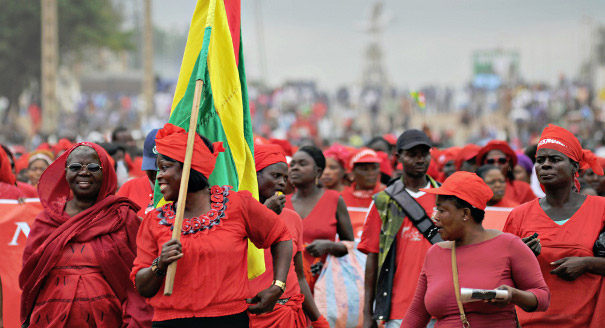
Source: Getty
Developmental change is an inherently political process and development aid must necessarily be politically informed and politically engaged to be successful.
Source: Guardian
Development Aid Confronts Politics: The Almost Revolution is a new book by Thomas Carothers and Diane de Gramont. The book makes the case for a more deep-seated embrace of politics and political analysis in global development debates. Ann Hudock, the global lead in DAI's governance practice — and the editor of DAI's own journal on this topic — asked the authors about their book and its implications for global development professionals.
Developmental change is an inherently political process and development aid must necessarily be politically informed and politically engaged to be successful. The international assistance community has made significant strides over the past 20 years to move away from its prior avoidance of politics and productively take politics into account. Yet this attempted transformation of assistance has still been only partially realised. Aid providers need to rethink and recommit to their political goals and more fully embrace politically smart methods.
It's true that major aid providers now carry out significant amounts of explicitly political programming. Yet a politically informed approach to development assistance involves more than that. To start with, most providers are only starting to effectively integrate their democracy and governance perspectives and programmes with traditional socioeconomic work in areas of assistance like health and agriculture. As a result, potential synergies are missed and different types of aid programmes sometimes work at cross purposes.
In addition, being political in development work is more than about embracing political goals. It also means developing politically smart methods. Early efforts at democracy and governance assistance tended to be politically naïve, assuming that deeply political problems like a lack of transparent public financial management or political party weakness could be resolved through technocratic methods such as training local actors on western best practices in these areas. Unsurprisingly, many of these programmes failed to meet their objectives. Civil society strengthening and accountability programmes represent a somewhat more political approach because they acknowledge that political will for reform often has to be promoted rather than assumed.
But they too have been hampered by a lack of understanding of what civil society actors can realistically accomplish in particular political contexts, which groups are likely to be the most effective partners, and the impact of donor funding on their domestic legitimacy.
Politically smart methods are not about creating new types of programmes as much as ensuring that all aid programmes are politically informed. Many donors now conduct political economy analyses and some have attempted to adopt more flexible and politically savvy operational methods. They have accepted at least in principle the need to rethink civil society assistance, work with a range of social partners beyond the usual NGOs, and pay more attention to relationships between state and society. Innovative programmes have focused more on facilitating locally driven reform efforts rather than replicating preset endpoints.
Thomas Carothers: I remember one evening in Kazakhstan in the early 1990s. I was there to help develop a legislative aid programme and was having dinner at my hotel with other members of the democracy assistance team. At another table was a group of consultants working for the World Bank on some economic reform programmes.
We got to talking and I was struck first by how little communication existed between those working on the political side of assistance and those on the socioeconomic side and second by how much misunderstanding and even suspicion there was between the two camps. The economic reformers, for example, thought that opening up the political system to a wider range of forces and voices would likely cause internal tensions and instability that would damage the country's socioeconomic prospects. They felt that political aid providers should leave the country and only return in 20 or 30 years when it had become much richer. I decided there was a need to bridge the separate communities of political and socioeconomic assistance. For me, this book is one result of a longtime preoccupation with how to achieve more synthetic, integrated approaches to development.
Political analyses do help donors avoid pouring resources into programmes that are not politically feasible or are likely to have negative political consequences. DfID political economy analyses in Nigeria and Nepal, for example, led to significant changes in the organisation's approach to both countries. Practitioners are often frustrated that political studies seem to point to so many negative recommendations, but it is even more frustrating to invest in a programme which then fails due to predictable political obstacles.
Political analyses and methods can also point to more productive, and often less costly ways. For example, the World Bank office in Zambia used insights from sector-level political economy analyses to change their message on electricity tariff reform from a focus on economic efficiency to a focus on expanded access for rural areas and successfully built support for change. The Asia Foundation in the Philippines built on less formalised political analysis to support coalitions of civil society, governmental, and other actors to successfully push for key policy reforms in sectors such as shipping and air transport.
Even when political analyses do not point to specific new strategies, many office heads and practitioners point to the value of general political awareness among country staff in injecting more realism and cross-sector co-operation in programming.
Political approaches do often allow aid agencies to do more with less, if we are discussing getting better outcomes with smaller budgets. Supporting informal reform coalitions or facilitating dialogues among political actors tends to be much cheaper than big infrastructural or social service projects and can sometimes unblock a key political bottleneck.
But more political approaches can unfortunately clash with the results and efficiency agendas as they are currently articulated within donor agencies. Politically informed projects sometimes require a greater degree of flexibility and the ability to revise objectives or timetables to take advantage of political opportunities, which do not fit well with the demand for preset and easily quantifiable short-term results. More political analysis and smaller-scale political projects also tend to require a greater proportion of administrative to operational resources, which is seen by some as a mark of inefficiency. But if what we are interested in is development impact, rather than delivering outputs, space needs to be created within aid agencies to accommodate such programmes.
One of the greatest obstacles to more politically informed development programmes is a lack of internal capacity for this kind of work within development organisations. If donors take this challenge seriously, they will need to place greater emphasis on political analysis skills and the ability to implement politically savvy programmes.
Political analysis is important to inform planning at every stage of the aid process, from broad sector strategies to country and programme plans to day-to-day project management. Development organisations thus need many different types of political analysts, from academically trained experts who can conduct formal political economy studies to politically informed practitioners who can serve as resource people within their country offices.
Second and just as importantly, development organisations need more people who are capable of implementing politically smart and adaptive programmes. The best political analysts are not necessarily good at engaging in practical politics. There is a need for practitioners skilled at coalition building, negotiation, political communication, and other elements of politically nuanced and responsive reform efforts.

Harvey V. Fineberg Chair for Democracy Studies; Director, Democracy, Conflict, and Governance Program
Thomas Carothers, director of the Carnegie Endowment for International Peace’s Democracy, Conflict, and Governance Program, is a leading expert on comparative democratization and international support for democracy.
Diane de Gramont
Former Nonresident Research Analyst, Democracy and Rule of Law Program
Diane de Gramont was a nonresident research analyst in Carnegie’s Democracy and Rule of Law Program.
Carnegie India does not take institutional positions on public policy issues; the views represented herein are those of the author(s) and do not necessarily reflect the views of Carnegie, its staff, or its trustees.

How is AI reshaping space security, creating governance challenges, and where does international diplomacy stand today?


Tejas Bharadwaj, Almudena Azcárate Ortega

After the chill in ties between 2020 and 2024 that brought India–China relations to their lowest point in several decades, the two countries have engaged each other afresh. This paper argues that there are predominantly four imperatives guiding India’s approach to China, and they exist in an order of priority.

Saheb Singh Chadha

This piece argues that India’s central challenge is not managing a single flashpoint but resolving the underlying tension between expansion and institutional coherency of the BRICS grouping.

Vrinda Sahai

A partnership between India, a country of subcontinental size, and Africa, a continent of fifty-four countries, may seem asymmetric until one notes that both are home to nearly the same number of people—1.4 billion. This essay spells out the existing challenges to the partnership, its optimal potential, and the possible pathways to realize it over the next quarter-century.

Rajiv Bhatia

The U.S.–India semiconductor cooperation story is well-stocked with top-level strategic intent. What remains unresolved, however, are some underlying challenges that will determine whether the cooperation actually functions. Three such friction points stand out.

Shruti Mittal