

Commentary
Dmitri Trenin
{
  "authors": [
    "Dmitri Trenin"
  ],
  "type": "legacyinthemedia",
  "centerAffiliationAll": "",
  "centers": [
    "Carnegie Endowment for International Peace",
    "Malcolm H. Kerr Carnegie Middle East Center",
    "Carnegie Russia Eurasia Center"
  ],
  "collections": [
    "Arab Awakening"
  ],
  "englishNewsletterAll": "",
  "nonEnglishNewsletterAll": "",
  "primaryCenter": "Carnegie Russia Eurasia Center",
  "programAffiliation": "",
  "programs": [],
  "projects": [
    "Eurasia in Transition"
  ],
  "regions": [
    "Egypt",
    "Levant",
    "Maghreb",
    "Middle East",
    "North Africa",
    "Russia"
  ],
  "topics": [
    "Political Reform",
    "Foreign Policy"
  ]
}
Source: Getty
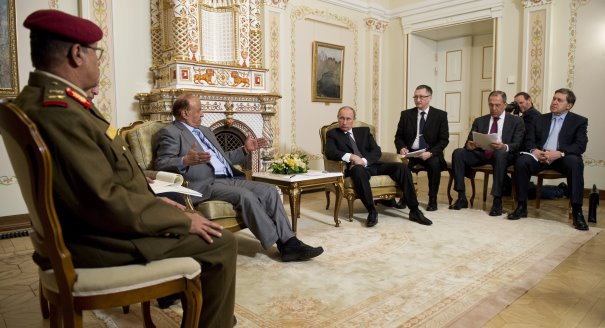
Russia is clearly concerned with the rise of Islamist extremists in the Middle East and is looking for ways to prevent destabilization in the region. At the same time, it is seeking to improve ties with various Arab countries.
Source: World Politics Review
Last month, Russian President Vladimir Putin hosted Mohammed Morsi, a former Muslim Brotherhood leader and Egypt’s first post-Arab Spring president, even as Russia continued to back Bashar al-Assad’s regime in Damascus against an assorted opposition that includes the Syrian branch of the Brotherhood. This apparent contradiction illustrates the challenges Russia is facing in the post-Arab Spring Middle East.Like virtually everyone else, Moscow was surprised by the groundswell of change that began in the Arab world in early 2011. Experts advising the Russian government call this a tectonic shift and compare its impact to that of the two defining periods in the region’s 20th-century history: the fall of the Ottoman Empire and the secular revolutions of the 1950s and 1960s. The present “Arab Awakening,” they opine, may take years, even decades, to unfold and is likely to transform the entire shape and fabric of the region. Its future course and dynamics are hard to predict, but in the end it will give a boost to the processes of social and political modernization that so far have largely bypassed the Arab Middle East and North Africa. ...
Read the full text of this article in World Politics Review.
Former Director, Carnegie Moscow Center
Trenin was director of the Carnegie Moscow Center from 2008 to early 2022.
Recent Work
Dmitri Trenin
Dmitri Trenin
Carnegie India does not take institutional positions on public policy issues; the views represented herein are those of the author(s) and do not necessarily reflect the views of Carnegie, its staff, or its trustees.

After the chill in ties between 2020 and 2024 that brought India–China relations to their lowest point in several decades, the two countries have engaged each other afresh. This paper argues that there are predominantly four imperatives guiding India’s approach to China, and they exist in an order of priority.

Saheb Singh Chadha

This piece argues that India’s central challenge is not managing a single flashpoint but resolving the underlying tension between expansion and institutional coherency of the BRICS grouping.

Vrinda Sahai

A partnership between India, a country of subcontinental size, and Africa, a continent of fifty-four countries, may seem asymmetric until one notes that both are home to nearly the same number of people—1.4 billion. This essay spells out the existing challenges to the partnership, its optimal potential, and the possible pathways to realize it over the next quarter-century.

Rajiv Bhatia

The India–EU Free Trade Agreement (FTA) is shaping up to be one of the most consequential trade negotiations, both economically and strategically. But, what’s in the agreement, what’s missing, and what will determine its success in the years ahead
Vrinda Sahai, Nicolas Köhler-Suzuki

Trump 2.0 has unsettled India’s external environment—but has not overturned its foreign policy strategy, which continues to rely on diversification, hedging, and calibrated partnerships across a fractured order.



Milan Vaishnav, ed., Sameer Lalwani, Tanvi Madan, …