

Commentary
Alexey Malashenko
{
  "authors": [
    "Alexey Malashenko"
  ],
  "type": "commentary",
  "centerAffiliationAll": "",
  "centers": [
    "Carnegie Endowment for International Peace",
    "Carnegie Russia Eurasia Center"
  ],
  "collections": [],
  "englishNewsletterAll": "",
  "nonEnglishNewsletterAll": "",
  "primaryCenter": "Carnegie Russia Eurasia Center",
  "programAffiliation": "",
  "programs": [],
  "projects": [],
  "regions": [
    "Russia"
  ],
  "topics": [
    "Political Reform"
  ]
}
Source: Getty
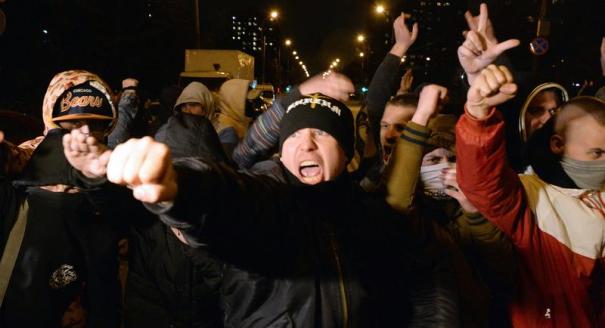
Though it is far more convenient to simply consider the last pogrom in Biryulyovo, Moscow, a sad occurrence and continue acting ad hoc, as usual, the authorities must take a strategic look at these events and act energetically, consistently, and, above all, intelligently.
The mass nationalist riots in the Moscow district of Biryulyovo this October have triggered an avalanche of Internet and media articles, as well as various political declarations. The Biryulyovo outburst was followed by disciplinary actions such as the dismissals of some mid- and lower-ranking officials, including those in law enforcement. As had been the case in the past, the explosion was set off by an altercation between a local resident Yegor Shcherbakov, ethnic Russian, and a migrant from the South Caucasus (Azerbaijan). The quarrel resulted in the local’s murder which provoked demonstrations by the residents of the neighborhood, who were immediately joined by 800 to 2,000 members of some of Moscow’s nationalist organizations. The demonstration morphed into a pogrom in which 3,000 to 5,000 people participated. About 400 of them were detained by the police.
How can one approach the events in Moscow? There could be two answers here. First—the Moscow pogrom is another serious and quite telling episode that reveals the growing nationalist trend in the Russian Federation, and the nationalists are confident that they enjoy the support of the majority of Russia’s Slavic citizens. It indicates that nationalism has become an influential systemic political force. It demonstrates that xenophobic sentiments against the migrants from Central Asia and Azerbaijan, as well as the Russian citizens from the North Caucasus, are on the rise in Russia. A few days after the Biryulyovo events, the popular Russian politician Vladimir Zhirinovsky called for imposing limits on the birthrates of the North Caucasus’ Muslims. Half of those listening to the Echo of Moscow—Russia’s most liberal radio station—supported this view.
The second approach to answering this question is to say that nothing special happened. The latest pogrom is nothing more than an episode. It is not customary to say this in public. But judging by the general reaction to the Biryulyovo events and the steps taken by the establishment after similar events in other Russian cities—Kondopoga, Pugachev, etc.—that is exactly what the establishment thinks. Of course, orders are issued, seminars and conferences take place, and various centers and committees are created. And there is lots of talking…
But there has been no progress whatsoever. Evidently, the leadership believes that such incidents are inevitable, if not normal. (The Sochi Olympics is far more important, and it has to be wrapped up without terrorist incidents and other complications.) Well, actually, why not? There is no coherent migration policy in Russia, nor are there policies on ethnic and religious issues. And there is nothing in store. Forget about policy—no official figure has a clear idea on how many migrants there are in Russia altogether. The number of Russian Muslims is also unknown. Incidentally, we do not know the exact number of Biryulyovo protestors either. Instead, there are fervent and mindless discussions about introducing a visa regime.
While taking a strategic look at the October events in Moscow, the authorities must act energetically, consistently, and, above all, intelligently. It is far more convenient to simply consider the last pogrom a sad occurrence and continue acting ad hoc, as usual. That is exactly what we are seeing now. Thus, we will soon witness another similar “episode.” And this, incidentally, is no less of a threat, or perhaps a greater threat, to the country’s stability and even national security than the alleged intrigues of the foreign enemies.
Former Scholar in Residence, Religion, Society, and Security Program
Malashenko is a former chair of the Carnegie Moscow Center’s Religion, Society, and Security Program.
Recent Work
Alexey Malashenko
Alexey Malashenko
Carnegie India does not take institutional positions on public policy issues; the views represented herein are those of the author(s) and do not necessarily reflect the views of Carnegie, its staff, or its trustees.

This piece argues that India’s central challenge is not managing a single flashpoint but resolving the underlying tension between expansion and institutional coherency of the BRICS grouping.

Vrinda Sahai
As India’s economy recovers from the coronavirus pandemic, Indian businesses need efficient financial structures to regain their ground. Key reforms to India’s Insolvency and Bankruptcy Code could fill these gaps.

Anirudh Burman
Access to cross-border data is an integral piece of the law enforcement puzzle. India is well placed to lead the discussions on international data agreements subject to undertaking necessary surveillance reforms.

Smriti Parsheera, Prateek Jha
After the coronavirus pandemic wanes, how will China’s reorientation of the Belt and Road Initiative to address global health concerns influence its relationships with South Asian countries?
Deep Pal, Rahul Bhatia
Early in the outbreak, government researchers forecast several high-risk scenarios that were downplayed or ignored in public messaging.
Gautam I. Menon