

In The Media
Lilia Shevtsova
{
  "authors": [
    "Lilia Shevtsova"
  ],
  "type": "commentary",
  "centerAffiliationAll": "",
  "centers": [
    "Carnegie Endowment for International Peace",
    "Carnegie Russia Eurasia Center"
  ],
  "collections": [],
  "englishNewsletterAll": "",
  "nonEnglishNewsletterAll": "",
  "primaryCenter": "Carnegie Russia Eurasia Center",
  "programAffiliation": "",
  "programs": [],
  "projects": [
    "Eurasia in Transition"
  ],
  "regions": [
    "Central Asia",
    "Caucasus",
    "Russia"
  ],
  "topics": [
    "Political Reform",
    "Democracy"
  ]
}
Source: Getty
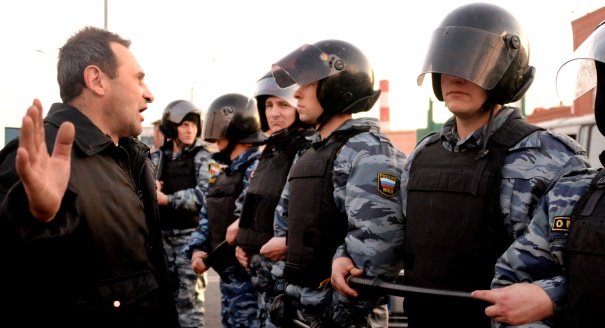
Introducing visas and closing borders with Central Asian countries should not be the first steps in solving the problem of ethnic hatred in Russia. Instead, there should come a transformation of the entire Russian state, a regime change, and a resolution of the problem of the North Caucasus.
When a regime finds it increasingly hard to keep the country under control, it starts looking for ways to neutralize discontent or channel it in a safe direction. There is a myriad of such ways: they may include attempts to find an enemy and turn it into an object of popular hatred, placate the critical segments of the population, and co-opt the opposition. While trying to retain power, the Kremlin is repeating the whole slew of old inventions. But thanks to Russia’s history and its leader’s mentality, fabricating an enemy and inciting the ever-hardening people against it are particularly popular with the Kremlin. The role of the enemy is generally assigned to the United States, the West as a whole, and the Russian liberals. However, the Russian reality has now bestowed a new enemy upon the Kremlin—the migrants. Actually, the Kremlin was clearly not planning to employ the migrants in this role. Why should they, if migrants in today’s Russia constitute the key labor force in various economic areas and a corruption resource for the siloviki and the local authorities—which is an important means for the system’s survival. Besides, the Kremlin certainly fears the rise of nationalism, which is increasingly turning against it. Finally, the mass anti-migrant campaign may hurt Putin’s plans to create the new Soviet Union in the guise of the Eurasian Union. But as other means to blow off steam are being exhausted and social dissatisfaction and anger are escalating, migrants have come around as a convenient candidate for an object of hatred.
One may get the impression that the particular choice of the Central Asian and Azerbaijan natives as enemies and their demonization are supposed to serve one more purpose—they are to shift the focus from the Russian citizens that hail from the North Caucasus, who most often get into conflicts with the Russian citizens of Slavic descent. The Moscow Mayor Sergei Sobyanin in his recent interview to Vlast admitted that, “when the Russian citizens demand to solve the problem with migration, they have in mind not the foreigners, but our own citizens from the southern republics.” Then the question inevitably arises: why the migrants from Azerbaijan and Central Asia are under the attack?
The palpable tension between the local population in the Russian cities and kavkaztcy, the Caucasus natives, results from two brutal wars that Moscow fought in the North Caucasus. The Kremlin’s pacification policy in the region can cause nothing but hatred toward Russia among the population of the Caucasus, especially its younger generation. Russia has essentially lost the Caucasus—or, more precisely, its people. However, the Kremlin still has not conceded defeat (it could not possibly do that, since the second Chechen war catapulted Putin into power and legitimized his rule) and is now trying to hold on to the Caucasus by letting the local sultans run it. The imperial claims supported through Kremlin’s payoffs to these sultanistic regimes breed the sense of permissiveness and the desire for revenge on the Slavs among the Caucasus natives. Here is the vicious circle: rising ethnic hostility in Russian cities is in many ways a reaction to the behavior of the Caucasus natives, which in turn is a product of the Kremlin policies.
The Kremlin does not want to acknowledge the true reasons of rising ethnic and racial hostilities. It does not want to acknowledge the absurdity of the situation in which Russia has become hostage to the Caucasus sultanistic regimes. The Kremlin looks for a safe outlet for ethnic hatred. Therefore, it singles out submissive migrants from Central Asia, Vietnam, or Azerbaijan as an object of hatred.
I have a feeling that the Kremlin authorities are ready to allow the Russian nationalist gangs to harass migrants, channeling in this direction the aggression which is growing within the society; and even the pogroms will be tolerated and used for the Kremlin’s tactical goals. But the authorities will do everything to prevent the nationalist movement from organizing itself and becoming a political force. The Kremlin wants to guarantee that only the authorities retain the right to play the nationalist card.
Moreover, the regime apparently believes it loses nothing by making enemies out of these particular migrants. Any anti-migrant campaign will result in deporting a few hundred Central Asian citizens. Others will take their place as even more submissive slaves. The Kremlin apparently hopes that it can regulate the process of stoking ethnic hatred in a way that will not undermine its imperial agenda and will not make the nationalist tide harder to control.
Unfortunately, provoking ethnic hatred is an expedient device for political consolidation and is being utilized by a wide variety of political forces that also include those who consider themselves part of the opposition. Meanwhile, everyone calling for introducing a visa regime for Central Asians is playing the Kremlin’s game. Indeed, Russia will have to introduce a visa regime and create meaningful borders with all of the new independent states at some point. But it makes no sense to do it now under the current corrupt state. If the visas are in fact introduced, there will simply be other beneficiaries of corruption, border guards and customs officials being among the latter. Erecting fences between Russia and Central Asia will not eliminate the problem of ethnic hatred, since its main source is Russia’s North Caucasus with its growing alienation from Russia.
Thus, introducing visas and closing borders should not be the first steps in solving the problem. Instead, there should come a transformation of the entire Russian state, a regime change, and a resolution of the problem of the North Caucasus.
Meanwhile, Vladimir Putin at his recent meeting in Ufa has demonstrated that the authorities have no clue as to what to do with the growing interethnic and racial hatred. The Kremlin decided to put all responsibility for interethnic relations on the local and regional authorities, threatening to fire those who fail to prevent the ethnic conflicts. The effect of this “remedy” is clear: the local authorities will turn to the means they know—violence and corruption.
In short, the mechanism that the Kremlin views as a way to blow off steam will produce another effect—that of a boiling kettle with its lid on. And, in all likelihood, the Russian kettle is already boiling…

Former Senior Associate, Russian Domestic Politics and Political Institutions Program, Moscow Center
Shevtsova chaired the Russian Domestic Politics and Political Institutions Program at the Carnegie Moscow Center, dividing her time between Carnegie’s offices in Washington, DC, and Moscow. She had been with Carnegie since 1995.
Recent Work
Lilia Shevtsova
Lilia Shevtsova
Carnegie India does not take institutional positions on public policy issues; the views represented herein are those of the author(s) and do not necessarily reflect the views of Carnegie, its staff, or its trustees.

This piece argues that India’s central challenge is not managing a single flashpoint but resolving the underlying tension between expansion and institutional coherency of the BRICS grouping.

Vrinda Sahai

Experts weigh in on whether the United States is too hostile toward China.


Stephen Wertheim, Evan S. Medeiros, Vijay Gokhale
As India’s economy recovers from the coronavirus pandemic, Indian businesses need efficient financial structures to regain their ground. Key reforms to India’s Insolvency and Bankruptcy Code could fill these gaps.

Anirudh Burman

Access to cross-border data is an integral piece of the law enforcement puzzle. India is well placed to lead the discussions on international data agreements subject to undertaking necessary surveillance reforms.

Smriti Parsheera, Prateek Jha
After the coronavirus pandemic wanes, how will China’s reorientation of the Belt and Road Initiative to address global health concerns influence its relationships with South Asian countries?


Deep Pal, Rahul Bhatia