

Commentary
How is AI reshaping space security, creating governance challenges, and where does international diplomacy stand today?
Tejas Bharadwaj, Almudena Azcárate Ortega
{
  "authors": [
    "Akio Kawato"
  ],
  "type": "commentary",
  "centerAffiliationAll": "",
  "centers": [
    "Carnegie Endowment for International Peace",
    "Carnegie Russia Eurasia Center"
  ],
  "collections": [],
  "englishNewsletterAll": "",
  "nonEnglishNewsletterAll": "",
  "primaryCenter": "Carnegie Russia Eurasia Center",
  "programAffiliation": "",
  "programs": [],
  "projects": [
    "Eurasia in Transition"
  ],
  "regions": [
    "North America",
    "United States",
    "South Asia",
    "Afghanistan",
    "East Asia",
    "China",
    "Russia"
  ],
  "topics": [
    "Economy",
    "Security",
    "Military",
    "Foreign Policy"
  ]
}
Source: Getty
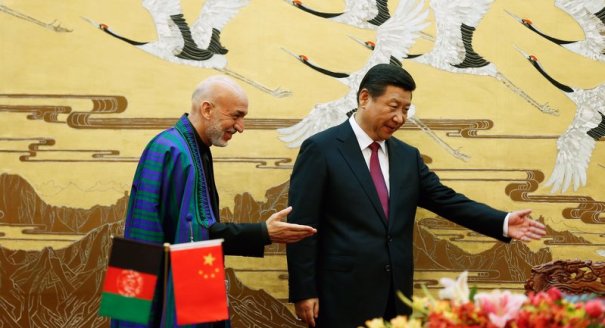
After the U.S. troops withdrawal from Afghanistan, the Taliban will most likely regain the power under the auspices of Pakistan and possibly of another neighbor—China.
The most probable development of the situation in Afghanistan-2014 would be a combination of the two historical cases: the U.S. withdrawal from South Vietnam in 1973, in which the local government quickly surrendered to the Vietcongs, and the U.S. evacuation from Iraq-2011, where the local government managed to keep the peace, though heavily reeling toward the neighboring Iran. In the case of Afghanistan-2014 the Taliban (they are not one, by the way) will regain the power under the auspices of Pakistan and possibly of another neighbor—China.
Most pundits in Russia and Central Asia take it for granted that the United States has an “ambition” to expand its influence in Afghanistan and Central Asia. Sure, this region has a unique strategic advantage; by keeping their military presence there the Americans would be able to yield influence on the surrounding big powers: Russia, China, India, and Iran.
But these people forget that the United States is not inherently imperialistic, and that, more importantly, it is almost impossible to safely maintain large armed forces in this land-locked area. Moreover, if the Afghans do not confer immunity for the American military “advisers” after 2014, Obama will not hesitate to thoroughly and quickly withdraw all forces from Afghanistan, as was the case with Iraq in 2011.
The ethnic composition in Afghanistan is even more complex than in Iraq, and some local aqsaqals will resist the foray of the Taliban (who are mostly ethnic Pashtuns), although the former will be eventually neutralized to allow Taliban’s come-back to power. Taliban’s rule this time, however, may be more “civilized” than it was before 2001, because the Afghan society has become more civilized with urbanization and spread of school education. But Taliban’s resurrection may incur a strong involvement of China in Afghan affairs.
Afghanistan is not alien for China. Afghanistan used to be a vital part of the Silk Road and was a conduit to India from where China imported Buddhism. Today Afghanistan has a more imminent meaning for China, because China fears Pakistani and Taliban terrorists attack in Shinjang, because she would hate Afghanistan to be used as a stronghold of the Uyghur separatists, and because she is now deeply involved in the mining of copper, oil, and gas in Afghanistan.
In September 2012, Zhou Yongkang, then Chinese top security official, made an unannounced visit to Kabul, demonstrating where China’s interests are. In his talk with President Karzai, Zhou offered assistance to the Afghan police and asked for privileges for China’s mining interest.
It seems that many Afghans are not fond of the Chinese, so China will not dare to send armed forces into this country (Afghanistan is notoriously a “graveyard of the superpowers”). Nevertheless, China’s growing influence in Afghanistan may induce Russia to resume her collaboration with Afghanistan’s northern tribes; they are mostly Uzbeks, Tajiks, and Turkmens. Incidentally, oil and gas reserves are mostly located in this area, and therefore the interests of China and Russia may collide here. In Afghanistan, too, Russia’s ambition to form a Eurasian Union now hits against today’s Great Wall, the China’s grandiose “New Silk Road” concept. Those who talk bigger tend to prevail.
Akio Kawato
Writer
Akio Kawato is a former Japanese diplomat and blogger.
Carnegie India does not take institutional positions on public policy issues; the views represented herein are those of the author(s) and do not necessarily reflect the views of Carnegie, its staff, or its trustees.

How is AI reshaping space security, creating governance challenges, and where does international diplomacy stand today?


Tejas Bharadwaj, Almudena Azcárate Ortega

After the chill in ties between 2020 and 2024 that brought India–China relations to their lowest point in several decades, the two countries have engaged each other afresh. This paper argues that there are predominantly four imperatives guiding India’s approach to China, and they exist in an order of priority.

Saheb Singh Chadha

This piece argues that India’s central challenge is not managing a single flashpoint but resolving the underlying tension between expansion and institutional coherency of the BRICS grouping.

Vrinda Sahai

A partnership between India, a country of subcontinental size, and Africa, a continent of fifty-four countries, may seem asymmetric until one notes that both are home to nearly the same number of people—1.4 billion. This essay spells out the existing challenges to the partnership, its optimal potential, and the possible pathways to realize it over the next quarter-century.

Rajiv Bhatia

The U.S.–India semiconductor cooperation story is well-stocked with top-level strategic intent. What remains unresolved, however, are some underlying challenges that will determine whether the cooperation actually functions. Three such friction points stand out.

Shruti Mittal