

Report
- +3
James M. Acton, Alexey Arbatov, Vladimir Dvorkin, …
{
  "authors": [
    "Petr Topychkanov"
  ],
  "type": "commentary",
  "centerAffiliationAll": "",
  "centers": [
    "Carnegie Endowment for International Peace",
    "Carnegie Russia Eurasia Center"
  ],
  "collections": [],
  "englishNewsletterAll": "",
  "nonEnglishNewsletterAll": "",
  "primaryCenter": "Carnegie Russia Eurasia Center",
  "programAffiliation": "",
  "programs": [],
  "projects": [
    "Eurasia in Transition"
  ],
  "regions": [
    "Middle East",
    "Syria",
    "South Asia",
    "India",
    "Russia"
  ],
  "topics": [
    "Security",
    "Foreign Policy",
    "Global Governance"
  ]
}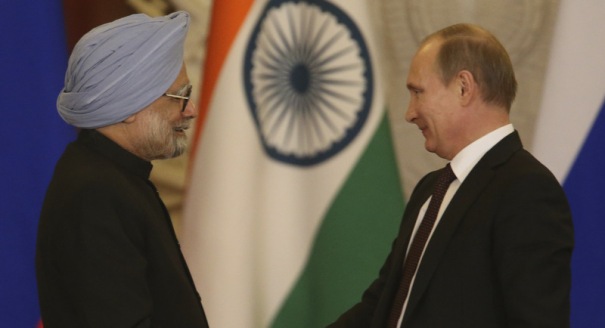
Source: Getty
India would be able to make an important contribution to the resolution of the Syrian crisis.
During the visit of the Indian Prime Minister Manmohan Singh to Moscow, the Russian side disclosed its plan to invite India to take part in the Geneva II. This idea was warmly welcomed by Syria.
This plan has not yet been converted into an official invitation to India and its agreement to attend the talks. But it has already demonstrated contradictions of the India’s position on Syria.
On the one hand, Delhi has traditionally had good relations with Damascus. According to the Business Standard report in October “President Assad expressed his whole-hearted gratitude to the people of India and the government for their consistent support to and solidarity with Syria at this crucial juncture.”
On the other hand, Delhi depends on trade with the Gulf countries, some of which are sponsors of the military opposition to Assad. There are thousands of Indian workers in these countries. It is obvious that India is not ready to emphasize differences in views on Syria with the Gulf countries because this would result in serious economic loses. Also to be mentioned is the extensive security cooperation between Delhi and Tel Aviv. An active support of Assad may reduce the level of trust between them.
Some observers believe that in this situation, “India may have more to lose than gain if it attends the Syrian negotiations in Switzerland,” and that it would “play safe by not getting involved in the negotiations.”
It seems that India could try to follow such advice not only because of its external relations, but also because of the domestic situation. Before general elections, the Indian authorities would prefer not to do anything which could be used by their opponents against them.
In this regard, some people could criticize the Russian plan to invite India to Geneva II, because even if India accepts this invitation, it would not be able to be a loyal ally of Russia at the negotiation table. I have two objections to such a position:
I would like to believe that Russia will be able to send to India an official invitation to Geneva II, and India will be able to make an important contribution to the resolution of the Syrian crisis.
Former Fellow, Nonproliferation Program, Moscow Center
Topychkanov was a fellow in the Carnegie Moscow Center’s Nonproliferation Program.
Recent Work

James M. Acton, Alexey Arbatov, Vladimir Dvorkin, …
Petr Topychkanov
Carnegie India does not take institutional positions on public policy issues; the views represented herein are those of the author(s) and do not necessarily reflect the views of Carnegie, its staff, or its trustees.

As AI grows more sophisticated, as the supply chains that power it become more contested, and as access to frontier models becomes geopolitically charged, India must begin to ask a different set of questions. Not what applications it can build on someone else’s infrastructure but what the world needs.

Konark Bhandari

The Indian Ocean Region hosts one of the densest concentrations of subsea cables in the world. Yet, despite accounting for a significant share of global internet traffic, India’s participation remains limited.

Charukeshi Bhatt

How is AI reshaping space security, creating governance challenges, and where does international diplomacy stand today?


Tejas Bharadwaj, Almudena Azcárate Ortega

After the chill in ties between 2020 and 2024 that brought India–China relations to their lowest point in several decades, the two countries have engaged each other afresh. This paper argues that there are predominantly four imperatives guiding India’s approach to China, and they exist in an order of priority.

Saheb Singh Chadha

This piece argues that India’s central challenge is not managing a single flashpoint but resolving the underlying tension between expansion and institutional coherency of the BRICS grouping.

Vrinda Sahai