• Research
  • About
  • Experts
Carnegie India logoCarnegie lettermark logo
AI
{
  "authors": [
    "Akio Kawato"
  ],
  "type": "commentary",
  "centerAffiliationAll": "",
  "centers": [
    "Carnegie Endowment for International Peace",
    "Carnegie Russia Eurasia Center"
  ],
  "collections": [],
  "englishNewsletterAll": "",
  "nonEnglishNewsletterAll": "",
  "primaryCenter": "Carnegie Russia Eurasia Center",
  "programAffiliation": "",
  "programs": [],
  "projects": [],
  "regions": [
    "East Asia",
    "China",
    "Japan",
    "Russia"
  ],
  "topics": [
    "Political Reform",
    "Economy"
  ]
}

Source: Getty

Commentary
Carnegie Russia Eurasia Center

Russia Needs Immigrants Anyway, But Not Too Many

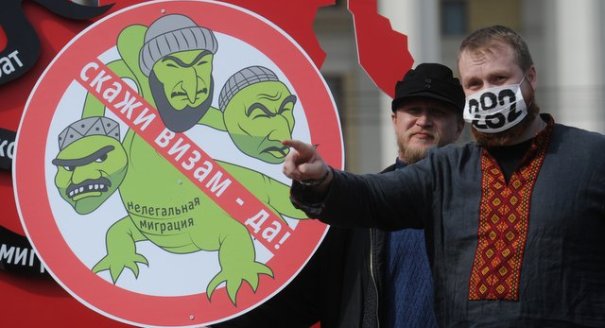
The simple axiom is: as far as you have a sufficient economic growth, you can be generous to the immigrants, but if the economy goes wrong, you should limit the inflow of foreign workers. The Russian economy is now ill, with a growth rate at slightly above one percent. And the more frustrated the Russians become, the more acute the ethnic problem becomes.

Link Copied
By Akio Kawato
Published on Nov 1, 2013

Alexander Pushkin once wrote in his poem, “My uncle is a most worthy man. But when he seriously fell ill, he forced us to hold him in honor. For others this is a mere clinical case, but…”

The Russian economy is now ill, with a growth rate at slightly above one percent. And the more frustrated the Russians become, the more acute the ethnic problem becomes. If the immigrants cause so many problems, Russia had better limit the inflow of immigrants just as the United States and the EU are trying to do.

But the right of immigration to Russia is one of the few means to keep her influence in the former Soviet republics, the Russians themselves would not want to work in construction sites, and the supply of fruits is monopolized by the Caucasus people anyway.

When economy grows, immigration works positively; it enlarges the size of the economy, whereas the immigrants try to adapt themselves to the local norms and mores in an effort to keep their jobs. The best example is the United States. The French thinker Jacques Attali says (“Une brève histoire de l'avenir”) that in 1880-1914 one fifth of the European population and one third of the world savings came over to the United States, and that this pushed up America to a superpower.

But when economy stagnates, immigrants generate social and cultural problems; if they do not have a proper job, they would prefer to stay with their own countrymen without trying to assimilate themselves into the local society. A typical example is today’s EU, in which non-Europeans constitute more than ten percent of the population. European indigenous people complain that immigrants take jobs and that they do not respect the local values and customs. The ensuing xenophobia brings to the fore ultra-nationalist or even fascist movement in Europe.

Japan is somewhere in-between. Contrary to the general understanding, Japan does have her own ethnic problems. About four hundred thousand ethnic Koreans remain in Japan since the pre-war days, and besides around two million foreigners permanently live in Japan (one third of them are the Chinese). Chinese waitresses are common in small Chinese noodle shops, Chinese clerks serve you in convenience stores, and you can find Chinese managers in numerous Japanese companies. (Many of them speak fluent Japanese, English, and of course Chinese. They are highly motivated and intelligent.)

However, thank God, we do not witness many ethnic confrontations. It is not only because we cannot distinguish Chinese and Koreans from Japanese, but also because most Japanese, Chinese, and Koreans are busy in making ends meet in their life in Japan (and they succeed in doing so).

There is no simple solution to the immigration issue. One has to keep balance between costs and benefits which immigration entails. And the equilibrium always fluctuates, depending upon the economy, politics, and society. The simple axiom is: as far as you have a sufficient economic growth, you can be generous to the immigrants, but if the economy goes wrong, you should limit the inflow of foreign workers.

But if Russia ever prohibits foreign workers, then she may have to cede to China the position as an Eldorado for foreign immigrant workers. Remember that in September the Chinese leader Xi Jinping proposed a visa-free traffic among the member countries of the Shanghai Cooperation Organization.

If Pushkin lived today, what kind of advice would he give? Or would he be again silenced in another duel, this time perhaps with a Chinese?

About the Author

Akio Kawato

Writer

Akio Kawato is a former Japanese diplomat and blogger.

Akio Kawato
Writer
Political ReformEconomyEast AsiaChinaJapanRussia

Carnegie India does not take institutional positions on public policy issues; the views represented herein are those of the author(s) and do not necessarily reflect the views of Carnegie, its staff, or its trustees.

More Work from Carnegie India

  • Paper
    Threading the Needle: India’s Path Forward with China

    After the chill in ties between 2020 and 2024 that brought India–China relations to their lowest point in several decades, the two countries have engaged each other afresh. This paper argues that there are predominantly four imperatives guiding India’s approach to China, and they exist in an order of priority.

      Saheb Singh Chadha

  • Article
    Managing Divergence: India’s BRICS Presidency in 2026

    This piece argues that India’s central challenge is not managing a single flashpoint but resolving the underlying tension between expansion and institutional coherency of the BRICS grouping.

      Vrinda Sahai

  • Article
    India’s Press Note 3 Gamble: Opening the FDI Door to China

    On March 10, 2026, India’s Union Cabinet approved amendments to Press Note 3, a regulation that mandated government approval on all foreign direct investment (FDI) from countries sharing a land border with India. This amendment raises questions primarily about whether its stated benefits will materialize and if the risks have been adequately weighed. This piece will address the same.

      Konark Bhandari

  • Commentary
    The Impact of U.S. Sanctions and Tariffs on India’s Russian Oil Imports

    This piece examines India’s response to U.S. sanctions and tariffs, specifically assessing the immediate market consequences, such as alterations in import costs, and the broader strategic implications for India’s energy security and foreign policy orientation.

      Vrinda Sahai

  • Paper
    India-China Economic Ties: Determinants and Possibilities

    This paper examines the evolution of India-China economic ties from 2005 to 2025. It explores the impact of global events, bilateral political ties, and domestic policies on distinct spheres of the economic relationship.

      Santosh Pai

Get more news and analysis from
Carnegie India
Carnegie India logo, white
Unit C-4, 5, 6, EdenparkShaheed Jeet Singh MargNew Delhi – 110016, IndiaPhone: 011-40078687
  • Research
  • About
  • Experts
  • Projects
  • Events
  • Contact
  • Careers
  • Privacy
  • For Media
Get more news and analysis from
Carnegie India
© 2026 Carnegie Endowment for International Peace. All rights reserved.