

Q&A
Dara Massicot, Aaron David Miller, Andrew S. Weiss
{
  "authors": [
    "Andrew S. Weiss"
  ],
  "type": "legacyinthemedia",
  "centerAffiliationAll": "dc",
  "centers": [
    "Carnegie Endowment for International Peace"
  ],
  "collections": [],
  "englishNewsletterAll": "ctw",
  "nonEnglishNewsletterAll": "",
  "primaryCenter": "Carnegie Endowment for International Peace",
  "programAffiliation": "russia",
  "programs": [
    "Russia and Eurasia"
  ],
  "projects": [],
  "regions": [
    "Russia"
  ],
  "topics": [
    "Security"
  ]
}
Source: Getty
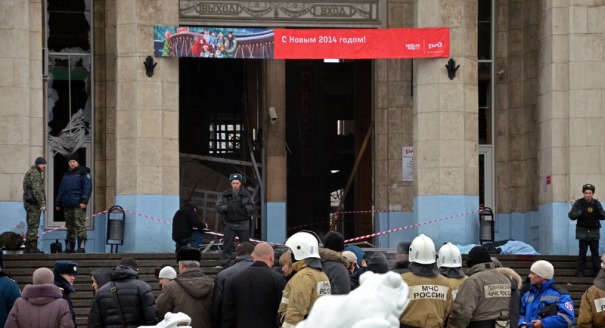
As Russia prepares for the Winter Olympic Games in Sochi, two terrorist attacks in Volgograd raise questions about security at the games and throughout the country.
Source: PBS NewsHour
HARI SREENIVASAN: Joining me now to discuss who might be behind the attacks and the security situation surrounding the upcoming Olympic Games are Andrew Weiss, an adviser on Russian in the Clinton White House. He's now a vice president at the Carnegie Endowment For International Peace. And Brian Jenkins has been a security consultant for major sporting events, including the Olympics and the World Cup. He's a terrorism expert and senior adviser at the RAND Corporation.
Andrew, I want to start with you.
What organization could be behind these attacks? You were also telling me that perhaps yesterday's bomber wasn't a woman. There is more information coming out?
ANDREW WEISS, Carnegie Endowment For International Peace: So, everything we know right now is very fragmentary.
The current Russian press accounts suggest that the bomber from Sunday's attack on the train station is a Russian -- ethnic Russian convert to Islam who comes from the Russian heartland from the Volga basin who moved to the Dagestan region to join the fighters there. There is at this point no information about who is responsible for the trolley bus attack earlier today.HARI SREENIVASAN: And, so, Brian Jenkins, I want to ask, when we think about these large sort of events like the Olympics and some event like this proceeding that, how does Russia prepare for it?
BRIAN JENKINS, RAND Corporation: Well, security has become an extremely important part of Olympic planning, ever since the Munich attack in 1972.
And security has come to really be a dominant issue. We saw enormous security for the Beijing Olympics and -- in 2008 and for the London Olympics in 2012. By now, all of the security measures would have been in place in Sochi.
And those would include measures to protect the actual venues, the sites of the events themselves, measures in place to protect the participants in those events, both the athletes and the officials, as well as measures to protect the spectators who will be coming to view the events.
HARI SREENIVASAN: Andrew, if all of this emphasis has been on Sochi, does that leave the rest of Russia unprotected and possibly targets for, I guess, insurgents?
ANDREW WEISS: I think there is no doubt that the Russian security establishment can do good site security. It can protect hard or symbolic -- symbolically important targets. You go to Red Square, there is no doubt there is a very strong security presence.
But you go to any major Russian train station, there are machines set up like the ones that apparently were in part of the attack yesterday that are there to scan your luggage, people just breeze past. I have never had to put my bags in recent memory on those kinds of scanning devices.
So I think the country abounds in soft targets. I think the rebel groups that are interested in embarrassing the regime ahead of the Olympic Games are likely to be looking for places where the security presence is either porous or minimal.
HARI SREENIVASAN: So, Brian Jenkins I have got to ask. Russia has been dealing with these sorts of -- this sort of low-level insurgency for years now. Why haven't they been able to stamp it out?
BRIAN JENKINS: Well, you know, the conflicts in the Caucasus go aback centuries. This is a long narrative of an area that has been conquered by, but never entirely pacified by Russia.
What we saw recently are two nasty wars. That has -- that has activated an increasingly Islamist character of the insurgency in itself. Stamping out a group like this takes -- often takes decades. We do see examples around the world where terrorist campaigns have gone on for scores of years.
HARI SREENIVASAN: Andrew Weiss, the timing of this, there is clearly a point to this. This is something that some of the sort of opposition has been saying out loud: We are planning to attack something near Sochi, if not Sochi.
But they're making a statement just by the timing of this, right?
ANDREW WEISS: I think the timing is -- is dreadful.
The Russian public are on their way to their biggest holiday of the year, which is New Year's. And so to create an atmosphere of panic and concern throughout the Russian body politic is a big deal.So, if you went to Moscow today, you would have seen train stations that were being evacuated, random searches.
And so I think it has created a real sense for people that there is a real threat, there's a live threat, and the authorities are going to be struggling to head it off.
HARI SREENIVASAN: So, Brian Jenkins, considering that the eyes of the world are going to be on Sochi, what sorts of measures have the Russians taken? There have been reports that they have essentially almost sealed off the city or they will seal off the city almost a month before the Games.
BRIAN JENKINS: Well, that is certainly their goal. They are going to try to turn the entire city of Sochi into the security equivalent of Ben-Gurion Airport in Tel Aviv. And so there will be multiple checks.
Something that's new at this Olympics that we haven't seen before are the credentialing of the spectators themselves. That is, people who buy tickets go online to buy these tickets, receive a credential, and that will become a way of verifying their identity at the entry to each one of the -- each one of the venues.
In addition, they have introduced a system that will enable them to monitor every telephone call, every e-mail message. Every form of electronic conversation, electronic communications in Sochi will be not only monitored, but they will have the ability to intervene and modify the messages themselves.
Beyond that, though, I mean, look, you can defend a piece of territory, protect a piece of territory for a period of time, but if the terrorists have virtually unlimited targets across Russia, what you're concerned about is either that there are people already in Sochi that have already infiltrated, and there are prepositioned weapons or devices in Sochi -- and the Russians have reported that they have busted up some plots where there have been prepositioned material at least close to Sochi -- or you worry about an attack that will be concurrent to the Olympics, but in another part of the country, but that nonetheless will cause embarrassment.
One of the greatest concerns is that we will see something like a Nairobi shopping mall attack or a -- more ambitiously, a Mumbai attack, or like some of the major hostage seizures that we have seen carried out by the Chechens before, with demands to suspend the Olympics.
HARI SREENIVASAN: So, Andrew, how much do the politics of Vladimir Putin and his tactics now play into this situation?
ANDREW WEISS: I think the Russian tactic and playbook has been pretty consistent over the past 15 years.
They have -- in the case of Chechnya, they basically pacified that country with the aid of a local warlord. So they have basically said anyone who is religiously observant, who is not fitting the sort of standard profile of a peaceful citizen, you are in our sights.
In Dagestan, they have a total mess on their hands, where you have a conflict with three or four layers. There is tremendous youth unemployment, radicalization. There is a fight in terms of two different strains of Islam. You have a corrupt authoritarian local government and a very heavy-handed security response.
So, in many ways, the Russians have created this problem. They have found no solution to fix it.
HARI SREENIVASAN: All right, Andrew Weiss from the Carnegie Endowment for International Peace, Brian Jenkins from the RAND Corporation, thanks so much for your time.
James Family Chair, Vice President for Studies
Andrew S. Weiss is the James Family Chair and vice president for studies at the Carnegie Endowment for International Peace, where he oversees research on Russia, Ukraine, and Eurasia. His graphic novel biography of Vladimir Putin, Accidental Czar: the Life and Lies of Vladimir Putin, was published by First Second/Macmillan in 2022.
Recent Work

Dara Massicot, Aaron David Miller, Andrew S. Weiss

Frances Z. Brown, Nate Reynolds, Priyal Singh, …

In any defense establishment, change is an ongoing process. However, despite the best of intentions, existing bureaucracies, bound by habit and years of socialization, have their limits in implementing transformative change.

Anit Mukherjee

After the chill in ties between 2020 and 2024 that brought India–China relations to their lowest point in several decades, the two countries have engaged each other afresh. This paper argues that there are predominantly four imperatives guiding India’s approach to China, and they exist in an order of priority.

Saheb Singh Chadha

This piece argues that India’s central challenge is not managing a single flashpoint but resolving the underlying tension between expansion and institutional coherency of the BRICS grouping.

Vrinda Sahai

This piece argues that the present Indian strategy, based on opportunistic diversification and utilization of limited strategic reserves, remains inadequate when confronting supply disruptions. It evaluates India’s options in the short, medium, and long terms.
Vrinda Sahai

This piece examines India’s response to U.S. sanctions and tariffs, specifically assessing the immediate market consequences, such as alterations in import costs, and the broader strategic implications for India’s energy security and foreign policy orientation.
Vrinda Sahai