

Commentary
The 1986 incident showed that a nuclear accident anytime is a nuclear accident for all time.
Corey Hinderstein
{
  "authors": [
    "Dara Massicot",
    "Aaron David Miller",
    "Andrew S. Weiss"
  ],
  "type": "questionAnswer",
  "blog": "Emissary",
  "centerAffiliationAll": "dc",
  "centers": [
    "Carnegie Endowment for International Peace"
  ],
  "englishNewsletterAll": "americanStatecraft",
  "nonEnglishNewsletterAll": "",
  "programAffiliation": "ASP",
  "programs": [
    "American Statecraft",
    "Russia and Eurasia"
  ],
  "regions": [
    "Russia",
    "Ukraine"
  ],
  "topics": [
    "Military",
    "Defense"
  ]
}
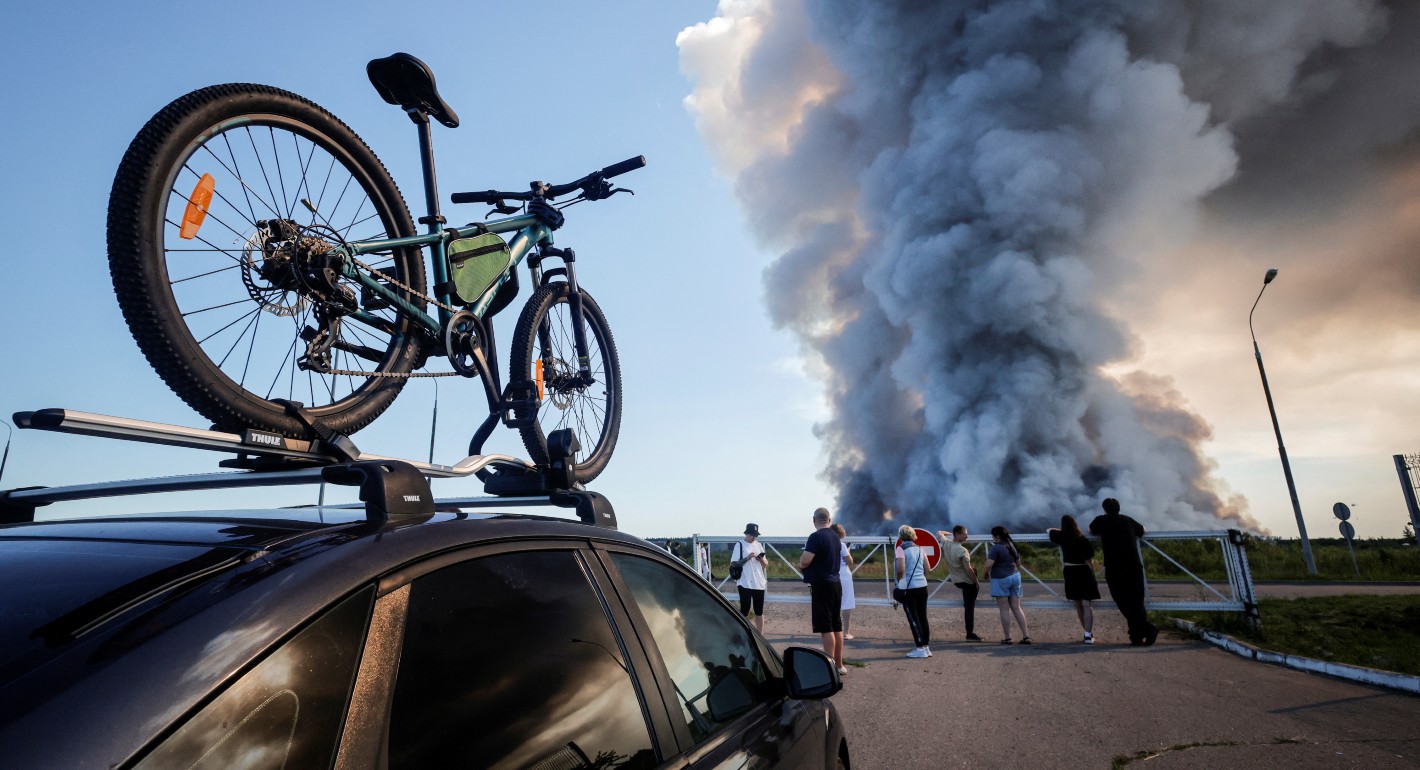
Bystanders watch as Wildberries’ logistics complexes burn on July 18, 2026, outside Moscow. (Photo by Tatyana Makeyeva/AFP via Getty Images)
Media coverage suggests Kyiv’s fortunes have changed. That shift may be important, but it only goes so far.
On a recent episode of Carnegie Connects, host Aaron David Miller spoke with Carnegie’s Dara Massicot and Andrew S. Weiss about the latest in the Russia-Ukraine war. A portion of their conversation, which has been edited and condensed for clarity, is below.
Aaron David Miller: Dara, you’re just back from Ukraine. Can you give us a sense of what the contours of the battlefield look like?
Dara Massicot: We are at the peak of summer offensive season. Fighting is active along the entire front. Russia continues to prioritize Donetsk, where they’re allocating a lot of resources and really adding pressure on the Ukrainians there.
But all in all, I was left with an impression that both sides are very calibrated to each other on the ground. Although I wouldn’t describe this as a stalemate, I do think we probably could use the word “stalemate” when it comes to armored maneuver. Both sides are not really able to use tanks or anything like that anymore because the environment is so complicated with drones and FPVs [first-person view munitions].
It is a combination of positional and attritional warfare. Russia continues to try to infiltrate with infantry at high cost to itself. And Ukraine continues to suppress them with drones in artillery. That hasn’t changed.
The second part of that question is, of course, we’re seeing in the news the ballistic missile strike campaign against Kyiv and other large cities is ramping up, as Russia realizes that Kyiv is out of Patriot interceptors, which are really the primary mechanism to intercept ballistic missiles. So I do think that we’re going to see Russia push on this issue more and more.
Aaron David Miller: What could change the situation?
Dara Massicot: The kill zone is expanding. Now we’re looking at 20 to 25 or 30 kilometers now, given the level of saturation on both sides of drones and FPVs. It’s really difficult to move to positions. It’s difficult to resupply positions. It’s incredibly difficult to group any type of mechanisms together before they are suppressed with artillery and drones.
I am not sure that there’s anything that I see on the six-month horizon could change that. The Russians are attempting attacks of various sizes every day. They don’t stop. We see them experimenting with larger mechanized assaults, but we just saw one defeated the other day. It was a roughly one battalion’s worth—that’s about twenty or thirty tanks and armored vehicles. If we saw them do this at a much larger scale simultaneously, that might make some problems. But they can’t—as soon as they begin to cluster, they get targeted. So again, I don’t see anything on the horizon this year that solves that main problem for both.
Aaron David Miller: There’s this vibe in media coverage that fortunes have turned and that Ukraine is doing really well. Is that vibe real?
Andrew S. Weiss: I think that the vibe shift is important, but it only goes so far. It’s hugely important that Russia is off balance, especially as a result of what Ukrainians have been doing since April: hitting Russian logistics through the so-called middle strike campaign, and then this really relentless pounding of Russian energy infrastructure, defense industrial sites, and some of the big cities.
Russia doesn’t have a counter in place right now for what Ukraine is able to do. I think it foreshadows the big strategic problem that Vladimir Putin created for himself, which is that Ukraine is always going to be expanding and innovating and creating new capabilities, and Russia’s going to have to defend against those. And those will be threatening and risky for the long term. So Putin, the strategic genius, has created a hornet’s nest that he has no solution for because total victory is off the table.
I think the vibe shift really was aimed at Putin and at shaking some of his confidence that all he has to do is keep punching and eventually he’ll get a breakthrough. As Dara just outlined, that’s a misplaced expectation.
The other key audience that we shouldn’t discount is Donald Trump. A lot of these activities were reaching their crescendo in the run-up to the NATO summit in Turkey at the beginning of July. Trump likes a winner, and Trump has been the big X factor in some of this because he has the ability to apply tremendous leverage on Ukraine and to try to ram a bad deal down Volodymyr Zelensky’s throat. That’s been something that the Ukrainians and the Europeans have been very worried about, especially given that the war with Iran has not gone well. People have been worried that Trump would look for other ways to show that he still has his mojo. I think that is now less of a concern because Zelensky is not desperate for a deal and Ukraine doesn’t feel like it’s on its last legs.
What this adds up to is a more protracted war. There’s no likelihood that Putin will ratchet back and decide that he can’t get what he wants. I think he will continue to hope either that he can leverage the Trump administration’s deep affection for him and put the screws on Zelensky or that something will break and things will go his way. So far, nothing in the mix will force him to behave differently, and that’s the great tragedy.
Invalid video URL
Aaron David Miller: The New York Times ran a story that Ukraine has now struck at least ten Wildberries warehouses. Wildberries is what, the equivalent in American terms of Amazon? At what point do Russians suffer pain and real dislocation, or has it already happened and there’s not much they can do about it?
Dara Massicot: Wildberries is mostly like Amazon, except for some of its dual-use military stuff that’s also stored there. It’s slightly more military-adjacent than we would consider a purely civilian situation.
What does this mean for the average Russian? Let’s isolate this a bit. In Crimea, the middle strike campaign is causing real problems for Russian citizens there. They’re not getting food. They’re not getting enough water. Electricity is spotty. Gas shortages are the main problem. As it was described to us, the Russian military in Crimea is making sure that it gets its survival needs met, but it’s not really looking after the civilians very much. So the civilians are leaving, and they’re angry, and they are talking about it. And that is the sort of thing that gets the Kremlin’s attention.
But I’m not seeing the pain from the Kremlin. And part of that reason is there has been a lot of false reporting in the Russian military up the chain on where their actual positions are. The Russians, depending on which map you read, are 15 kilometers outside one of these fortress cities or 4 kilometers outside the fortress city. Four is a lot different from fifteen when we were talking about this kind of grueling fight. If Putin’s people are telling him, “We’re four kilometers ahead, and we can do this in the next two months,” then that seems like a good sell to him. Let’s keep the pace, right?
I don’t know how we in the West have an ability to get inside that decisionmaking loop of a very closed system. But right now, it’s still all systems go.
Aaron David Miller: What’s the relationship of the war to domestic opinion and and lifestyle for Russians? Does it matter if you’re in Moscow versus out in the provinces?
Andrew S. Weiss: I think the lifestyle impact is really concentrated on one guy, and last I checked, Vladimir Putin has a very comfortable lifestyle. I’m not sure his summer vacation plans are going to involve gas lines or having to worry about getting a hot meal in Crimea.
All glibness aside, the Russian people don’t get a vote. And the Kremlin’s strategy, even before the war, was to keep the Russian public atomized politically and passive. That is not necessarily showing any real cracks in terms of broader political mobilization. There’s certainly nothing in what I think matters the most: elite fracturing.
This war, from Putin’s perspective, isn’t going to hinge on economic factors. I really think we in the West, when we’re sort of out of options, we lean back on economic determinism, as if, you know, Putin opens the Wall Street Journal in the morning and looks at how the markets are doing. That’s just not what we’re dealing with. It’s a system in which there’s plenty of opportunities for him to either rob Peter to pay Paul or to grab resources to keep the war going.
For more, listen to or watch the full conversation, and subscribe to Carnegie Connects.
Understand the world with the latest from our scholars around the world.

Senior Fellow, Russia and Eurasia Program
Dara Massicot is a senior fellow in the Russia and Eurasia Program at the Carnegie Endowment for International Peace. Her work focuses on defense and security issues in Russia and Eurasia.

Senior Fellow, American Statecraft Program
Aaron David Miller is a senior fellow at the Carnegie Endowment for International Peace, focusing on U.S. foreign policy.

James Family Chair, Vice President for Studies
Andrew S. Weiss is the James Family Chair and vice president for studies at the Carnegie Endowment for International Peace, where he oversees research on Russia, Ukraine, and Eurasia. His graphic novel biography of Vladimir Putin, Accidental Czar: the Life and Lies of Vladimir Putin, was published by First Second/Macmillan in 2022.
The 1986 incident showed that a nuclear accident anytime is a nuclear accident for all time.
Corey Hinderstein
Putin’s blunder has created new and enduring security challenges for Russia and Europe.
Eugene Rumer
Two experts discuss how drone technology is shaping yet another conflict and what the United States can learn from Ukraine.

Steve Feldstein, Dara Massicot
On the fourth anniversary of Russia’s full-scale invasion, Carnegie experts discuss the war’s impacts and what might come next.


Eric Ciaramella, Aaron David Miller, Alexandra Prokopenko, …
It’s dangerous to dismiss Washington’s shambolic diplomacy out of hand.
Eric Ciaramella