

Q&A
Milan Vaishnav, Ila Patnaik
{
  "authors": [
    "Ila Patnaik"
  ],
  "type": "legacyinthemedia",
  "centerAffiliationAll": "dc",
  "centers": [
    "Carnegie Endowment for International Peace"
  ],
  "collections": [],
  "englishNewsletterAll": "ctw",
  "nonEnglishNewsletterAll": "",
  "primaryCenter": "Carnegie Endowment for International Peace",
  "programAffiliation": "SAP",
  "programs": [
    "South Asia"
  ],
  "projects": [],
  "regions": [
    "South Asia",
    "India"
  ],
  "topics": [
    "Democracy",
    "Civil Society"
  ]
}
Source: Getty
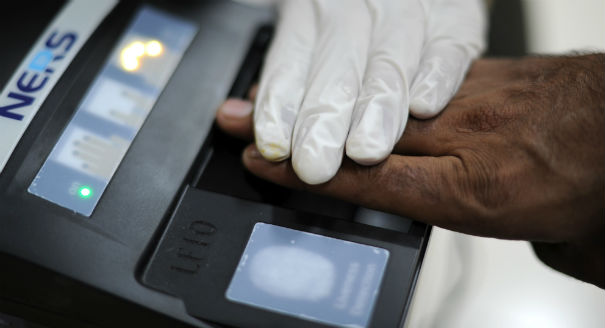
India should step up its use of biometric identification to streamline its welfare system.
Source: Indian Express
The government appears to be working towards an amicable solution on the question of who can collect biometric information data for the Indian population. There has been disagreement about whether this will be done by the UIDAI headed by Nandan Nilekani, or the National Population Register headed by Home Minister P. Chidambaram. It now seems that both may continue to collect data but share its use.
When any country sets about building biometric tracking of each individual, with full information held by the government, there are concerns about privacy and protection for the individual. There is legitimate concern when governments are given more information and more power. There is much merit in this discomfort. Elaborate systems of checks and balances are required before giving any power to the government.As the many attacks on freedom of speech around us demonstrate, Indian democracy is as yet a fledgling project. Judges are supposed to be the ultimate defenders of freedom, but we even have judges who want censoring of the Internet as in China. A population-wide biometric UID, whether implemented by the UIDAI or by the NPR, could prove to be dangerous in the hands of an authoritarian government. The concerns of those who are worrying about the interaction between biometric databases and the Indian state are in that way legitimate.
There is, however, one class of applications of biometric identification which is unencumbered by controversy. This is about implementation of government transfer and subsidy programmes.
At present, product subsidies (for instance diesel or LPG) are done when the government is not able to clearly identify the poor. A government that cannot identify the poor tends to indulge in wastage of public resources, giving money to all users of diesel or LPG. The bulk of LPG or diesel is consumed by the rich, so the existing subsidy programme is extremely inefficient. This is effectively a reallocation of resources from the poor to the rich. The money that is spent here is money that could have been used for producing genuine public goods such as police or judiciary, in establishing water and sanitation systems, or in building railway lines. The money that is spent here drives up the fiscal deficit, which hurts everyone through maladies such as inflation and reduced GDP growth. The net effect of not targeting a subsidy properly is undoubtedly bad for the poor and bad for everyone.
Despite decades of complaining about these problems, the status quo has stayed in place. The Left and the Right agree that diesel and LPG subsidies are wrong, that the bulk of PDS grains is stolen, etc. Yet, the decades are going by without any sign of subsidy reform.
Not all the theft can be attributed to problems of ghost or duplicate identity. Corruption also happens when the better-off households are misidentified as poor. In addition, theft happens when trucks carrying wheat are stolen somewhere along the way. Wastage happens when it is eaten up by rats in warehouses, or rots even before it reaches the warehouses. All those problems need to be addressed. But the problem of duplication and ghost households who obtain PDS grain and kerosene can be taken care of if every household that is supposed to be given subsidised wheat and rice can be issued a unique identity, through which it obtains the subsidised product, it can prevent the theft taking place in PDS.
Critics of a food stamp system are worried that there will be corruption in handing out these stamps or the rich will somehow get them. A black market would spring up, where food stamps are traded and used as quasi-cash. Biometric identity will help greatly. If the IDs are linked to bank accounts, then one can conceive of a system in which instead of the government hoarding up millions of tons of grain, BPL families would buy rice from the open market, using the ID provided to the head of the household and her bank account would be credited the amount of the subsidy.
But that will only be a small part of the gain. The bigger gain will be in products such as diesel or LPG where the subsidy is given to all consumers. Once subsidy can actually be delivered to some, these individuals can be provided stamps or vouchers,or it could be paid directly into their bank accounts for every litre of diesel bought,say by farmers,who are expected to use it for pump irrigation.
All payment currently being made by the government, whether widow pensions, NREGA payments ,girl child payments etc. if made electronically and using a biometric identification system will help reduce harassment. Harassment, especially of young widows, while trying to get their pensions is a daily feature of life that few women dare to protest against. Instead of physically presenting themselves at a government office, a biometric ID presented at a bank branch will establish proof of living as well as prevent delays and harassment.
These advantages of identification, targeted subsidies and electronic payments do not depend on who provides these IDs. Biometric identification for anyone who wishes to connect to a government subsidy program, without a short-term effort to roll out for the entire population, would address concerns about civil liberties and the future of Indian democracy. As far as the population is concerned, the agency that can put the system of providing IDs most efficiently and at a lower cost should be made responsible for doing that.
Former Nonresident Senior Associate, South Asia Program
Patnaik, an expert on India’s economy, was a nonresident senior associate in Carnegie’s South Asia Program.
Recent Work

Milan Vaishnav, Ila Patnaik
Ila Patnaik, Ajay Shah
Carnegie India does not take institutional positions on public policy issues; the views represented herein are those of the author(s) and do not necessarily reflect the views of Carnegie, its staff, or its trustees.

In any defense establishment, change is an ongoing process. However, despite the best of intentions, existing bureaucracies, bound by habit and years of socialization, have their limits in implementing transformative change.

Anit Mukherjee

As AI grows more sophisticated, as the supply chains that power it become more contested, and as access to frontier models becomes geopolitically charged, India must begin to ask a different set of questions. Not what applications it can build on someone else’s infrastructure but what the world needs.

Konark Bhandari

The Indian Ocean Region hosts one of the densest concentrations of subsea cables in the world. Yet, despite accounting for a significant share of global internet traffic, India’s participation remains limited.

Charukeshi Bhatt

How is AI reshaping space security, creating governance challenges, and where does international diplomacy stand today?


Tejas Bharadwaj, Almudena Azcárate Ortega

After the chill in ties between 2020 and 2024 that brought India–China relations to their lowest point in several decades, the two countries have engaged each other afresh. This paper argues that there are predominantly four imperatives guiding India’s approach to China, and they exist in an order of priority.

Saheb Singh Chadha