

Article
Thomas de Waal
{
  "authors": [
    "Thomas de Waal"
  ],
  "type": "commentary",
  "centerAffiliationAll": "",
  "centers": [
    "Carnegie Endowment for International Peace",
    "Carnegie Europe",
    "Carnegie Russia Eurasia Center"
  ],
  "collections": [],
  "englishNewsletterAll": "",
  "nonEnglishNewsletterAll": "",
  "primaryCenter": "Carnegie Europe",
  "programAffiliation": "",
  "programs": [],
  "projects": [],
  "regions": [
    "Caucasus",
    "Russia",
    "Georgia"
  ],
  "topics": [
    "Foreign Policy"
  ]
}
Source: Getty
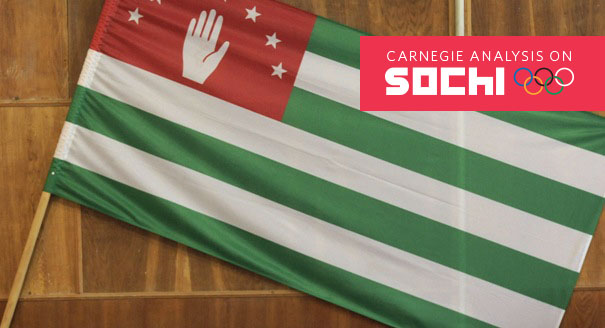
Abkhazia has a right to feel disappointed. The Olympic Games are happening just a few miles to the north and yet the republic has little to do with it.
People in Abkhazia have a right to feel disappointed. The Olympic Games are happening just a few miles to the north and yet the republic—still regarded by most of the world as the sovereign territory of Georgia, recognized by Russia as independent—has little to do with it.
This is has very little to do with Georgian pressure, and a lot to do with Russia's own calculations. Two years ago, it was surely part of Vladimir Putin's plan to use the Sochi Games as a vindication for his 2008 recognition policy of Abkhazia—and simultaneously poke his bête noire, then Georgian leader Mikheil Saakashvili, in the eye.
There was speculation about opening the airport in Abkhazia or settling Olympic tourists in Gagra and Pitsunda. It would have been quite easy to give Abkhaz President Alexander Ankvab a prominent seat at the Opening Ceremony.
None of that happened. As the Sochi games turned into Russia's "Lockdown OIympics," politics was subordinated to security. For the Russian authorities, the turning point was surely the assassination last September in Abkhazia of the Russian vice-consul there. A Chechen, now in detention in Georgia, is the prime suspect.
That killing will have prompted the decision to set up a new 11-kilometer "border zone" south of the River Psou that divides Abkhazia from Sochi. The Georgian foreign ministry issued a formal protest (even though the decision had no real consequences for them), but the main losers were the local Abkhaz who had to put up with extra security measures—and who anyway cannot even take their cars across the border to Sochi and must use public transport to travel to the games.
Ankvab was at the ceremony but not conspicuously. He at least will be grateful for the games because they have put on ice a domestic political struggle inside Abkhazia which will probably resume in the spring.
All in all, the main thing the Georgians got upset about was a satellite picture of their country at the Opening Ceremony in which Abkhazia and South Ossetia were obscured by clouds.
And the main achievement for Abkhazia was the success of a stunning tourist video advertising its natural beauty in many languages, including the extraordinary throaty native language of the Abkhaz themselves. Those lakes and mountains are still beautiful—and still remote.

Senior Fellow, Carnegie Europe
Thomas de Waal is a senior fellow at Carnegie Europe, specializing in Eastern Europe and the Caucasus.
Recent Work
Thomas de Waal
Thomas de Waal
Carnegie India does not take institutional positions on public policy issues; the views represented herein are those of the author(s) and do not necessarily reflect the views of Carnegie, its staff, or its trustees.

After the chill in ties between 2020 and 2024 that brought India–China relations to their lowest point in several decades, the two countries have engaged each other afresh. This paper argues that there are predominantly four imperatives guiding India’s approach to China, and they exist in an order of priority.

Saheb Singh Chadha

This piece argues that India’s central challenge is not managing a single flashpoint but resolving the underlying tension between expansion and institutional coherency of the BRICS grouping.

Vrinda Sahai

A partnership between India, a country of subcontinental size, and Africa, a continent of fifty-four countries, may seem asymmetric until one notes that both are home to nearly the same number of people—1.4 billion. This essay spells out the existing challenges to the partnership, its optimal potential, and the possible pathways to realize it over the next quarter-century.

Rajiv Bhatia

The India–EU Free Trade Agreement (FTA) is shaping up to be one of the most consequential trade negotiations, both economically and strategically. But, what’s in the agreement, what’s missing, and what will determine its success in the years ahead
Vrinda Sahai, Nicolas Köhler-Suzuki

Trump 2.0 has unsettled India’s external environment—but has not overturned its foreign policy strategy, which continues to rely on diversification, hedging, and calibrated partnerships across a fractured order.



Milan Vaishnav, ed., Sameer Lalwani, Tanvi Madan, …