

Commentary
Dmitri Trenin
{
  "authors": [
    "Dmitri Trenin"
  ],
  "type": "commentary",
  "centerAffiliationAll": "",
  "centers": [
    "Carnegie Endowment for International Peace",
    "Carnegie Russia Eurasia Center"
  ],
  "collections": [],
  "englishNewsletterAll": "",
  "nonEnglishNewsletterAll": "",
  "primaryCenter": "Carnegie Russia Eurasia Center",
  "programAffiliation": "",
  "programs": [],
  "projects": [],
  "regions": [
    "North America",
    "United States",
    "Russia",
    "Eastern Europe",
    "Ukraine"
  ],
  "topics": [
    "Political Reform",
    "Civil Society"
  ]
}
Source: Getty
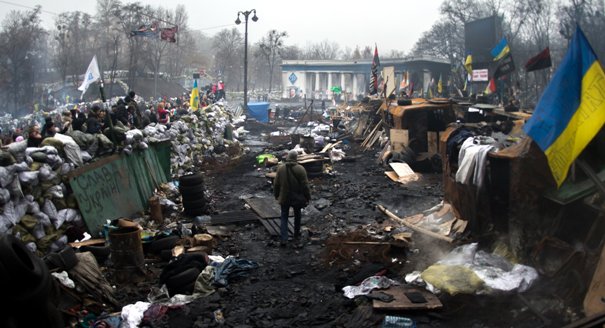
To keep Ukraine in one piece, and at peace with itself, the Ukrainians evidently need to reform their political system. The West and Russia should help the Ukrainian parties reach an agreement on the parameters of a federal parliamentary republic.
Curiously, the Olympic Games in Sochi have seemingly put the Ukrainian crisis on hold. However, in the last several weeks, this crisis has reached the stage beyond which its further aggravation would lead to severe consequences for Russia, the European Union, and the United States. Yet, overtly at least, the principal outside parties have been more engaged in polemics and counter-accusations than in looking for ways to begin jointly managing the situation in Europe's biggest country outside Russia. This needs to give way to more positive interaction.
As elsewhere, for example Syria and Iran, Russian-Western collaboration on Ukraine would not be based on their new rapprochement, and should not be seen as paving the way to it. Rather, it would stem from the recognition of the fact that an unstable Ukraine will damage both Russia and the EU economically and would draw them, alongside the United States, in an unnecessary, yet damaging political competition. The starting point, then, should be helping Ukraine to stay in one piece, and on its own.
In principle, this should be reasonably easy to agree upon. The recent developments have amply demonstrated to the EU and to Russia that "winning" Ukraine to their side would be prohibitively costly, in economic and financial terms. Even more important, in political terms, Ukraine would rather break up than go either west or east. During the current crisis, the political dynamics in West-Central and South-Eastern Ukraine have been strikingly different. Still, division of the country along geographical lines can hardly happen peacefully, and should be seen not as a solution to promote, but as a catastrophe to be avoided.
To keep their country in one piece, and at peace with itself, the Ukrainians evidently need to reform their political system. The current unitary set-up with a strong presidency should be replaced with a system better attuned to reflecting the Ukrainian political culture and the diversity of the country. A parliamentary system would provide for a healthier balance of interests across the entire country, and a federal structure would give the regions a role in governance and a stake in national unity.
The EU, the United States, and Russia should help the Ukrainian parties reach an agreement on the parameters of a new—fourth—Ukrainian republic. The Ukrainians are already moving in that direction. Within the next 12 months, a new Constitution needs to be instituted, and new parliamentary elections held. The government formed as a result of the national vote will face the daunting task of keeping Ukraine going, economically. This will only be possible if there is a modicum of domestic unity, and if there is a certain amount of international cooperation, essentially between Russia and the West.
Once the Olympics are over in two weeks' time, Ukraine may return to the front pages with a vengeance. The way forward is for Russian President Vladimir Putin and German Chancellor Angela Merkel to take up the issue of Ukraine at their next inter-governmental consultations in March in Germany. Ukraine should be viewed as an area of pragmatic German-Russian cooperation for the sake of regional stability, not an area of lose-lose geopolitical competition. Moscow and Berlin should give Ukraine time to perfect its polity and overhaul its economy before the EU and Russia sort out their future relationship.
Former Director, Carnegie Moscow Center
Trenin was director of the Carnegie Moscow Center from 2008 to early 2022.
Recent Work
Dmitri Trenin
Dmitri Trenin
Carnegie India does not take institutional positions on public policy issues; the views represented herein are those of the author(s) and do not necessarily reflect the views of Carnegie, its staff, or its trustees.

India and the United States are close to concluding a Reciprocal Defense Procurement Agreement (RDPA) that will allow firms from the two countries to sell to each other’s defense establishments more easily. While this may not remedy the specific grievances both sides may have regarding larger bilateral issues, an RDPA could restore some momentum, following the trade deal announcement.

Konark Bhandari

On the last day of the India AI Impact Summit, India signed Pax Silica, a U.S.-led declaration seemingly focused on semiconductors. While India’s accession to the same was not entirely unforeseen, becoming a signatory nation this quickly was not on the cards either.
Konark Bhandari

This piece examines India’s response to U.S. sanctions and tariffs, specifically assessing the immediate market consequences, such as alterations in import costs, and the broader strategic implications for India’s energy security and foreign policy orientation.

Vrinda Sahai
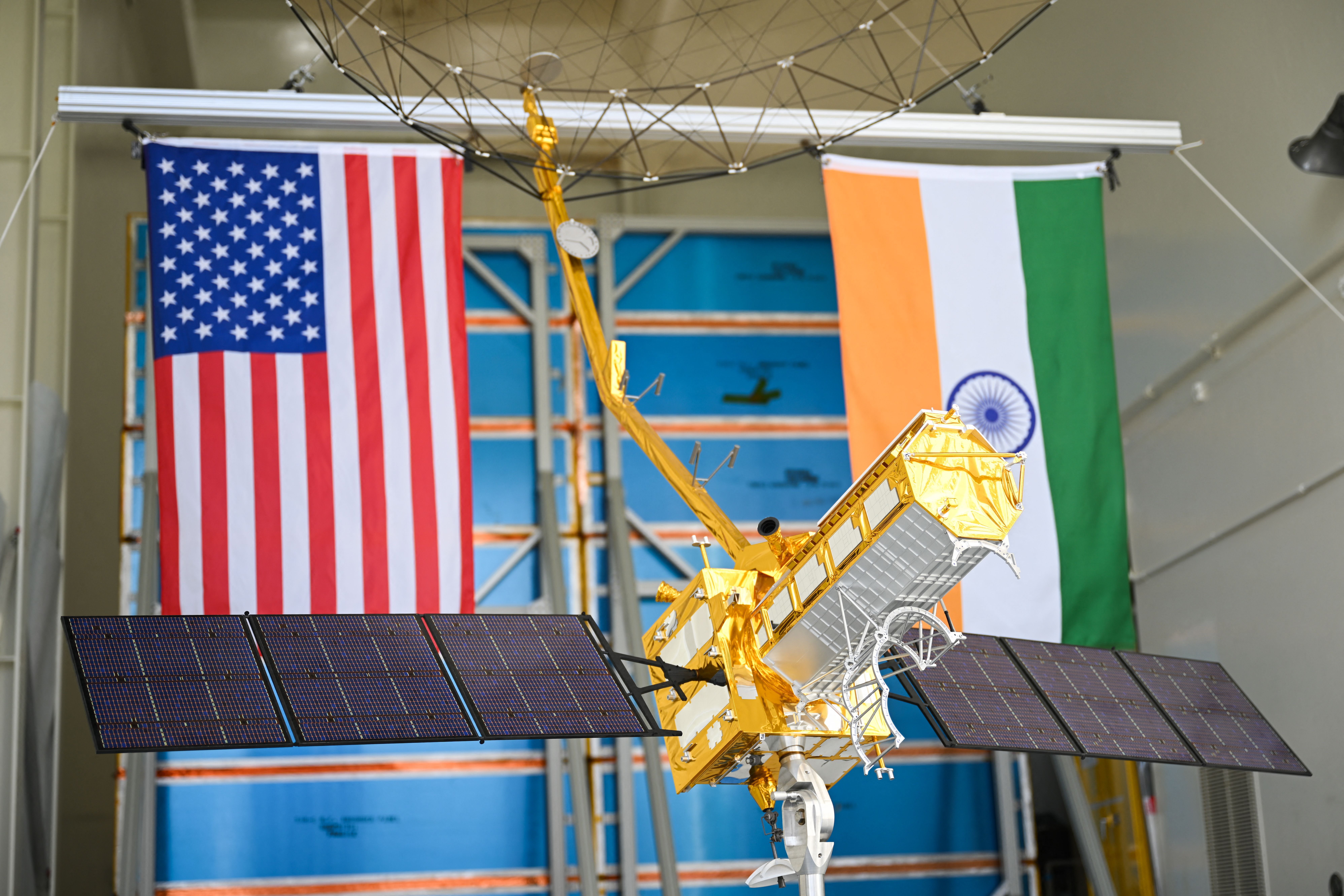
On July 30, 2025, the United States announced 25 percent tariffs on Indian goods. While diplomatic tensions simmered on the trade front, a cosmic calm prevailed at the Sriharikota launch range. Officials from NASA and ISRO were preparing to launch an engineering marvel into space—the NASA-ISRO Synthetic Aperture Radar (NISAR), marking a significant milestone in the India-U.S. bilateral partnership.

Tejas Bharadwaj
The India-U.S. relationship currently appears buffeted between three “Ts”—TRUST, Tariffs, and Trump.
Arun K. Singh