

Research
- +4
Milan Vaishnav, Rahul Verma, Rukmini S., …
{
  "authors": [
    "Christophe Jaffrelot"
  ],
  "type": "legacyinthemedia",
  "centerAffiliationAll": "dc",
  "centers": [
    "Carnegie Endowment for International Peace"
  ],
  "collections": [],
  "englishNewsletterAll": "ctw",
  "nonEnglishNewsletterAll": "",
  "primaryCenter": "Carnegie Endowment for International Peace",
  "programAffiliation": "SAP",
  "programs": [
    "South Asia"
  ],
  "projects": [],
  "regions": [
    "South Asia",
    "India"
  ],
  "topics": [
    "Security",
    "Military"
  ]
}
Source: Getty
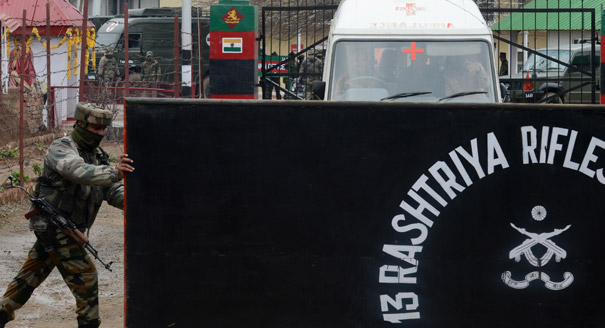
For the Indian army to remain national, it has to be multicultural—and this problem may need to be addressed as urgently as those pertaining to arms procurement.
Source: Indian Express
Earlier this month, the former chief of the Indian army, General V. K. Singh, joined the BJP, less than two years after retiring. It was an unprecedented move. None of his predecessors had ever joined politics in such a manner. But this first occurred in a specific context and as the culminating point of a series of events.
Over the last few years, ex-servicemen have taken public stands more often than before — usually against the UPA government, overtly or covertly. The first controversy crystallised around the Armed Forces (Special Powers) Act (AFSPA), which had been denounced by human rights organisations as the root cause of abuses by the military in Jammu and Kashmir and the Northeast (especially Manipur), because of the impunity it granted to the army and paramilitary. The UPA government appointed the Jeevan Reddy committee in 2005, to review the working of the AFSPA. Prime Minister Manmohan Singh had then claimed that he would show zero tolerance for human rights abuses. But P. Chidambaram, as Union home minister, said the “army had taken a strong stand against any dilution” of the law. The AFSPA has not been repealed or amended, suggesting that the military has prevailed.Last September came the The Indian Express’s revelations of an army probe report on the functioning of the Technical Services Division (TSD), a military intelligence unit set up in 2010 by the then army chief, V.K. Singh. It had allegedly attempted to topple the J&K government and spied on politicians and ministry of defence officials.
The same General Singh had been in the news for a tussle over his date of birth. He had even appealed to the Supreme Court to delay his mandatory retirement for one year, on the grounds that the date in the army records was wrong. He lost the case and retired in May 2012. But in January 2012, the manœuvres that two army units had carried out near Delhi had touched off unprecedented alarm in the MoD.
Last but not least, the letter that V.K. Singh had sent to the prime minister, denouncing government delays in the procurement process, made its way into the public domain. As a result of the alleged hindrances to the modernisation of the army, V.K. Singh declared in his letter, the Indian army was now “unfit for war”. He reiterated these criticisms in Courage and Conviction: An Autobiography, the book he published after retiring, along with charges of corruption against the UPA.
Through these controversies, the BJP has taken the army’s side. The party expressed strong reservations about any dilution of the AFSPA in J&K or Manipur. In September 2013, party president Rajnath Singh, speaking on the sidelines of a function in Bihar, said: “The Congress-led UPA government is troubling eminent personalities who want to join the BJP”. V.K. Singh had not joined the party then, but he had just shared the stage with Narendra Modi at an ex-serviceman rally in Rewari, while officially supporting another ex-serviceman, Anna Hazare. But Colonel Rajywardhan Singh Rathore, the shooter who had won a silver medal at the Athens Olympics, had already resigned from the army to join the BJP.
The Hindu nationalist movement has had a long association with the army. It goes back to V.D. Savarkar, author of Hindutva: Who is a Hindu? who supported initiatives such as the Nasik-based Bhonsala Military School of B.S. Moonje and requested Hindus to join the British army during World War II, to learn how to use modern weapons and “militarise Hindudom”. Among those who followed his advice was N.D. Apte, accused in the Mahatma Gandhi murder conspiracy along with Nathuram Godse.
Yet the Savarkarite tradition was subdued for decades, until the revelations of the FIR drafted by Hemant Karkare in the 2008 Malegaon case. This FIR resulted in the chargesheeting of an army man, Lieutenant Colonel Purohit and of an ex-army man, Ramesh Upadhyay, who had once headed the ex-servicemen cell of the BJP in Mumbai. The cell had first gained momentum in the 1990s, when the BJP was on the rise. The party attracted a large number of former senior officers, including two heroes of the 1971 war, Lieutenant General K.P. Candeth and Lieutenant General J.F.R. Jacob, as well as Major General B.C. Khanduri, who became an MP in 1991, a minister in the Atal Bihari Vajpayee government and chief minister of Uttarakhand in 2007. They were in the company of ex-armymen such as Jaswant Singh and Jagatveer Singh Drona, who became the RSS sanghchalak of Kanpur and an MP in 1990.
The BJP is rising to power once again and its ex-servicemen cell is gaining momentum, as is evident from its many activities, including “Kargil Diwas”. What is new is the Sangh Parivar receiving support from former officers who are associated with official institutions. The Centre for Land Warfare Studies (CLAWS), based in the Delhi cantonment is a case in point. In January, its director, Major General Dhruv C. Katoch, wrote an article entitled “Combating Left Wing Extremism” in the RSS weekly, The Organiser, criticising the UPA government’s approach to the Maoist threat. Another member of the CLAWS, Alok Bansal, published an article in The Organiser on “the perils of wahabisation” in J&K.
The Hindu nationalist movement’s appeal for security experts and army men stems from the sense of vulnerability generated by Pakistan-backed Islamist terrorist attacks and Chinese expansionism. But it has also to do with frustration over the neglect of the army by successive governments. Arms procurements have been delayed, submarine mishaps (including the one which led the navy chief to resign last month) have become more numerous and the recruitment crisis has not been addressed, as is evident from the growing deficit of officers. Military analyst Bharat Karnad, in an article entitled “Politicising an apolitical military” (September 24, 2013) felt: “The fact is, India could do with many more Khanduris and Bhagwats [a reference to the involvement of Admiral Vishnu Bhagwat in Bihar politics] at the Central level, and more ESM [ex-servicemen] at the state, town and village government levels, who, by dint of character and inflexible values, begin cleansing the system and righting the ship of state that is beginning to take a lot of water”.
But the proponents of change (“cleansing”, as an otherwise moderate Karnad puts it) among ex-servicemen do not turn to the BJP just because of their disillusionment with the UPA and the BJP’s commitment to security. There are ideological affinities, evident from the words of General V.K. Singh while joining the BJP. He described the party as the most “nationalist” one.
The ideological affinities between ex-servicemen and the BJP have been reinforced by the vanishing of minorities from the army ranks. Who among the jawans and the officers interacts professionally with Muslims — who represent a minuscule proportion of the officers? They are known mostly as the Other, in the garb of an enemy or a threat. In December 2003, a survey by the Centre for the Study of Developing Societies showed that 19 per cent of the soldiers interviewed believed that the army practised “religious discrimination”. Among the Muslim respondents, 24 per cent shared this feeling. For the Indian army to remain national, it has to be multicultural — and this problem may need to be addressed as urgently as those pertaining to arms procurement.
This article was originally published by the Indian Express.
Former Nonresident Scholar, South Asia Program
Jaffrelot’s core research focuses on theories of nationalism and democracy, mobilization of the lower castes and Dalits (ex-untouchables) in India, the Hindu nationalist movement, and ethnic conflicts in Pakistan.
Recent Work

Milan Vaishnav, Rahul Verma, Rukmini S., …
Christophe Jaffrelot
Carnegie India does not take institutional positions on public policy issues; the views represented herein are those of the author(s) and do not necessarily reflect the views of Carnegie, its staff, or its trustees.

In any defense establishment, change is an ongoing process. However, despite the best of intentions, existing bureaucracies, bound by habit and years of socialization, have their limits in implementing transformative change.

Anit Mukherjee
As AI grows more sophisticated, as the supply chains that power it become more contested, and as access to frontier models becomes geopolitically charged, India must begin to ask a different set of questions. Not what applications it can build on someone else’s infrastructure but what the world needs.

Konark Bhandari

The Indian Ocean Region hosts one of the densest concentrations of subsea cables in the world. Yet, despite accounting for a significant share of global internet traffic, India’s participation remains limited.

Charukeshi Bhatt

How is AI reshaping space security, creating governance challenges, and where does international diplomacy stand today?


Tejas Bharadwaj, Almudena Azcárate Ortega

After the chill in ties between 2020 and 2024 that brought India–China relations to their lowest point in several decades, the two countries have engaged each other afresh. This paper argues that there are predominantly four imperatives guiding India’s approach to China, and they exist in an order of priority.

Saheb Singh Chadha