

In The Media
Lilia Shevtsova
{
  "authors": [
    "Lilia Shevtsova"
  ],
  "type": "commentary",
  "centerAffiliationAll": "",
  "centers": [
    "Carnegie Endowment for International Peace",
    "Carnegie Russia Eurasia Center"
  ],
  "collections": [],
  "englishNewsletterAll": "",
  "nonEnglishNewsletterAll": "",
  "primaryCenter": "Carnegie Russia Eurasia Center",
  "programAffiliation": "",
  "programs": [],
  "projects": [],
  "regions": [
    "Russia",
    "Eastern Europe",
    "Ukraine"
  ],
  "topics": [
    "Security",
    "Foreign Policy"
  ]
}
Source: Getty
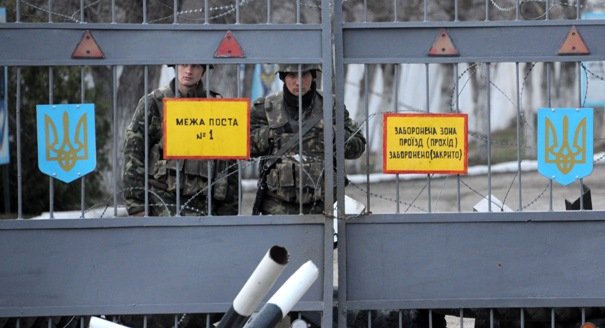
The Kremlin’s intervention in Crimea and direct involvement in the destabilization of the southeast of Ukraine exemplifies Putin’s Doctrine. This concept is based on the premise that Russia can only exist as the center of the galaxy surrounded by the satellite-statelets.
I’ve just returned from my trip to Ukraine. Let me share with you my thoughts on the latest Ukrainian developments.
The most popular answer to the question would be: “Putin wants Ukraine back.” But why hadn’t he tried to do that before? And why did he get interested in Ukraine rather than, say, Moldova?
I would argue that the Kremlin’s intervention in Crimea and direct involvement in the destabilization of the southeast of Ukraine exemplifies President Vladimir Putin’s Doctrine. This concept is based on the premise that Russia can only exist as the center of the galaxy surrounded by the satellite-statelets. Many viewed this Doctrine as a rhetorical exercise. Putin proved that this is real stuff.
However, new Kremlin imperialism does not justify the brashness of the invasion—making the Ukrainian story even more complicated and dramatic. Firstly, Russian aggression is in direct response to the Maidan victory, which Moscow sees both as a blow to the personalized power system, and as a dangerous example for the Russian population. Moreover, Maidan happened in a state which the Kremlin considers an extension of Russia. Apparently, by invading Ukraine, the Kremlin decided to showcase its response to “extremists,” who are undermining the authorities and deposing “legitimate” leaders. Such extremists will be punished and the Maidan evil will be eliminated.
I also think that the blatant and aggressive punishment that Putin subjected Ukraine to has certain psychological underpinnings. The Kremlin’s actions could be interpreted as an open desire to humiliate the Ukrainian state and the nation—to both punish and scare them.Actually, the Kremlin’s tactics against Ukraine are the same as those it used against the Bolotnaya protesters. The underlying theme is the same: the government will use both psychological and real terror tactics to ensure it’s dominance and guarantee obedience.
Ukraine has long been Putin’s personal project, although he was defeated during the 2004 Orange Revolution. The Kremlin is now taking revenge on both past and present acts and teaching the rebellious Ukrainians and warning the Russians about the price of insubordination. Here is another angle too. The Russian invasion is a warning to the West: “Don’t Meddle—this is our playground!”
The Kremlin’s project to force Ukraine to cohabitate with Russia has a technical side, which many analysts tend to focus on. They talk about the secession of Crimea and the destabilization of the southeast. However, for Moscow, these tasks are merely the means to an end and it does not concentrate on one scenario. I bet the optimal solution for the Kremlin would be to turn Crimea into Ukrainian Transnistria which will help to keep Ukraine in the status of the failed state. However, the Russian Duma plans to endorse a new law that will allow it to incorporate new subjects into the Russian Federation. This means that Moscow is moving in a direction of total annexation of Crimea. Anyway, Crimea has been lost for Kyiv for a number of years and the Ukrainian authorities are guilty of not paying attention to the peninsular.
The problem is that the Ukrainian Transnistria may become the Ukrainian Chechnya, since it is home to a powerful and consolidated Tatar community that has no desire to live under Russian control and has already pledged to support the independent Ukrainian state.
The destiny of the southeast (Donetsk, Lugansk, Kharkiv, Odessa) is crucial for the Ukrainian statehood. Here the real battle for Ukraine has started. The Kremlin has openly demonstrated its plan to control the area which could take various forms—from attempts to use the pro-Russian lobby to efforts to build a satellite state.
The Ukrainians recovered from their initial shock and confusion (I believe the turning point was March 3 or 4). The Kremlin did what no Ukrainian political force previously could. The Russian invasion set off the consolidation of Ukraine’s disparate political forces—liberals, nationalists, the left, oligarchs, communists, and even the Party of Regions. A significant number of the Party of Regions representatives have refused to become Moscow’s fifth column. This is exactly why Moscow was forced to bus Russian citizens into the southeast and Crimea to play the local pro-Russian forces. This is the reason why an ex-con has become the Crimean governor with the help of Moscow’s gunmen. The previously dormant segments of its population in the southeast are becoming more active, revealing that they also do not want to live under Russia’s thumb. Odessa and Kharkov residents that took to the streets supporting the Ukrainian state, as well as the flurry of political activism in other southeastern cities, illustrate this trend.
So, in a very short time span, Moscow managed to unite yesterday’s implacable enemies behind the national liberation idea. In addition, the interim government definitely made the right move by involving Ukrainian oligarchs in governing certain southeastern regions. This was done to stabilize the situation in the regions and maintain the territorial integrity of the country. Thus, Ihor Kolomoyskyi will be a governor in Dnipropertrovsk. Rinat Akhmetov pledged that the 300,000 his employees would defend stability in the region. Dmytro Firtash wrote to the Russian oligarchs calling for the dialogue.
Victor Pinchuk went to the West to seek the Western help for Ukraine. Orienting oligarchs toward protecting national interests and independence, as well as having them commit their resources to their country’s revival, can lay a foundation for the future transformation of Ukraine’s oligarchic system—provided that the oligarchs will actually realize that independent Ukraine and their role in it are at stake.
To be continued…
Former Senior Associate, Russian Domestic Politics and Political Institutions Program, Moscow Center
Shevtsova chaired the Russian Domestic Politics and Political Institutions Program at the Carnegie Moscow Center, dividing her time between Carnegie’s offices in Washington, DC, and Moscow. She had been with Carnegie since 1995.
Recent Work
Lilia Shevtsova
Lilia Shevtsova
Carnegie India does not take institutional positions on public policy issues; the views represented herein are those of the author(s) and do not necessarily reflect the views of Carnegie, its staff, or its trustees.

After the chill in ties between 2020 and 2024 that brought India–China relations to their lowest point in several decades, the two countries have engaged each other afresh. This paper argues that there are predominantly four imperatives guiding India’s approach to China, and they exist in an order of priority.

Saheb Singh Chadha

This piece argues that India’s central challenge is not managing a single flashpoint but resolving the underlying tension between expansion and institutional coherency of the BRICS grouping.

Vrinda Sahai

A partnership between India, a country of subcontinental size, and Africa, a continent of fifty-four countries, may seem asymmetric until one notes that both are home to nearly the same number of people—1.4 billion. This essay spells out the existing challenges to the partnership, its optimal potential, and the possible pathways to realize it over the next quarter-century.

Rajiv Bhatia

The India–EU Free Trade Agreement (FTA) is shaping up to be one of the most consequential trade negotiations, both economically and strategically. But, what’s in the agreement, what’s missing, and what will determine its success in the years ahead
Vrinda Sahai, Nicolas Köhler-Suzuki

This piece argues that the present Indian strategy, based on opportunistic diversification and utilization of limited strategic reserves, remains inadequate when confronting supply disruptions. It evaluates India’s options in the short, medium, and long terms.
Vrinda Sahai