

Commentary
Sarah Chayes
{
  "authors": [
    "Sarah Chayes"
  ],
  "type": "legacyinthemedia",
  "centerAffiliationAll": "dc",
  "centers": [
    "Carnegie Endowment for International Peace"
  ],
  "collections": [
    "Anti-Corruption"
  ],
  "englishNewsletterAll": "democracy",
  "nonEnglishNewsletterAll": "",
  "primaryCenter": "Carnegie Endowment for International Peace",
  "programAffiliation": "DCG",
  "programs": [
    "Democracy, Conflict, and Governance"
  ],
  "projects": [],
  "regions": [
    "Southern, Eastern, and Western Africa"
  ],
  "topics": [
    "Political Reform",
    "Democracy",
    "Security"
  ]
}
Source: Getty
Nearly every country facing an extremist insurgency is run by a kleptocratic clique. Corruption, in other words, has security implications.
Source: Los Angeles Times
On Feb. 20, Nigerian President Goodluck Jonathan fired his respected central bank governor, who was trying to discover what had happened to an estimated $20 billion that disappeared from the nation's oil revenue over an 18-month period.
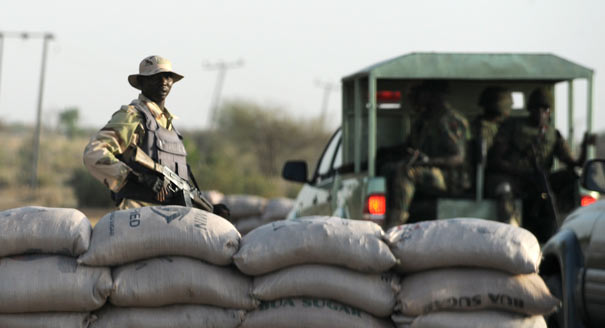
Four days later, across the country in the parched northeast, members of the Boko Haram extremist group attacked a public boarding school, shooting children in their sleep and setting school buildings afire. It was the latest in a string of massacres by the group, whose statements call for an Islamic state ruled by sharia law in Nigeria.
Is there any connection between the president's actions and the Boko Haram insurgency?Motivations for complex phenomena like insurgencies never stem from a single driver. Still, a remarkable correlation exists between severe and systemic corruption and ideological extremism. Of the bottom 11 countries on Transparency International's Corruption Perceptions Index — a well-known annual ranking of perceived corruption in nations around the world — eight harbor a violent extremist movement. Not one of the 11 countries identified as least corrupt does.
In fact, nearly every country facing an extremist insurgency, from Nigeria to Afghanistan to the Philippines, is run by a kleptocratic clique. And almost every popular revolt aimed at toppling a government in recent years, from the Arab uprisings to Ukraine's revolution, began as a protest against acute corruption.
Corruption, in other words, has security implications.
Nigeria, Africa's largest oil producer, exemplifies some of them. For months before his ouster, the central bank governor, Lamido Sanusi, had been denouncing the gap between the sales price of exported oil and the amount of money that actually reaches government coffers. Most of the missing billions are believed to have been diverted to the pockets of the president and his cronies — with the help of the oil minister, who keeps the accounts.
As one Western official in the capital, Abuja, put it in November: "The oil minister is Jonathan's ATM."
Nigeria is a textbook example of the "resource curse." It is blessed with vast mineral and oil wealth, but government officials have diverted much of those riches to their own pockets. As a result, Nigeria's development outcomes are hardly higher than those of its destitute West African neighbors.
Given the widespread graft at the top, it is no surprise that corruption permeates every level of government. Police officers shake down street vendors and bus passengers; they imprison people just to release them for payment of an illegal "bail."
"Most of our men joined the police to make money," concedes Muhammad Guri, commander of a police bomb squad in the northern city of Kano, the target of numerous Boko Haram attacks on police stations.
The worst offenders, say many Nigerians, are civil servants. Oil money that does make it to government coffers is often funneled to lower-ranking officials through contract fraud.
Layers of padding in the contracts ensure kickbacks for the civil servants involved in awarding them, as well as hefty profits for the contractors themselves. In this way, even government spending that was supposed to contribute to economic development or health or education is hijacked for personal gain.
Many Nigerians suggest the emergence of Boko Haram was in part a reaction to this systematized corruption. The group's moniker translates to "Western-style education is sinful." Many Westerners assume the name to be a rejection of tolerance, critical thinking and the scientific method; the significance may be quite different.
In Nigeria, the entire system of schooling is part of the corrupt structure. Students pay others to take their exams. Parents pay for a place in university. Even in nursery school, says Esther, the mother of a 3-year-old boy, "if you give something extra to the teacher at the end of the week, she pays attention to your child. If not, your child gets cranky." University spots are extremely tough for ordinary Nigerians to secure, and plum jobs in the civil service are open only to college graduates.
Kemi Okenyodo, director of the anti-corruption advocacy group CLEEN, puts it this way: "At least initially, Boko Haram had the principle of kicking back against the corruption in the state. It wasn't against Western education per se. Western education was seen as a tool for corruption and oppression." Many Nigerians share this analysis.
None of this excuses Boko Haram, which perpetrates savage attacks on ordinary people who are victims of government corruption themselves. But militant, puritanical religious views of the type espoused by the group are a common reaction to acute corruption well beyond Nigeria. The reflex is visible among disenfranchised youths across North Africa, and in Somalia, Afghanistan, Central Asia and elsewhere. And government corruption is a common theme in foundational Al Qaeda documents.
Closer examination of the correlation between corruption and extremism, and of how severe corruption interacts with other risk factors to fuel international security challenges, could inform better policy approaches.
Secretary of State John F. Kerry recently condemned the "unspeakable violence" of Boko Haram militants before announcing increased counter-terrorism assistance for Nigeria's government. As so often when confronted with extremism, U.S. decision-makers have allied themselves with the corrupt government and abusive security services.
Missing from Kerry's statements was any criticism of the suspension of the central bank governor or of the vast official theft of oil money, a crime that affects all Nigerians and may be providing fodder for the very extremists U.S. leaders would like to help eradicate.
This article was originally published in the Los Angeles Times.
Former Senior Fellow, Democracy, Conflict, and Governance Program
Sarah Chayes is internationally recognized for her innovative thinking on corruption and its implications. Her work explores how severe corruption can help prompt such crises as terrorism, revolutions and their violent aftermaths, and environmental degradation.
Recent Work
Sarah Chayes
Carnegie India does not take institutional positions on public policy issues; the views represented herein are those of the author(s) and do not necessarily reflect the views of Carnegie, its staff, or its trustees.

In any defense establishment, change is an ongoing process. However, despite the best of intentions, existing bureaucracies, bound by habit and years of socialization, have their limits in implementing transformative change.

Anit Mukherjee

After the chill in ties between 2020 and 2024 that brought India–China relations to their lowest point in several decades, the two countries have engaged each other afresh. This paper argues that there are predominantly four imperatives guiding India’s approach to China, and they exist in an order of priority.

Saheb Singh Chadha

A partnership between India, a country of subcontinental size, and Africa, a continent of fifty-four countries, may seem asymmetric until one notes that both are home to nearly the same number of people—1.4 billion. This essay spells out the existing challenges to the partnership, its optimal potential, and the possible pathways to realize it over the next quarter-century.

Rajiv Bhatia

This piece argues that the present Indian strategy, based on opportunistic diversification and utilization of limited strategic reserves, remains inadequate when confronting supply disruptions. It evaluates India’s options in the short, medium, and long terms.

Vrinda Sahai

This piece examines India’s response to U.S. sanctions and tariffs, specifically assessing the immediate market consequences, such as alterations in import costs, and the broader strategic implications for India’s energy security and foreign policy orientation.
Vrinda Sahai