

Commentary
How is AI reshaping space security, creating governance challenges, and where does international diplomacy stand today?
Tejas Bharadwaj, Almudena Azcárate Ortega
{
  "authors": [
    "Akio Kawato"
  ],
  "type": "commentary",
  "centerAffiliationAll": "",
  "centers": [
    "Carnegie Endowment for International Peace",
    "Carnegie Russia Eurasia Center"
  ],
  "collections": [],
  "englishNewsletterAll": "",
  "nonEnglishNewsletterAll": "",
  "primaryCenter": "Carnegie Russia Eurasia Center",
  "programAffiliation": "",
  "programs": [],
  "projects": [],
  "regions": [
    "North America",
    "United States",
    "East Asia",
    "Japan",
    "Russia",
    "Eastern Europe",
    "Ukraine"
  ],
  "topics": [
    "Foreign Policy"
  ]
}
Source: Getty
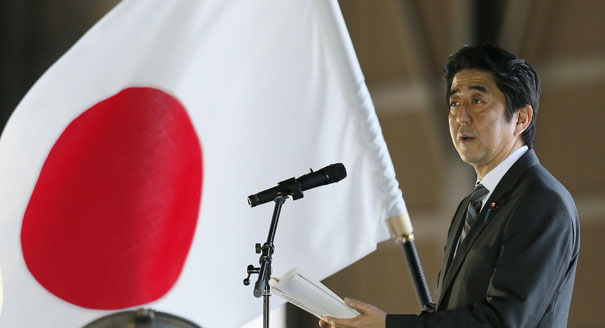
Japan makes judgment about Ukraine in the context of her balancing game among the United States, Russia, and China. However, if Moscow sends troops to Eastern Ukraine, the Japanese political class will unanimously support serious measures to stop Russia.
When Japan and China brawl over tiny Senkaku Islands, people in the regions far from East Asia dismiss it as a needless conflict over small rocks. But in the eyes of the Japanese the current tug of war over Ukraine looks like a self-imposed confrontation between Russia and the United States. Although neither the United States nor Russia is ready to take the full burden of Ukraine, they engage in a tit-for-tat tussle, drawing in their allies and friends.
At first, the situation in Ukraine was a distant issue for the Japanese. However, Russia’s annexation of Crimea became the top news, though the recent tax hike and issues involving the United States, South Korea, North Korea, and China draw more earnest attention. Now the prevailing narrative in Japan about the annexation of Crimea is that it was realized under the coercive effect of the Russian military force. Though newspapers do report about the gruesome anti-Russian activities of the Ukrainian rightists, this is something too complex for foreigners to swallow. Nevertheless, some hesitation about joining “sanctions” against Russia remains, partly because the Japanese are not yet totally convinced that this is the right step to take, and partly because it is “mottai-nai” (it is a pity) to throw away recent achievements in Russo-Japanese relations.
Japan makes judgment about Ukraine in the context of her balancing game among the United States, Russia, and China. The alliance with the United States remains, of course, the mainstay of Tokyo’s foreign policy. Japan does not like that “needless” conflicts are created in remote areas and that the U.S. government’s attention and U.S. forces are distracted elsewhere. Therefore, Japan would be willing to contribute to a quick stabilization of Ukraine.
However, if things take a fatal downward spiral in Ukraine, Japan will play it out. If Russia sends troops to Eastern Ukraine, for example, the Japanese political class will unanimously support serious measures to stop Russia. The situation in Ukraine has started to resemble very much the start of the Cold War, when Czechoslovakia in 1947-1948 was forced by the Soviet Union to reject the Marshall Plan and was drawn into Moscow’s orbit.
Akio Kawato
Writer
Akio Kawato is a former Japanese diplomat and blogger.
Carnegie India does not take institutional positions on public policy issues; the views represented herein are those of the author(s) and do not necessarily reflect the views of Carnegie, its staff, or its trustees.

How is AI reshaping space security, creating governance challenges, and where does international diplomacy stand today?


Tejas Bharadwaj, Almudena Azcárate Ortega

After the chill in ties between 2020 and 2024 that brought India–China relations to their lowest point in several decades, the two countries have engaged each other afresh. This paper argues that there are predominantly four imperatives guiding India’s approach to China, and they exist in an order of priority.

Saheb Singh Chadha

This piece argues that India’s central challenge is not managing a single flashpoint but resolving the underlying tension between expansion and institutional coherency of the BRICS grouping.

Vrinda Sahai

A partnership between India, a country of subcontinental size, and Africa, a continent of fifty-four countries, may seem asymmetric until one notes that both are home to nearly the same number of people—1.4 billion. This essay spells out the existing challenges to the partnership, its optimal potential, and the possible pathways to realize it over the next quarter-century.

Rajiv Bhatia

The U.S.–India semiconductor cooperation story is well-stocked with top-level strategic intent. What remains unresolved, however, are some underlying challenges that will determine whether the cooperation actually functions. Three such friction points stand out.

Shruti Mittal