

Commentary
How is AI reshaping space security, creating governance challenges, and where does international diplomacy stand today?
Tejas Bharadwaj, Almudena Azcárate Ortega
{
  "authors": [
    "John Judis",
    "Linda Kinstler"
  ],
  "type": "legacyinthemedia",
  "centerAffiliationAll": "",
  "centers": [
    "Carnegie Endowment for International Peace"
  ],
  "collections": [],
  "englishNewsletterAll": "",
  "nonEnglishNewsletterAll": "",
  "primaryCenter": "Carnegie Endowment for International Peace",
  "programAffiliation": "",
  "programs": [],
  "projects": [],
  "regions": [
    "United States"
  ],
  "topics": [
    "Political Reform"
  ]
}
Source: Getty
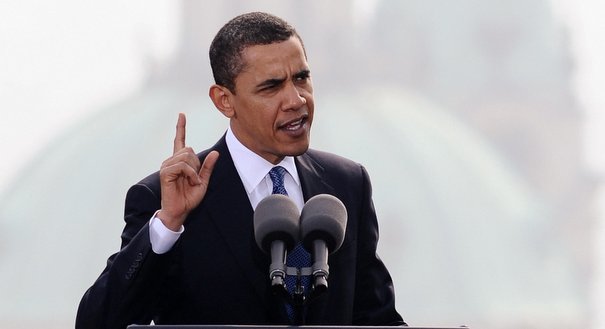
Barack Obama promised in the 2008 and 2012 campaigns that he would enforce net neutrality, but he has not kept that promise.
Source: New Republic
Imagine for a moment that normal telephone lines were afflicted with static, and that when your office called you, you had difficulty making out what the person on the other end was saying, and imagine that the telephone companies started offering a static-free service for a large sum that only the big telemarketers could afford, so that when Visa called you to offer you a new deal on your credit card, you could hear them clearly. That would be pretty awful, wouldn't it? Under Federal Communications Commission law, a common carrier like the telephone company can’t do that. Yet that is exactly the kind of the thing that could start happening on the Internet over the next decade if the FCC adopts the standards that its chairman Thomas Wheeler is circulating among the agency’s commissioners.
According to several news reports—and to a telecom lobbyist who has discussed the proposals with FCC staff—Wheeler is proposing that internet providers, led by Comcast, which hopes to swallow up Time Warner, be allowed to offer faster and better transmission to content providers such as Comcast’s NBC, who are willing and able to pay a premium. That would allow larger firms to overpower smaller ones and to stifle innovative startups. In current lingo, the FCC would violate the principle of net neutrality.Wheeler, a former telecommunications industry lobbyist, has claimed that the reports of the proposed new rules contain a “great deal of misinformation.” Wheeler and the FCC say they are proposing to reinstate the older 2010 net neutrality ruling by the FCC that the D.C. Appeals Court struck down this January. This new proposal would merely use language that was acceptable to the court. "The Notice proposes the reinstatement of the Open Internet concepts by the Commission in 2010,” the FCC announced on its blog today.
The 2010 ruling was plagued by loopholes—it didn’t apply, for instance, to wireless transmission—but it did ban “unreasonable discrimination in transmitting lawful network traffic.” But in Verizon v. FCC, the court specifically struck down the FCC’s right to ban discrimination. The court relied on the FCC’s own ruling in 2002, under Republican chair Michael Powell, that broadband was an “information service” and not a “common carrier” like the telephone that was barred from discriminating. (Powell is now chairman of the National Cable and Telecommunications Association.)
In responding to the court decision, Wheeler had three choices: he could appeal; he could propose to the commissioners that they redefine broadband as a common carrier; or he could introduce some hallucinatory formulation that seemed to suggest he was retaining the power to stop discrimination, but that the court, which would know better, would allow to stand. The only choice that would have respected the public interest would have been to repeal Powell’s ruling. Wheeler’s predecessor Julius Genachowski proposed doing that five years ago, but facing an outcry from industry, backed down. Wheeler, too, has decided to avoid a fight with industry. He has chosen the third alternative—hallucinatory wording.
Wheeler is proposing that the FCC prohibit “commercially unreasonable” policies by the big companies. But as an FCC spokesman made clear, commercially unreasonable activity would not include offering premiums to companies for better service. An FCC official compared the new policy to offering superior service to a medical facility wanting to link the internet to a patient’s heart monitor. But the most likely customer for the new premium service is Comcast’s MSNBC or Hulu, not the Mayo Clinic. As Craig Aaron of the Free Press has pointed out, if the FCC actually did construe “commercially reasonable” to ban price discrimination, the new rules would be thrown out in court just as were the old. But it clearly doesn’t construe them in this manner.
Anna Eshoo, the ranking Democrat on the Communications and Technology Subcommittee and congressional representative for parts of Silicon Valley, isn’t fooled by the new wording. “Like many Internet users, I fear that the latest round of proposed net neutrality rules from the FCC will not do enough to curtail discrimination of Internet traffic, but rather leave the door open to discrimination under more ambiguous terms,” she says. “Fundamentally, consumers and businesses must be protected from actions by online gatekeepers that threaten free speech, harm competition or diminish the continued openness of the Internet.” Eshoo needs to tell that not just to Wheeler but to the man in the White House who appointed him. Barack Obama promised in the 2008 and 2012 campaigns that he would enforce net neutrality, but he has not kept that promise.

Former Visiting Scholar
As a visiting scholar at Carnegie, Judis wrote The Folly of Empire: What George W. Bush Could Learn from Theodore Roosevelt and Woodrow Wilson.
Linda Kinstler
Carnegie India does not take institutional positions on public policy issues; the views represented herein are those of the author(s) and do not necessarily reflect the views of Carnegie, its staff, or its trustees.

How is AI reshaping space security, creating governance challenges, and where does international diplomacy stand today?


Tejas Bharadwaj, Almudena Azcárate Ortega

The U.S.–India semiconductor cooperation story is well-stocked with top-level strategic intent. What remains unresolved, however, are some underlying challenges that will determine whether the cooperation actually functions. Three such friction points stand out.

Shruti Mittal

India and the United States are close to concluding a Reciprocal Defense Procurement Agreement (RDPA) that will allow firms from the two countries to sell to each other’s defense establishments more easily. While this may not remedy the specific grievances both sides may have regarding larger bilateral issues, an RDPA could restore some momentum, following the trade deal announcement.

Konark Bhandari

On the last day of the India AI Impact Summit, India signed Pax Silica, a U.S.-led declaration seemingly focused on semiconductors. While India’s accession to the same was not entirely unforeseen, becoming a signatory nation this quickly was not on the cards either.
Konark Bhandari

This piece examines India’s response to U.S. sanctions and tariffs, specifically assessing the immediate market consequences, such as alterations in import costs, and the broader strategic implications for India’s energy security and foreign policy orientation.

Vrinda Sahai