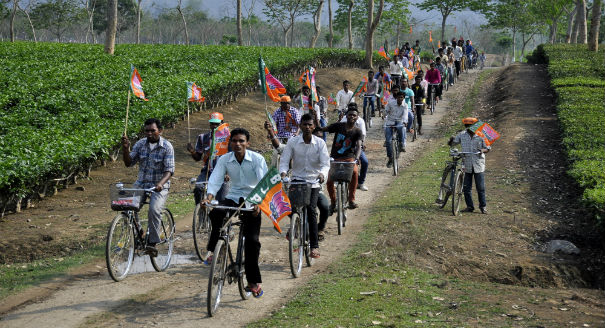
Even if the rural/urban divide did once provide an accurate description of the country, there is good reason to doubt it as India heads to the polls in 2014.
Come election time, a standard trope goes that India is engaged in a relentless tug-of-war between its rural and urban populations. On the one hand sit urban metropolises like Mumbai and Bangalore, whose cosmopolitan citizens rail against corrupt politicians, fetishise growth and care little for parochial concerns, like caste. On the other hand sits India’s vast rural hinterlands, where caste dictates social relations and corruption takes a backseat to basic sustenance. Yet if this divide did once provide an accurate description of the country, there is good reason to doubt it as India heads to the polls in 2014.
In a sense, this urban-rural divide has become shorthand for the old “Bharat versus India” dichotomy propagated by some Indian leaders, who divide the country into two: one traditional [Bharat], the other modernised and secular. And it remains true that, in strictly demographic terms, India is predominantly rural: the 2011 census places the urban share of the population at roughly 31 per cent.
Yet a recent nation-wide survey of Indian political attitudes sponsored by the Lok Foundation (to which we contributed) finds this binary construct to be outdated. Indeed, the survey finds that on several important dimensions rural India is increasingly shaped by urban sensibilities.
The Lok survey, conducted during the final quarter of last year, asked a random sample of 51,000 Indians which party they intended to vote for if the 2014 general elections were held then. The responses across rural and urban India were remarkably consistent: the Bharatiya Janata Party-led National Democratic Alliance (NDA) bested the Indian National Congress-led United Progressive Alliance (UPA) in urban areas (30 to 24 per cent) as well as rural (31 to 23 per cent). There were some class differences, with the better off more willing to support the NDA than UPA in both rural and urban areas. But overall there was no major rural-urban split in vote intention.
The survey also provided voters with a list of eight issues, asking which most influenced their vote. Again, the priorities of rural and urban hardly diverge. The top three issues in urban settings were growth (27 per cent), corruption (23 per cent), and inflation (17 per cent). In rural areas, the list of priorities looks very similar: growth (23 per cent) ranks first with inflation and corruption close behind (19 per cent each). True, rural voters place greater weight on access to government schemes and changes in personal income. These differences, however, are not substantial; in aggregate, economic factors and corruption trump all else.
The results were similar in other areas. 46 per cent of Indians have no issue with their Member of Parliament hailing from a political family; a level that is identical in rural and urban areas. When asked directly whether they would have any qualms voting for a candidate with serious criminal charges, 27 per cent of rural dwellers and 25 per cent of urban residents claimed they would not.
Indeed, if anything, what the data show is that it is differences across states — rather than between urban and rural segments — that are most striking. For instance, 25 per cent of Indians rated economic growth as the issue that would most colour their vote choice. But while that number didn’t differ hugely between town and country, the variation across states is considerable.
What might help explain why the stark rural and urban divides of the past appear to be blurring? Several stand out.
For starters, rural to urban migration, as well as the growing importance of non-agricultural income in rural India, has increased links between the “two Indias.” A family living in eastern Uttar Pradesh with a relative working in urban Maharashtra is bound to feel the influence of greater urban contact.
Second, the influences of electronic media, cell phones and television are chipping away at the urban-rural cleavage. Better rural connectivity through better infrastructure also likely plays a role; the improvement in the country’s rural road network may be one of the UPA government’s biggest successes.
But there may be a more direct effect at play as well, which is the extent to which rapid growth in the 2000s has transformed the expectations of rural and urban dwellers alike — a “revolution of rising expectations” that may have left Indians of all stripes wanting more. When it comes to the defining issues of this election, therefore, it appears as if there is one, not two, Indias.
Neelanjan Sircar is a visiting research fellow at the Centre for the Advanced Study of India at the University of Pennsylvania. Milan Vaishnav is an associate at the Carnegie Endowment for International Peace.
Milan Vaishnav is a senior fellow and director of the South Asia Program and the host of the Grand Tamasha podcast at the Carnegie Endowment for International Peace. His primary research focus is the political economy of India, and he examines issues such as corruption and governance, state capacity, federalism, and electoral behavior. He also conducts research on the Indian diaspora.
Neelanjan Sircar
Associate Professor, Ahmedabad University
Neelanjan Sircar is an associate professor at Ahmedabad University and one of the country’s leading scholars of Indian politics. He has spent years studying party organizations, welfare politics, and electoral change across states—including West Bengal and Assam.
Carnegie India does not take institutional positions on public policy issues; the views represented herein are those of the author(s) and do not necessarily reflect the views of Carnegie, its staff, or its trustees.
In any defense establishment, change is an ongoing process. However, despite the best of intentions, existing bureaucracies, bound by habit and years of socialization, have their limits in implementing transformative change.
As AI grows more sophisticated, as the supply chains that power it become more contested, and as access to frontier models becomes geopolitically charged, India must begin to ask a different set of questions. Not what applications it can build on someone else’s infrastructure but what the world needs.
The Indian Ocean Region hosts one of the densest concentrations of subsea cables in the world. Yet, despite accounting for a significant share of global internet traffic, India’s participation remains limited.
After the chill in ties between 2020 and 2024 that brought India–China relations to their lowest point in several decades, the two countries have engaged each other afresh. This paper argues that there are predominantly four imperatives guiding India’s approach to China, and they exist in an order of priority.